Beyond Security: TPRM as an Operational Resilience Requirement

Updated on: Aug 10, 2026 5 Minute Read
On July 19, 2024, a faulty software update pushed through by a security vendor brought down 8.5 million Windows devices across hospitals, airlines, and financial institutions within hours. Most affected organizations had current, valid assessments of CrowdStrike as a direct vendor. Their Third-Party Risk Management (TPRM) programs recorded it as reviewed and approved. What those programs lacked was an architecture to surface the depth of the operational dependency and what a failure at that layer would cost in practice.
DORA, NIS2, and the wave of operational resilience standards now being enforced have moved to close that gap. The compliance requirement has shifted from whether a vendor is secure to whether the organization can sustain operations when that vendor becomes unavailable. Most third-party risk programs were designed before that was the ask.
Vendor security scores do not equal operational resilience
DORA (the Digital Operational Resilience Act) extends the compliance requirement for European financial entities into a territory most TPRM programs were never designed to cover. While verifying that a vendor meets security standards remains a prerequisite, what the regulation adds is a set of operational requirements that security posture assessment alone cannot satisfy.
DORA’s ICT third-party risk framework pushes financial entities well past traditional vendor security assessment.
NIS2 extended similar requirements across critical infrastructure sectors, linking incident-reporting obligations to operational impact as the primary measure of severity.
Every one of these requirements points past vendor security and toward what happens to the business when that vendor fails.
The risk lives where your program has no line of sight
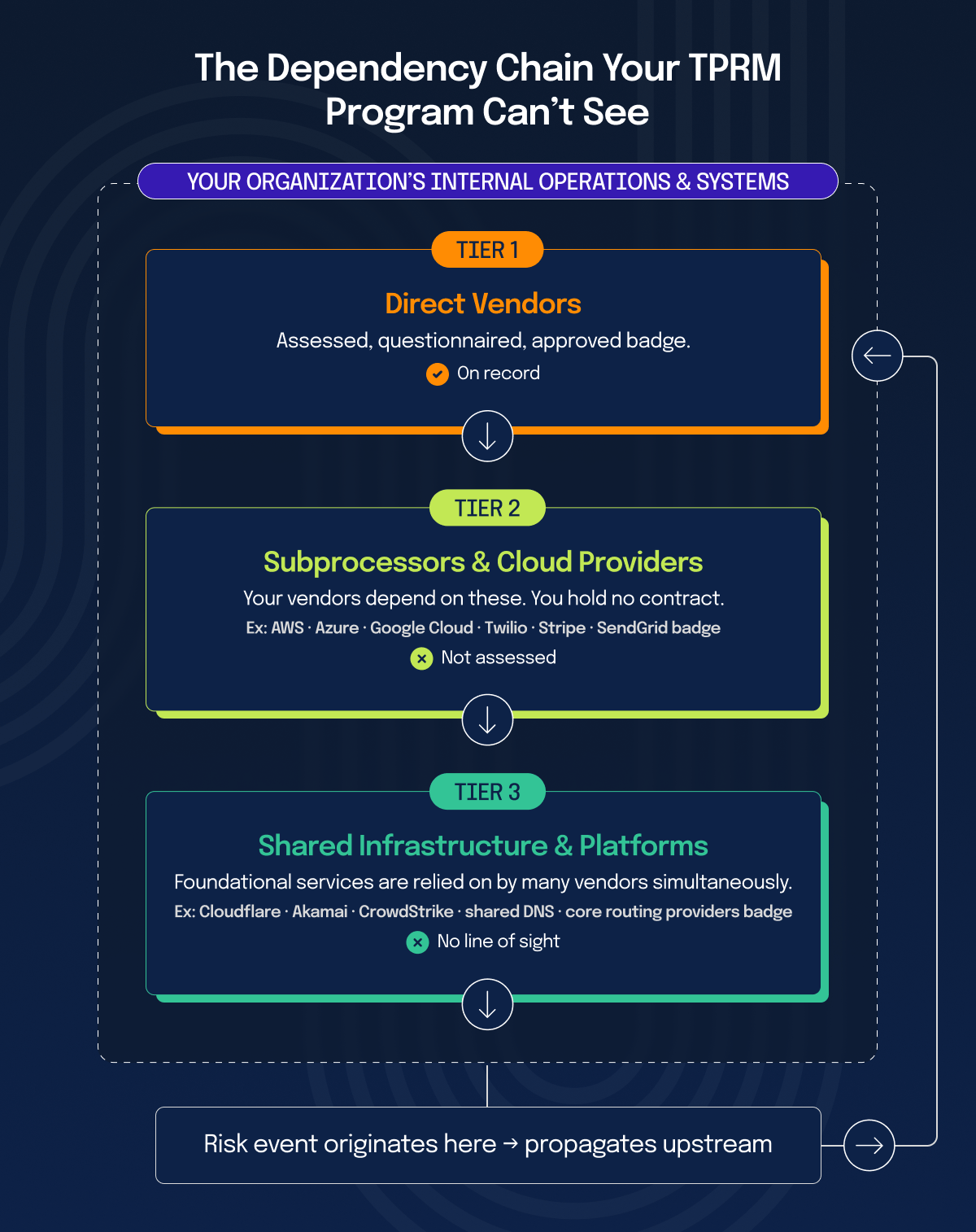
TPRM programs are built to evaluate direct vendor relationships. What sits beneath those relationships, the cloud subprocessors and infrastructure providers that lie one layer below the contracts the organization holds, falls outside their scope entirely. When a risk event originates there, the Tier 1 assessment record provides neither warning nor context.
The SolarWinds breach in 2020 illustrated this at scale. Attackers embedded malicious code in a legitimate software update distributed to approximately 18,000 organizations. Among those were managed service providers and IT vendors whose own clients had no SolarWinds relationship and no awareness that their environment was accessible through their provider’s compromised tooling. The dependency existed two layers deep, and the assessment architecture had no line of sight to it.
DORA’s dependency mapping requirements explicitly codify this operational gap. A vendor questionnaire captures a point-in-time security posture at the Tier 1 level. It produces no evidence of what the organization can sustain when a critical dependency in the chain beneath that vendor fails.
Point-in-time assessments cannot keep up with continuous risk
According to our 2026 IT Risk and Compliance Benchmark Report findings, among organizations whose GRC budgets tightened, direct involvement in managing third-party risks dropped from 84% to 52%. When bandwidth contracts, reassessment cadence slips first. Evidence ages, and the vendor risk posture on record diverges from the environment the business is actually operating in.
The same report found that 34% of organizations still identify and manage third-party risks using spreadsheets. Spreadsheets can hold a vendor record, but they cannot run continuous monitoring or surface changes in vendor risk posture between review cycles. The tools in use determine what is operationally possible.
Continuous resilience assurance is built on specific mechanics. Vendor tiering tied to what each relationship enables for the business. Reassessment triggers are tied to vendor events and contract changes. Dependency mapping that extends past Tier 1. A risk register is maintained in real time. These are what DORA and NIS2’s requirements point toward, and what a spreadsheet-based architecture cannot produce.
Resilience assurance is an operating model headache
The gap most TPRM programs carry is architectural, and it becomes visible only when the business outgrows it. A global payments organization operating across 130 countries came to us with exactly this situation. Individual vendor assessments took up to six weeks. Parallel assessments required constant manual intervention. Coverage existed on paper. Execution was the constraint.
The structural mismatch was clear. The program had been built for periodic review of a bounded vendor list. The actual environment had grown to serve 140 million customers across 130+ countries, a vendor ecosystem that the original architecture was not designed to manage. Once the architecture matched the operational requirement, 150 simultaneous assessments were completed in under two weeks.
Hyperproof’s TPRM capabilities were built around a vendor risk register that stays current through continuous monitoring, connected to live assessments and remediation workflows.
In our experience, getting the architecture right determines whether an enterprise meets the resilience standard regulators are enforcing or finds itself rebuilding its posture after the next vendor failure event makes the gap visible.
Related Resources

Ready to see Hyperproof in action?