Risk Management Automation: The Hidden Cost of Slow Framework Adoption

Updated on: Mar 30, 2026 12 Minute Read
Compliance should be a mechanism for growth. It should open doors to new markets, build trust with enterprise buyers, and give leadership confidence that the business is protected as it scales. But for most organizations, that’s not what compliance feels like. It feels like a backlog, a bottleneck, and a recurring source of pressure on teams that are already stretched. At the center of that problem is slow framework adoption, and risk management automation is how high-performing organizations are solving it.
In this blog, we explore where manual GRC programs keep breaking down, what risk management automation looks like when it’s working, and how compliance can finally keep pace with growth. Before we get there, let’s understand the full cost of slow framework adoption.
What does slow framework adoption actually cost?
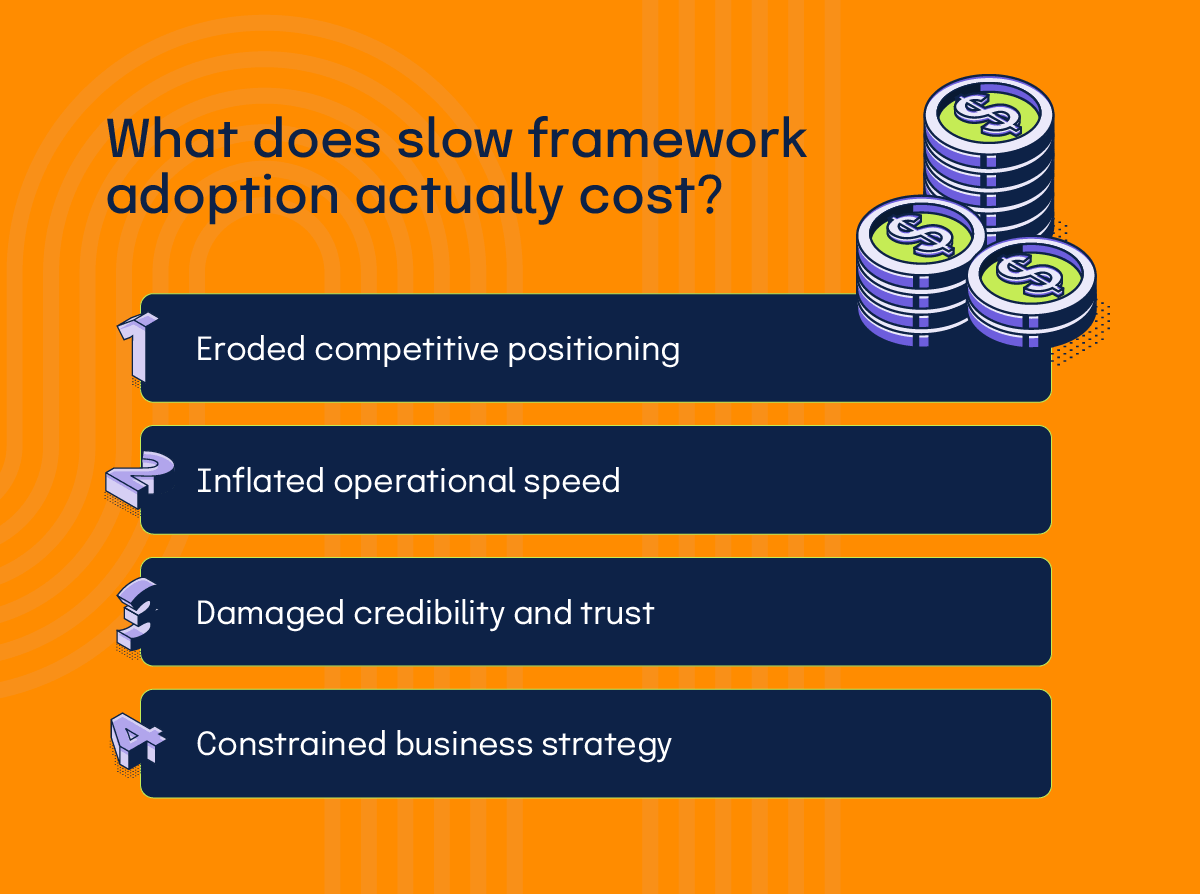
Most organizations don’t feel the cost of slow framework adoption all at once. It accumulates quietly, eroding your position in the market and shrinking the strategic options available to your business.
The cost surfaces in four distinct ways.
1. Eroded competitive positioning
In highly regulated industries like financial services, healthcare, and government contracting, compliance certifications are often the first thing a prospect checks. Organizations with faster framework adoption cycles are simply able to say yes sooner, which matters more than most compliance teams realize when deals are moving quickly.
2. Inflated operational spending
When compliance teams build each new framework from scratch, the cost compounds with every new certification added to the roadmap. External consultants get brought in to accelerate timelines that internal teams can’t move through fast enough, engineers get pulled from core work during audit season, and overlapping controls across frameworks get documented repeatedly as if they’re entirely separate projects.
What looks like a resourcing problem is almost always a process problem, and process problems don’t get cheaper the longer they go unaddressed.
3. Damaged credibility and trust
Compliance frameworks exist, in large part, to signal trustworthiness. Customers and regulators want evidence that you take data security and risk management seriously. When your organization is slow to adopt frameworks that industry peers already hold, it raises questions. Customers, regulators, and prospects may even begin to wonder if your actual security posture is strong.
Rebuilding that trust after a failed audit or a gap surfaced during due diligence takes far longer than it took to lose it, and in competitive markets, that time isn’t a luxury most businesses have.
4. Constrained business strategy
Perhaps the most underappreciated cost of slow framework adoption is what it does to your strategic agility. When compliance is a slow and resource-intensive process, business leaders start making decisions around it rather than alongside it.
Here are some examples of the downstream effects:
Over time, compliance stops being an enabler of growth and starts functioning as a ceiling on ambition. That’s the real cost of slow framework adoption, and it’s one that risk management automation is specifically built to address.
Why do manual frameworks keep failing?
Manual compliance processes were built for a different era, one where organizations operated under a handful of frameworks, audit cycles were predictable, and regulatory change moved slowly enough that spreadsheets and shared drives could more or less keep up.
That era is over, and yet, many organizations are still running their GRC programs the same way they always have, which is exactly why framework adoption keeps stalling.
Failure isn’t usually a lack of effort, compliance teams work hard. The problem is structural. Manual processes create compounding inefficiencies that get worse as your compliance program grows, not better. Here’s where those inefficiencies tend to show up.
These problems reinforce each other. The longer an organization stays on manual frameworks, the harder it becomes to break the cycle without automation.
What are the benefits of risk management automation?
Risk management automation has moved well past the early-adopter stage. Organizations that have made the shift have fundamentally changed how their compliance programs operate.
Here’s how risk management automation plays out across a real compliance program.
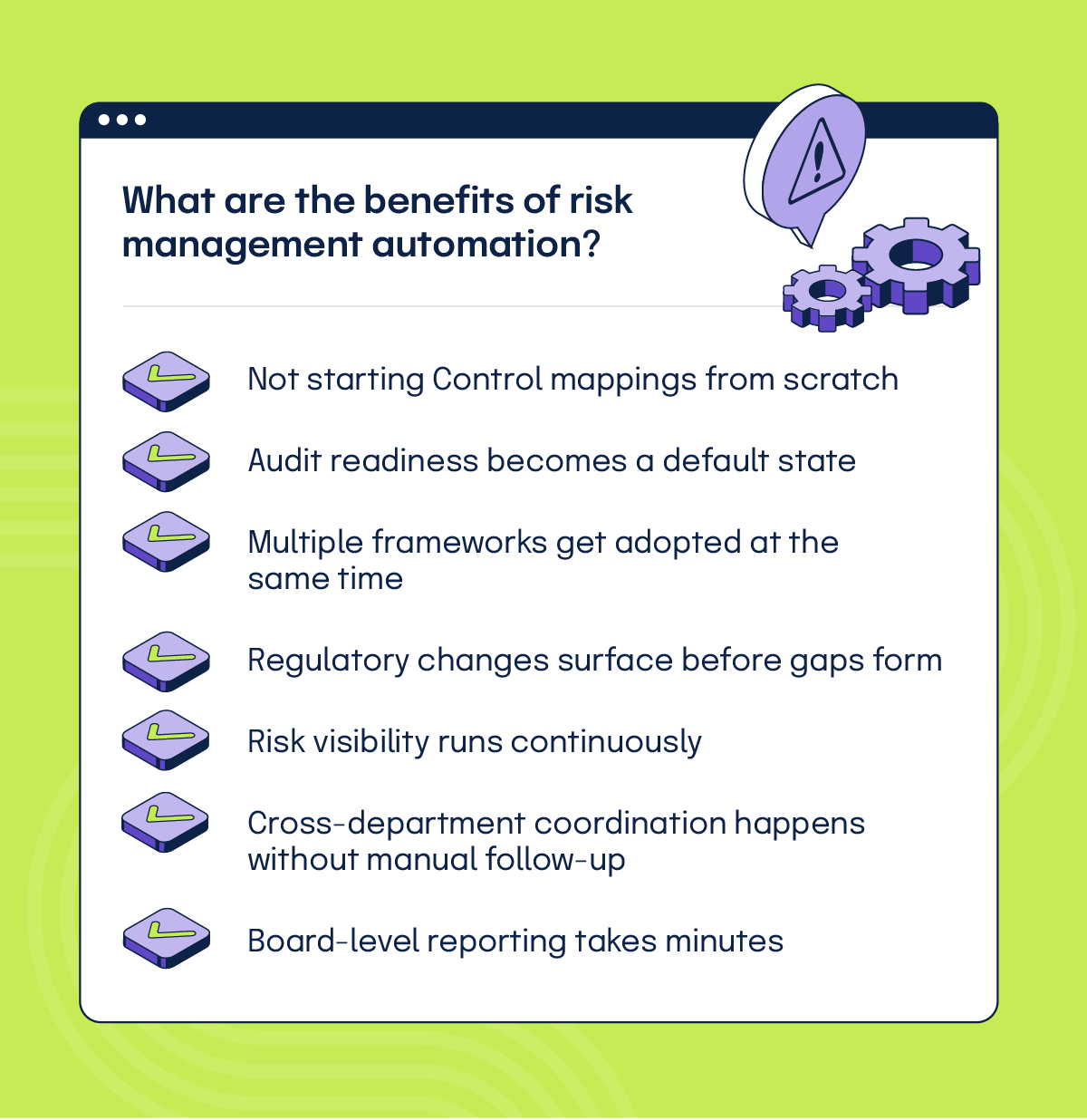
Not starting control mapping from scratch
When a new framework shares requirements with one you’ve already implemented, risk management automation lets you inherit existing controls rather than rebuild them. The work your team did to achieve SOC 2® compliance carries forward into ISO 27001, NIST CSF, or whatever framework your next market expansion requires.
Adoption timelines that previously took months compress significantly because you’re building on an existing foundation rather than starting from zero every time.
Audit readiness becomes a default state
Automated platforms collect and update evidence on an ongoing basis rather than waiting for an audit to trigger the process. That matters more than it might seem. According to Hyperproof’s 2026 IT Risk and Compliance Benchmark Report, manual overhead during audit prep has reached a breaking point. 50% of professionals struggle with the tedium of user access reviews, while 44% are bogged down by the scramble of locating documents and responding to auditor follow-ups. These are clear indicators that reactive evidence collection is the primary driver for automation.
When an auditor requests documentation, it’s already organized and current. The operational burden that makes manual compliance so expensive gets eliminated at the source rather than managed around it.
Multiple frameworks get adopted at the same time
Manual programs adopt frameworks sequentially because the effort required to adopt one exhausts the team’s capacity before they can start the next.
Risk management automation removes that constraint because existing control work carries forward into each new framework rather than treating every adoption as a standalone project. Control mapping, evidence collection, and stakeholder coordination build on what’s already in place, which means organizations can pursue multiple frameworks simultaneously. This directly accelerates the pace at which your business can:
Regulatory changes surface before gaps form
Regulations change, frameworks get updated, and new requirements emerge with little warning. Automated platforms monitor those changes and surface relevant updates to your control environment before they become audit findings.
Risk visibility runs continuously
Manual programs produce risk snapshots. Automated ones produce a living picture of your control environment, updated as evidence comes in and as frameworks evolve. That ongoing visibility gives leadership and GRC teams the context they need to make better decisions faster, without waiting for the next audit cycle to find out where things stand.
Cross-department coordination happens without manual follow-up
A significant portion of compliance work in manual programs involves coordinating across departments, following up with stakeholders, and tracking who has completed what. Risk management automation handles that coordination systematically, routing tasks, sending reminders, and logging completions.
GRC professionals get their time back for the strategic work their roles actually exist to do.
Board-level reporting takes minutes
When all your compliance data lives in a single automated platform, reporting across frameworks draws from the same underlying evidence and control set. Preparing board-level risk reports or demonstrating compliance posture during due diligence takes a fraction of the time it would in a manual program where data is scattered across spreadsheets and shared drives.
Taken together, these capabilities change what’s possible for a compliance program.
Acuity International, a government-focused occupational health organization managing five compliance frameworks simultaneously, is a good example of what that shift looks like at scale. Before automating, their team spent around 4,000 hours a year managing governance packages and preparing for audits, almost entirely through manual evidence collection and spreadsheet coordination.
After moving to Hyperproof, audit preparation time dropped by over 70%, evidence collection hours fell by 80%, and a process that previously took 30 hours now takes three. They also reused 80 controls from their existing NIST SP 800-53 program to build out their SOC 2® Type II certification, which directly shortened the timeline to qualify for new government contracts.
That’s what risk management automation actually does in practice. However, the right outcomes depend entirely on choosing the right platform to deliver them.
How risk management automation platforms can help
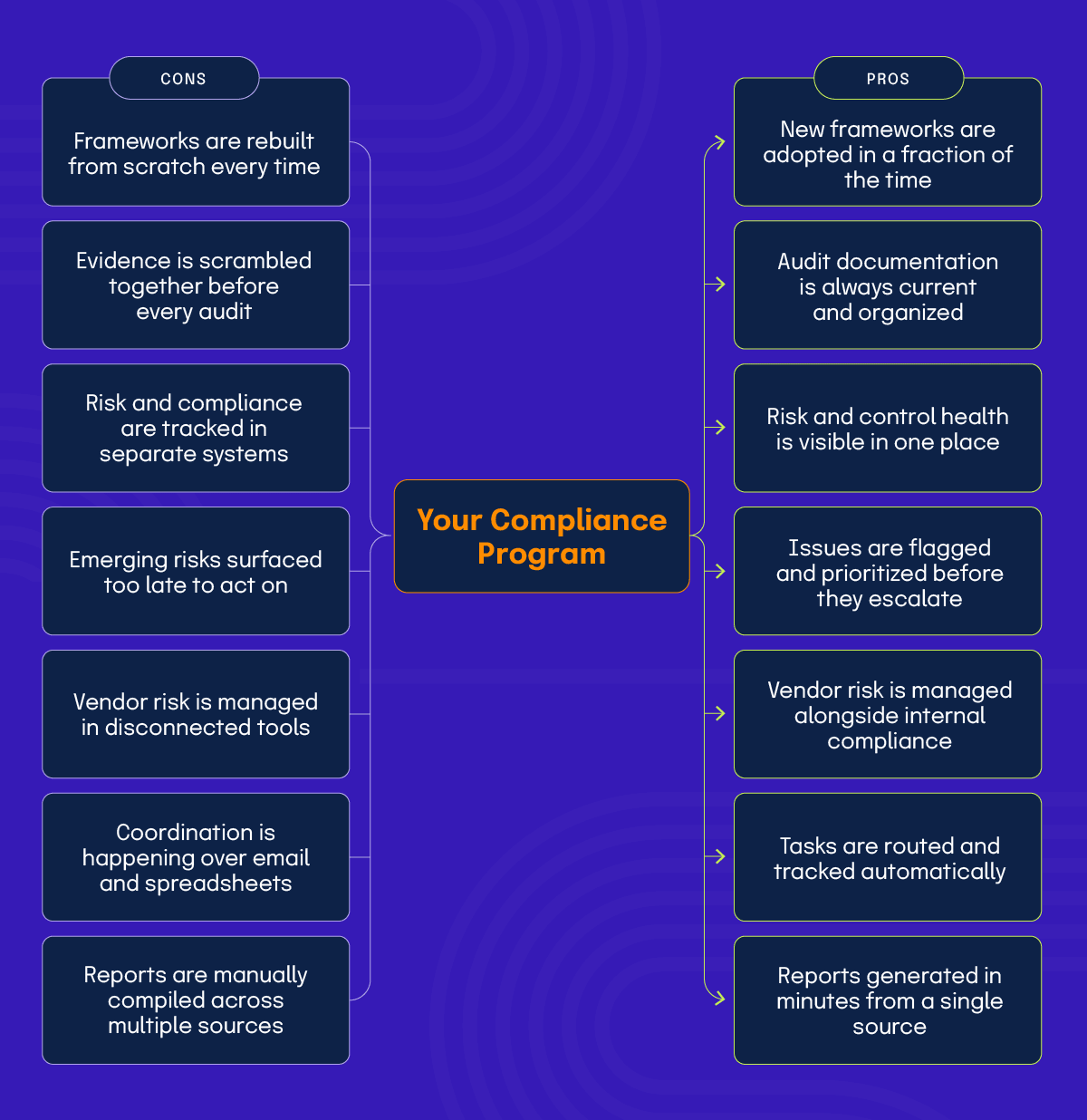
Manual frameworks create compounding inefficiencies that get harder to escape the longer they go unaddressed.
A risk management automation platform breaks that cycle by changing how compliance programs operate at a structural level, not just how fast individual tasks get done.
The most impact shows up in the following ways:
It stops every new framework from starting at zero
A platform with a large pre-built framework library and cross-framework control mapping means existing work carries forward into new certifications. Controls mapped for one framework apply automatically to the next, and adoption timelines that previously took months compress significantly. Hyperproof supports more than 140 pre-built framework templates and a Jumpstart feature that maps existing controls across new frameworks without duplicating effort.
It makes audit readiness a continuous state rather than a periodic scramble
Evidence flows into the platform automatically through integrations with tools your business already uses, staying current without manual intervention. When an auditor requests documentation, it’s already organized and ready. Hyperproof’s Hypersyncs include more than 200 data connectors that collect evidence on-demand or on a scheduled cadence.
It connects risk and compliance into a single picture
When compliance data and risk data live in separate systems, teams end up managing two programs instead of one. A platform that links control health directly to risk registers gives leadership and GRC teams real-time visibility into where things stand without waiting for the next audit cycle. Hyperproof’s Mitigate module does exactly that, connecting control health data to risk registers so the picture is always current.
It surfaces emerging risks before they become audit findings
Rather than relying on ad hoc emails or informal conversations to surface new risks, a platform with standardized intake workflows captures risk signals from employees and partners through a structured process. Hyperproof includes customizable intake surveys that ensure emerging issues get logged and prioritized early.
It brings vendor risk into the same environment as everything else
Third-party risk managed in a separate tool means separate processes, separate data, and separate blind spots. A platform that handles vendor assessments, security questionnaires, renewal tracking, and residual risk measurement alongside internal compliance work gives teams a complete view of their risk landscape. Hyperproof’s vendor risk management module covers all of this in one place.
It removes the manual coordination that drains GRC teams
Task assignments, stakeholder reminders, and completion tracking should run automatically inside the platform. When cross-departmental coordination happens systematically, compliance team members get their time back for the strategic work their roles actually exist to do.
It makes reporting something you generate, not something you compile
When all compliance data lives in a single platform, board-level reports, audit packages, and customer security questionnaires draw from the same underlying source. Hyperproof’s exportable dashboards pull from a unified data set across all frameworks and risk registers, so reporting takes minutes rather than days.
How can organizations accelerate framework adoption with Hyperproof?
Hyperproof is an AI-powered GRC platform built to help organizations adopt new compliance frameworks faster, run multiple programs in parallel, and turn compliance into a genuine business enabler. The platform handles everything from control inheritance to continuous evidence collection. Here’s what that translates to in practice.
Teams using Hyperproof have reported a 90% improvement in stakeholder risk visibility, cut time on manual processes by half, and saved more than 100 hours previously lost to evidence collection. For GRC teams that have been stretched thin managing compliance reactively, those aren’t marginal gains. They’re the difference between a compliance program that holds the business back and one that moves with it.
If framework adoption is taking longer than your business can afford, book a demo and see what faster looks like.
TL;DR: Accelerating framework adoption with risk management automation
Slow framework adoption costs more than most organizations realize, and manual GRC programs are structurally built to keep producing that cost. Here’s what this blog covered.
See Hyperproof in Action
Related Resources
Ready to see
Hyperproof in action?