Guide
Navigating the Pause: The Increased Impact of CMMC Self-Assessments

Introduction
With rules likely changing for the Cybersecurity Maturity Model Certification (CMMC), are you prepared to mitigate False Claims Act liability?
Recent updates from the Department of War (DoW) have introduced a shift in the rollout of the CMMC program. In a July 13 announcement, the Pentagon suspended plans to introduce Phase 2 third-party assessment requirements — originally slated to mandate independent Certified Third-Party Assessment Organization (C3PAO) certifications starting November 10, 2026. The DoW will initiate a 60-day, top-to-bottom review of the program.
While this announcement alters the immediate roadmap for independent validation, it does not erase federal cyber enforcement. Phase 1 requirements remain fully in effect, meaning that submission of Level 1 and Level 2 self-assessments remains a strict condition for contract eligibility.
For defense contractors handling Controlled Unclassified Information (CUI), this pause represents an operational window to refine security postures rather than an excuse to delay implementation. Achieving an audit-ready architecture requires a grounded understanding of ongoing contractual mandates, federal cloud infrastructure criteria, and exact boundary control.
Only an estimated 0.5% of the Defense Industrial Base (DIB) is currently Level 2 certified. Failing to secure a compliant posture early creates a high risk of being priced out or pushed out of the defense market.
This guide provides a clear roadmap for security leaders to navigate the updated timeline, evaluate tool security baselines, and leverage automation to determine if a self-assessment is appropriate and, if so, execute defensible self-assessments. Third-party assessors remain a critical part of the ecosystem and many organizations will find that third-party attestation is their best path forward to mitigating the risk of False Claims Act enforcement.
The shifting timeline of CMMC compliance
The compliance landscape for the DIB has entered a period of recalibration following the Pentagon’s decision to launch a comprehensive program review. While the suspension of the November 10, 2026 third-party assessment mandate changes near-term milestones, the core contractual obligations governing defense supply chains stay firmly in place.
Contractors must continue to navigate active Phase 1 requirements, which dictate mandatory self-assessments logged via the Supplier Performance Risk System (SPRS).
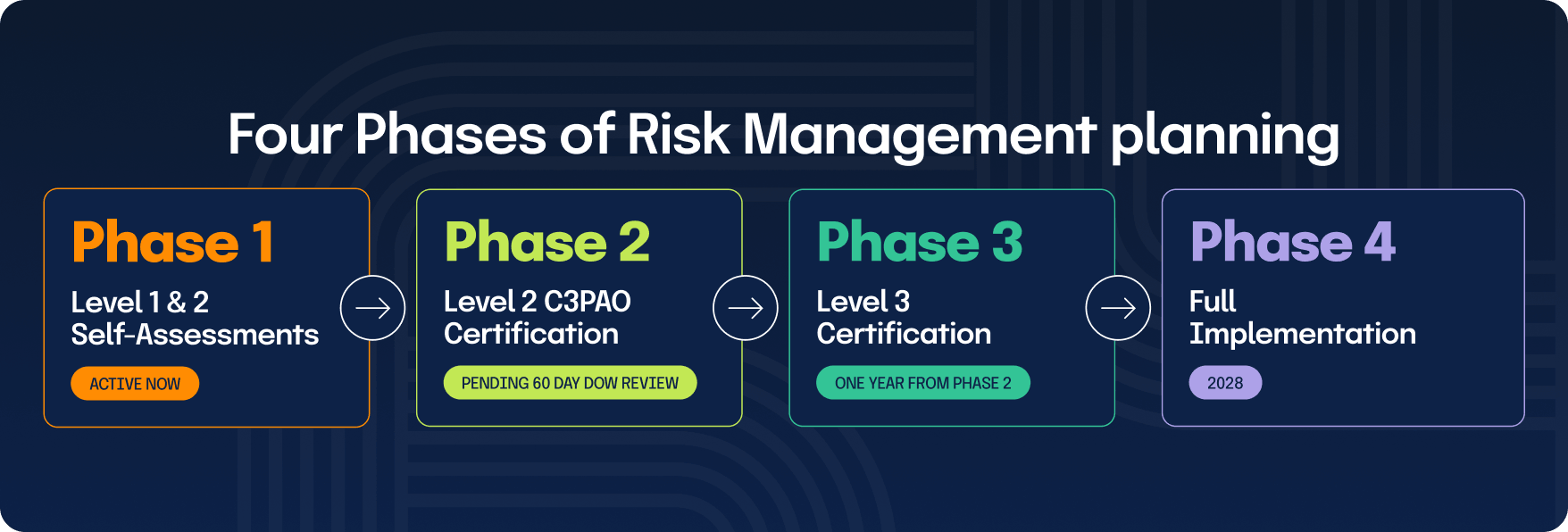
Despite the pause on independent C3PAO oversight, three foundational realities continue to dictate defense contractor security operations:
Rather than pausing compliance operations, enterprise contractors are utilizing this window to re-engineer their internal evaluation processes, shifting away from superficial paperwork exercises toward continuous, verifiable self-assessments.
Additionally, if the 60-day program review reinstates the C3PAO certification requirement, a significant supply-and-demand imbalance still remains within the compliance ecosystem:
Defining your assessment boundary: The NIST 800-171 baseline
A common pitfall in federal compliance planning is boundary creep, which occurs when organizations fail to isolate controlled unclassified information (CUI).
Even with the Department of War’s suspension of mandatory CMMC third-party C3PAO audits, the statutory requirement to isolate and protect CUI remains active under DFARS 252.204-7012. The physical and logical perimeter where CUI is processed, stored, or transmitted defines the explicit scope of your internal assessment boundary. Allowing federal data to migrate into standard corporate networks expands your compliance footprint, driving up administrative orchestration costs and increasing the probability of security gaps.
Precise scoping architectures rely on network segmentation to contain the compliance perimeter. Security teams restrict CUI to a dedicated enclave using firewall configurations, logical access controls, and strict identity verification protocols. By isolating sensitive federal data from general business operations, you limit the infrastructure subject to the 110 controls of NIST SP 800-171, making internal reviews predictable and targeted.
The system security plan (SSP) must document this scoping strategy by detailing every system component, user group, and third-party tool within the security enclave. Under the interim enforcement model, an accurate, data-backed SPRS self-assessment score is your primary representation of compliance to the government and prime contractors. GRC professionals utilize an integrated risk register to map vulnerabilities specifically to the assets inside this boundary. This localized visibility ensures that security issues are identified and remediated through automated workflows.
Tooling under the microscope: The FedRAMP requirement
The suspension of third-party C3PAO audits changes how you verify compliance, but it does not alter the federal mandates governing data environments. A frequently overlooked aspect of CMMC readiness concerns the platforms used to manage the compliance process. Under DFARS 252.204-7012, any cloud service provider used to process, store, or transmit CUI must meet FedRAMP Certified Class C (rev5) standards (formerly known as FedRAMP Moderate Authorized). It cannot be met with a FedRAMP-certified Class C (20x) tool.
Enterprise organizations frequently introduce severe audit risk by managing system security plans, control telemetry, and assessment evidence within standard commercial SaaS tools. If a GRC platform contains artifact submissions, vulnerability descriptions, or system design documentation that references CUI, that platform must meet the federal standard.
Critical Compliance Note: This requirement directly applies to your GRC platform. Managing CMMC evidence, control documentation, or system security plans (SSPs) within a non-compliant cloud environment creates an immediate gap in your assessment boundary, providing assessors with grounds to derail the entire certification.
Evaluating the mitigation paths: Certified vs. equivalent
Organizations seeking to preserve their legacy GRC investments occasionally attempt to establish the required security posture by pursuing the DoD equivalency path for non-certified software. The operational barriers of this approach are severe, often demanding more resources than the underlying infrastructure compliance project itself.
|
Operational Element |
The Certified Path (Hyperproof Gov) |
The DoD Equivalency Path |
|---|---|---|
|
Documentation Burden |
Zero. Handled entirely by the platform’s existing ATO. |
Full 3PAO-assessed Body of Evidence required. |
|
POA&M Tolerance |
100% compliant at launch. |
Zero tolerance. Requires 100% control implementation. |
|
Maintenance Frequency |
Automated updates and continuous monitoring. |
Monthly vulnerability scans and annual reassessments. |
|
Assessment Risk |
Low. Assessors validate the platform using verified marketplace credentials. |
High. The manual package is reviewed from scratch, creating an unpredictable timeline risk. |
The strategic value of evidence reuse
Enterprise defense contractors rarely manage CMMC in a vacuum. Most organizations must simultaneously maintain alignment with commercial and international frameworks like SOC 2®, ISO 27001, and NIST CSF. Manually collecting, verifying, and mapping evidence for each of these frameworks independently creates severe operational friction, leading to pervasive audit fatigue across engineering and IT security teams.
Modern GRC platforms enable the creation of a single control environment that scales across the entire business. By establishing a common control framework, a security professional can map a single internal control — such as a multi-factor authentication policy or a vulnerability management workflow — to multiple requirements across CMMC Level 2, FedRAMP, and ISO 27001 simultaneously.
Streamlining evidence collection workflows
When a piece of evidence is gathered, GRC automation automatically links that artifact to every related control across all active programs.
1 Minimize redundant requests
Control owners upload documentation a single time, satisfying multiple audit requests concurrently.
2 Drastically cut audit preparation time
Cross-framework mapping reduces duplicative controls by up to 66%, freeing technical teams to focus on strategic security initiatives rather than administrative workflows.
3 Ensure continuous control health
Automated evidence collection keeps evidence fresh across multiple dashboards, providing real-time compliance updates to leadership before formal assessments begin.
The NIST SP 800-171 and SPRS self-assessment checklist
The pause on formal CMMC third-party assessments shifts the immediate burden of proof back to your internal control operations and SPRS entries. Contractors must maintain a continuous, auditable operational rhythm that map directly to existing regulatory obligations.
This checklist provides an operational architecture to organize your compliance artifacts, verify system boundaries, and document a defensible compliance posture that satisfies the data flow-down demands of prime contractors.
1 Phase 1
//
Boundary definition and data scoping
2 Phase 2
//
Control implementation and GRC automation
3 Phase 3
//
Risk integration and continuous evaluation
4 Phase 4
//
Assessment preparation and continuous monitoring
5 Phase 5
//
C3PAO assessment readiness
(If the C3PAO requirement is reinstated)

Download the NIST SP 800-171 and SPRS self-assessment checklist
Driving Revenue and Market Expansion Through CMMC
Viewing CMMC simply as a mechanism to retain defense contracts reduces the considerable time and capital spent on compliance to an operational tax. Forward-looking organizations treat CMMC as a strategic investment to aggressively capture new business and shorten time-to-market in lucrative commercial sectors.
The high security standards required to secure a defense enclave overlap directly with dominant commercial security frameworks. By mapping CMMC requirements to the broader regulatory landscape, you can turn a singular defense compliance effort into a multi-market entry framework:
Secure your GRC program with Hyperproof Gov
Given the volatile regulatory landscape and the unpredictability of upcoming Department of War initiatives, maintaining a proactive compliance posture is a strategic necessity rather than a future goal. Staying ahead of regulatory changes means your defense enclave is prepared to absorb shifts in federal enforcement without disrupting core business operations.
The 110 security controls of NIST SP 800-171 establish a foundational security baseline, but managing them through manual data workflows introduces operational bottlenecks and execution risk. Relying on traditional spreadsheets to track version history, log artifact updates, and monitor control status forces security teams into a cycle of reactive collection. For enterprise defense contractors, achieving continuous compliance requires a shift from manual tracking to a centralized GRC architecture.
GRC automation unifies your administrative workflows, internal telemetry, and evidence requirements into a single system of record. Instead of treating each information security framework as an isolated project, an automated platform maps overlapping requirements across CMMC, SOC 2®, and ISO 27001. This core framework mapping enables an organization to build a common control set in which a single operational test or architectural artifact satisfies multiple audit criteria simultaneously, reducing control redundancy by up to 66%.
Hardening your audit architecture
CMMC readiness requires complete confidence in the defensibility of your compliance data. Manual collection workflows expose organizations to human error, outdated files, and missing documentation during complex evaluations.
Hyperproof Gov operates on a FedRAMP Certified Class C (Rev5) infrastructure, providing a protected cloud environment that natively satisfies federal security baselines. By centralizing your compliance operations within a pre-authorized GRC platform, your team can maintain continuous control visibility, preserve historical evidence validity, and present a structured body of evidence that holds up to rigorous scrutiny. The Hyperproof platform is additionally equipped with highly useful tools for CMMC, like automated SPRS scoring, SSP generation, and POA&M management.
Hyperproof is the only GRC platform that is both FedRAMP Class C Certified (rev5) and purpose-built for the operational complexity of enterprise-grade CMMC programs
If your organization handles CUI and plans to preserve eligibility for federal defense solicitations, proactive preparation provides immediate defense and long-term stability.
See Hyperproof Gov in action.