Audit Collaboration: How to Streamline Your Audit Across the Organization

Updated on: Apr 16, 2026 12 Minute Read
For many organizations, audit collaboration follows a familiar pattern. A deadline approaches, requests go out across departments, teams scramble to locate and submit evidence, and the compliance team spends weeks coordinating a process that consumes far more time and energy than anyone planned for. By the time the audit wraps up, everyone involved is ready to move on and not think about it again until the next cycle begins.
The challenge is that the next cycle always comes around, and without any structural changes in between, the experience tends to repeat itself in roughly the same way. Evidence still lives across a dozen different systems. The same people get pulled in to answer the same requests. Coordination still happens over email. And the compliance team still finds itself in the position of chasing rather than managing.
As organizations grow and take on more frameworks, more systems, and more stakeholders, that pattern becomes progressively harder to sustain.
This guide walks through why that happens, what effective audit collaboration actually looks like when the right foundations are in place, and how Hyperproof’s Hypersyncs can make things easier.
Why does audit collaboration break down at scale?
Audit collaboration doesn’t break down because people stop caring. It breaks down because the way most organizations are structured simply wasn’t designed to support it at scale.
As teams grow and technology footprints expand, evidence of control activities ends up scattered across dozens of systems, each owned by a different department, each managed by people who have their own priorities and deadlines. Nobody has the full picture. Ownership of controls gets assumed rather than formally assigned, which means when audit requests land, everyone thinks someone else is handling it.
On top of all this, most organizations still treat audit as a once-a-year event rather than something that runs continuously in the background. So when the audit window opens, teams are essentially starting from scratch every single time, chasing the same evidence, answering the same requests, and pulling the same people away from their actual jobs. The bigger the organization, the worse this gets.
Before we get to the fix, let’s first look at what effective audit collaboration actually requires.
What does effective audit collaboration actually require?
Effective audit collaboration requires four things: a single place where audit work lives, clearly assigned ownership at the control level, compliance embedded into daily workflows, and evidence collected on a continuous basis rather than assembled before each audit cycle. These fundamentals build on each other.
Below’s a detailed look at each.
Audit work lives in one place
Spreading audit coordination across email threads, shared drives, and spreadsheet trackers makes it genuinely difficult to track what has been submitted, what is pending, and what is missing.
A single shared space gives every stakeholder the same view of progress at any given point in time. Organizations appear to be moving in this direction at scale. Hyperproof’s 2026 IT Risk and Compliance Benchmark Report found that 86% of organizations now operate with a centralized GRC team, and that shift tends to have the most practical impact when the work itself is consolidated in one place alongside it.
When everything is visible in a single workspace, responding to audit requests becomes a matter of locating and sharing rather than searching and reconstructing.
Every control has a named owner
Assigning a named owner to every control means someone knows exactly what evidence is expected from them and when. Audit requests reach the right person the first time, and the resolution process moves considerably faster without the usual back and forth across departments.
Ownership at the individual level also creates a clearer paper trail. When a control has a named owner, there is a single point of accountability for its status, its evidence, and its history over time.
Compliance is part of daily work
With ownership defined and a central workspace in place, the next layer is cadence. When evidence collection happens as part of how teams already operate throughout the year, the workload gets distributed across the year rather than compressed into a few weeks. Control owners in IT, HR, Finance, and Legal collect and submit evidence on a regular cadence rather than all at once.
Some of the things that tend to follow from this include:
Evidence is collected continuously
All of this builds toward one outcome, evidence that exists before it is asked for. Rolling evidence collection means that by the time an audit begins, most of what auditors need already exists and is organized. It also tends to produce more reliable evidence since it reflects the actual state of controls as they operate day to day rather than a version assembled under time pressure.
That reliability matters because it is what gives auditors confidence in what they are reviewing and keeps the process moving forward without unnecessary delays.
How can Hypersyncs streamline audit collaboration?
Hypersyncs are Hyperproof’s built-in data connectors, purpose-built to automatically pull compliance evidence directly from the third-party applications and cloud services an organization already uses.
Rather than asking a system administrator to log in, export a report, and email it across, a Hypersync does that work automatically, either on a schedule the team defines or on demand whenever evidence is needed.
The result is that evidence arrives in Hyperproof already normalized, timestamped, and tagged with metadata showing exactly where it came from, when it was collected, and who configured the connection. That matters because auditors are looking at evidence that comes directly from source systems rather than from a person, which significantly increases its credibility and reduces time spent on verification.
With this context in mind, here is how organizations typically put Hypersyncs to work across their audit program.
Identify and connect your critical systems
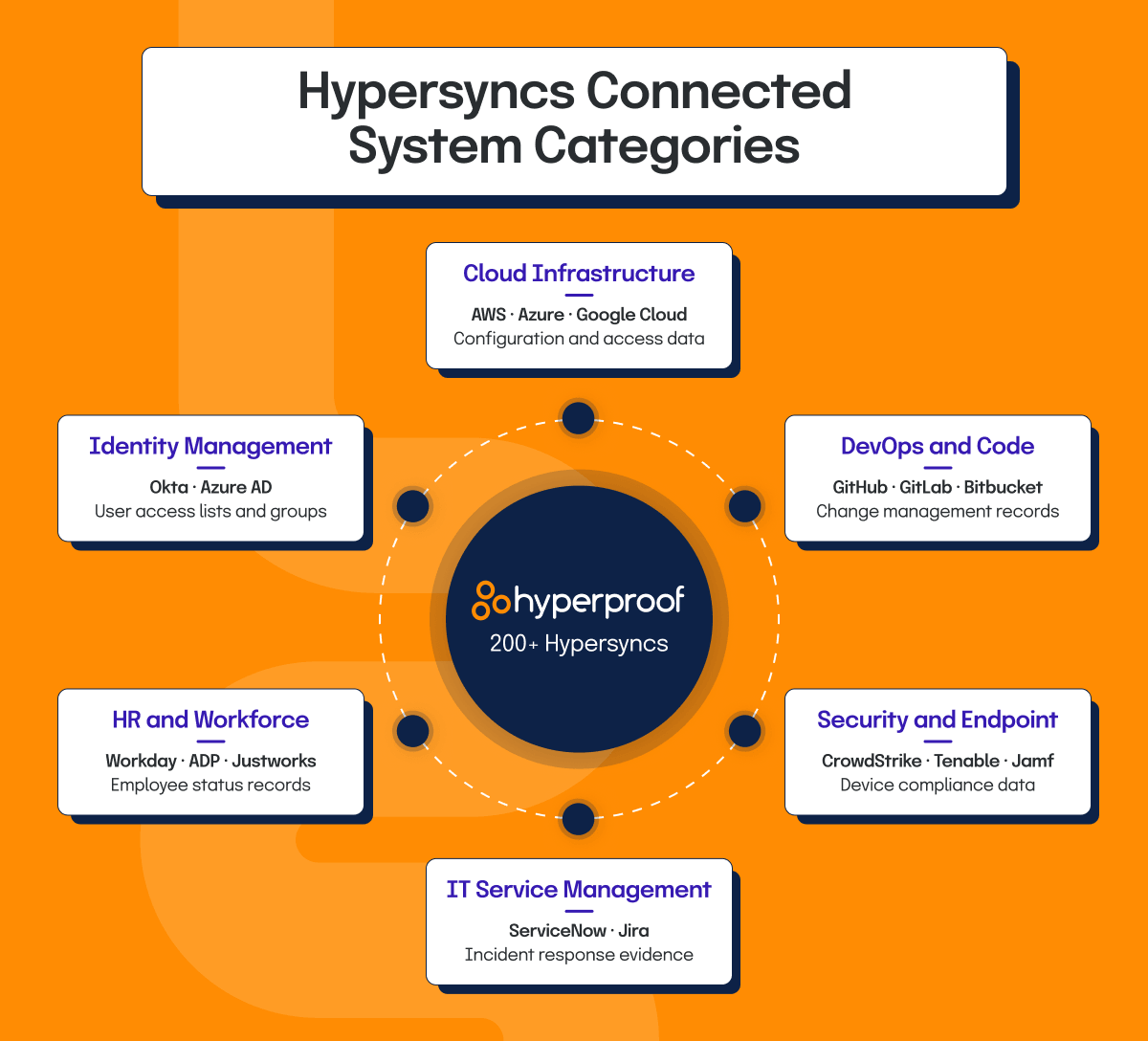
The starting point is identifying which systems in your environment hold the evidence your controls require. Hyperproof supports over 200 out-of-the-box integrations across the tools most organizations already run. Once the relevant systems are identified, connecting them to Hyperproof is a one-time setup.
From that point forward, the connection runs on whatever cadence is configured without any ongoing manual involvement. The most commonly connected system categories include:
For organizations running unique internal systems not covered by existing integrations, Hyperproof also provides a Software Development Kit that enables development teams to build custom Hypersyncs to those systems using the same underlying framework.
Map evidence to controls and compliance frameworks
Once a connection is live, the next step is mapping which evidence from that system corresponds to which controls.
A single Hypersync can feed evidence to multiple controls simultaneously, and a single control can draw evidence from multiple Hypersyncs. This is particularly useful for organizations managing more than one compliance framework, because a piece of evidence collected from Okta, for example, can satisfy access control requirements across both SOC 2® and ISO 27001 without being collected twice.
According to Hyperproof’s 2026 IT Risk and Compliance Benchmark Report, 56% of organizations already use a common controls framework to manage this kind of cross-framework complexity, making evidence reuse across frameworks one of the more widely adopted approaches to scaling compliance without proportionally growing the workload alongside it.
The more deliberate controls are mapped at setup, the more leverage the organization gets from every Hypersync connection it builds over time.
Configure collection cadence based on control frequency
Hypersyncs allow teams to define how frequently evidence is collected for each connection independently. Controls that require frequent validation, such as user access lists or password policy configurations, can be set to collect evidence daily or weekly.
Controls that change less frequently can run on a monthly or quarterly cadence. Teams can also trigger on-demand collection at any point, which is useful in the lead-up to an audit or when a control needs to be validated outside of its normal schedule.
This flexibility means the evidence collection program can be tuned to the actual risk profile and audit requirements of the organization rather than running everything on a single fixed schedule.
Shift from evidence gathering to continuous review and testing
With evidence flowing in automatically, the compliance team’s role shifts from gathering to reviewing. Hyperproof surfaces collected evidence directly on the relevant control, complete with metadata showing its source, timestamp, and collection history. Teams can write automated tests against the evidence to validate that controls are operating as expected and configure alerts to flag anything that falls outside defined parameters.
When an auditor submits a request, the team can respond directly from Hyperproof because the evidence already exists in the platform, organized and traceable, rather than needing to be assembled from scratch in response to the request.
Operationalizing continuous audit readiness with Hyperproof’s Hypersyncs: 90-day roadmap
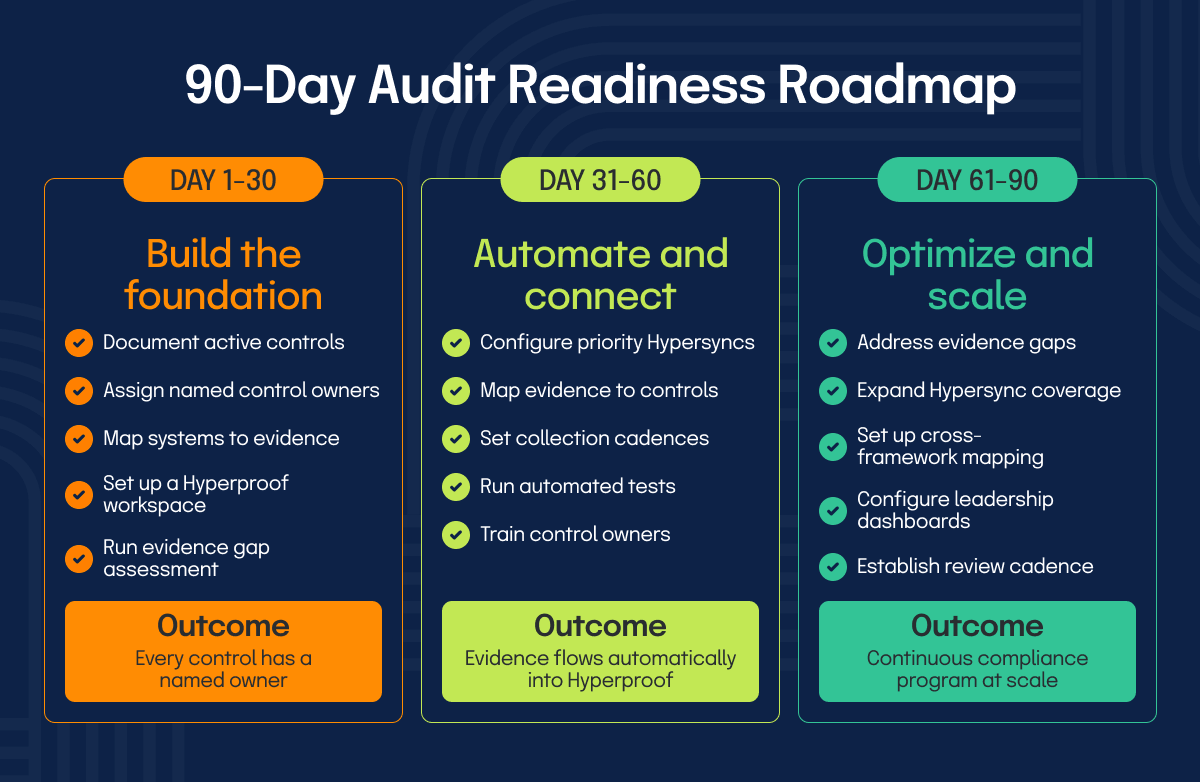
Getting audit collaboration right across an organization doesn’t happen overnight. It’s a gradual shift in how people work, how evidence is managed, and how compliance gets embedded into day-to-day operations. A phased approach helps teams make that transition in a structured way without disrupting ongoing work.
Here is what that typically looks like across the first 90 days.
Day 1 to 30: Build the foundation
The first month is about getting the basics in place before any automation is introduced. This means auditing the current state of controls, identifying who actually owns what, and mapping out which systems hold the evidence those controls require.
Key activities in this phase include:
- Documenting all active controls and their current ownership status
- Assigning named control owners across IT, HR, Finance, Legal, and Operations
- Identifying the systems and tools that hold the evidence for each control
- Establishing a single workspace in Hyperproof where all audit-related work will live going forward
- Running an initial evidence gap assessment to understand what exists and what is missing
The goal at the end of this phase is clarity. Every control has an owner, every owner knows what is expected of them, and the team has a clear picture of where evidence currently lives across the organization.
Day 31 to 60: Automate and connect
With the foundation in place, the second month focuses on activating Hypersyncs across the critical systems identified in phase one. This is where manual evidence collection starts to get replaced by automated evidence collection running on a defined cadence.
Key activities in this phase include:
By the end of this phase, the team should have a working automated evidence collection program covering the highest priority controls, with evidence flowing into Hyperproof on a regular basis without manual intervention.
Day 61 to 90: Optimize and scale
The third month is about refining what has been built, expanding coverage, and establishing the reporting cadence that gives leadership ongoing visibility into compliance posture.
Key activities in this phase include:
At the 90-day mark, the organization should have moved from a reactive, audit-season driven model to a continuous compliance program where evidence is collected automatically, ownership is clearly defined, and the team spends its time on review and improvement rather than gathering and chasing.
Audit collaboration at scale is ultimately an operational discipline. The organizations that handle it well are not necessarily the largest or the best resourced. They are the ones who have made deliberate decisions about how audit work is structured, who owns what, and how evidence moves through the organization throughout the year rather than all at once.
The fundamentals covered in this guide do not require a complete overhaul to get started. They build on each other progressively, which is exactly the point of the 90-day roadmap. Small structural changes compound over time into a compliance program that is considerably more manageable and considerably more reliable than what most organizations are running today.
If you are evaluating how Hyperproof’s Hypersyncs could fit into your audit program specifically, the best next step is to see it in the context of your own environment.
See how Hyperproof can help your organization build a more connected, continuous approach to audit collaboration. Book a demo
See Hyperproof in Action
Related Resources
Ready to see
Hyperproof in action?