What to Look for in a Crowded Market of Automated Evidence Collection Solutions

Updated on: Mar 13, 2026 14 Minute Read
On the surface, many automated evidence collection solutions appear similar. They connect to cloud services, retrieve configuration data, store documentation, and generate reports.
But as more organizations invest in automation, they realize that not all evidence-collection solutions deliver the same value. Some reduce manual tasks, but introduce new operational burdens. Others promise scale, but struggle to support complex compliance environments. Some create security concerns that prevent teams from fully adopting them.
When evaluating a crowded market, feature lists are not enough. Organizations need to look deeper at how automated evidence collection fits into their broader governance, risk, and compliance strategy.
Here are the most important considerations.
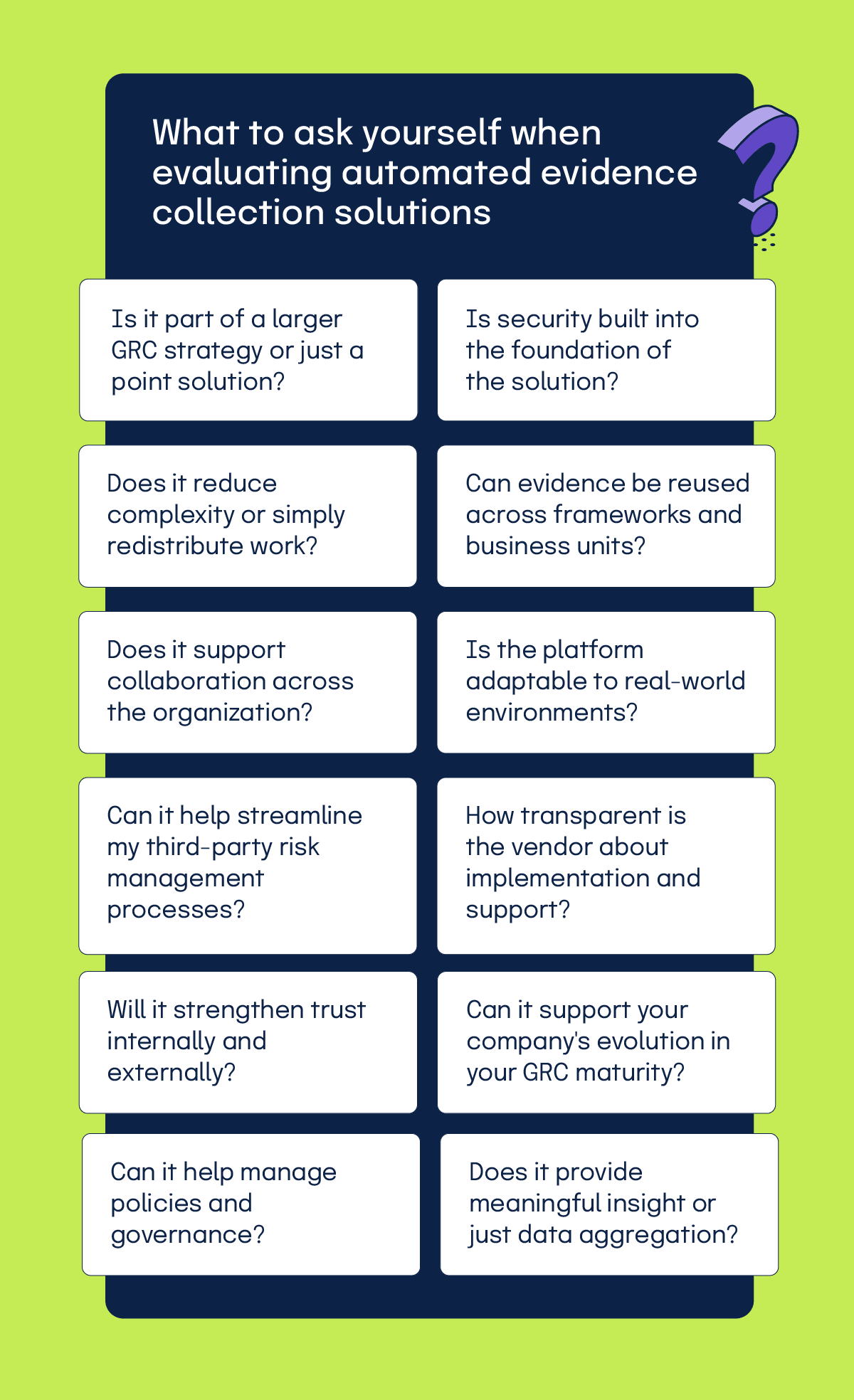
Is it part of a larger GRC strategy or just a point solution?
Evidence collection does not exist in a vacuum. It supports controls, and controls mitigate risk, which informs business decisions.
When automation is delivered as a standalone tool, it often addresses only one piece of the puzzle. It may retrieve data efficiently, but the evidence remains disconnected from risk registers, control performance dashboards, and executive reporting. Teams still rely on spreadsheets or separate systems to provide context.
In contrast, when automated evidence collection is embedded within a modern GRC platform, the value compounds.
Evidence can be mapped to multiple controls and frameworks without duplication. Control performance can be monitored continuously rather than assessed only during audit cycles. Risk owners gain visibility into how evidence supports mitigation efforts. Executives can see real-time assurance metrics rather than static audit snapshots.
Organizations should ask whether a solution strengthens their overall compliance ecosystem or simply automates a narrow task. Automation that does not integrate with broader GRC workflows may reduce effort in one area while increasing fragmentation elsewhere.
The goal is not just to collect evidence faster. It is to create a connected, intelligent compliance program.
With Hyperproof, evidence is natively connected to risks, controls, frameworks, tasks, and reporting dashboards. Instead of managing evidence in isolation, teams can see how evidence supports the entire ecosystem.
Is security built into the foundation of the solution?
Evidence often contains highly sensitive information. It may include user access configurations, system logs, architectural diagrams, encryption settings or details about security controls.
If an evidence collection solution requires broad permissions, stores data without strong encryption or lacks granular access controls, it introduces risk into the very process designed to reduce risk.
This is one reason many organizations underutilize the automation tools they purchase. Security teams may hesitate to grant the necessary access. Compliance leaders may worry about concentrating sensitive data in a single repository without clear safeguards.
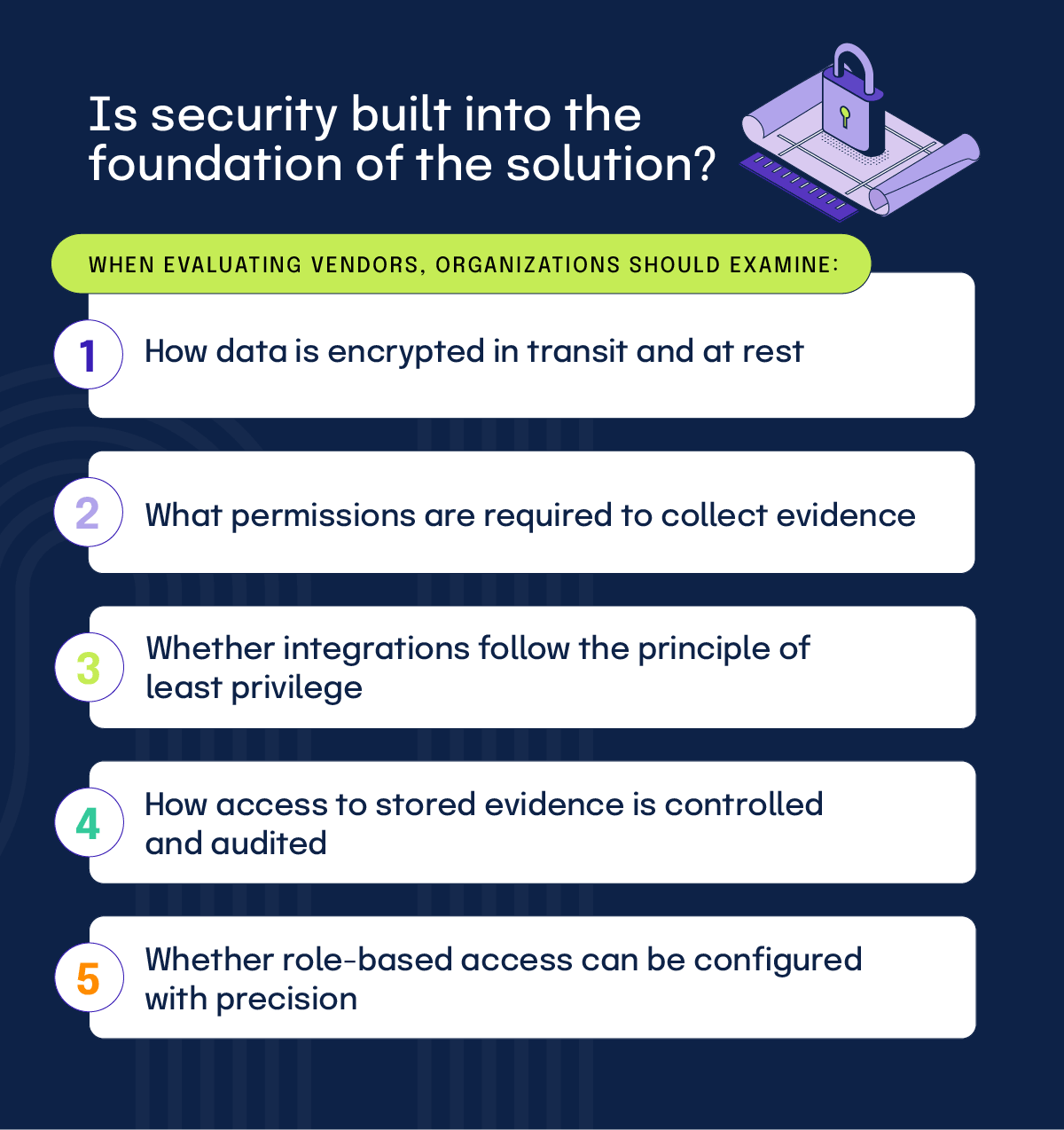
When evaluating vendors, organizations should examine:
- How data is encrypted in transit and at rest
- What permissions are required to collect evidence
- Whether integrations follow the principle of least privilege
- How access to stored evidence is controlled and audited
- Whether role-based access can be configured with precision
Security should not be an add-on or a marketing bullet, it should be evident in the architecture, documentation, and implementation process. If a vendor cannot clearly explain how evidence is protected at every stage of collection and storage, that uncertainty may limit adoption and erode trust internally.
Does it enable continuous compliance or reinforce audit cycles?
Traditional GRC programs often operate in bursts of activity. Evidence is gathered in the months leading up to an audit, controls are reviewed intensively, and once the audit concludes, activity slows.
Automation has the potential to break that cycle. Scheduled evidence collection, automated testing, and real-time alerts can transform compliance from a reactive scramble into an ongoing discipline.
But not all solutions support this shift.
Some tools are optimized for one-time pulls of documentation, while others require manual initiation. Without scheduling, monitoring, and alerting capabilities, organizations may still rely on periodic checks rather than continuous validation.
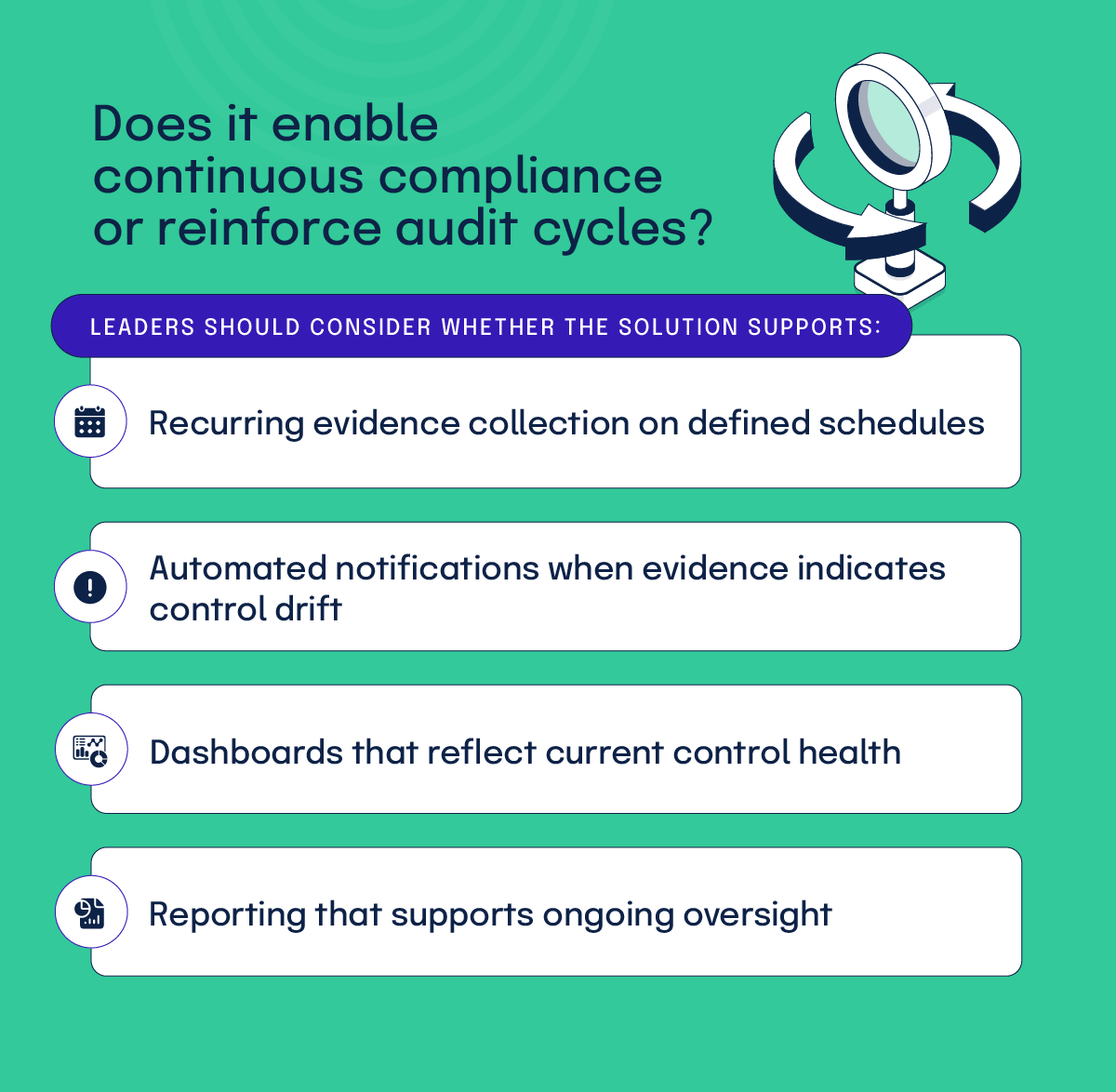
Leaders should consider whether the solution supports:
Continuous compliance is a key part of the shift toward sustained assurance and the right solution should make that shift feasible.
Does it reduce complexity or simply redistribute work?
Automation promises efficiency, but in practice some solutions shift manual effort rather than eliminate it.
Teams may still need to download files, verify mappings, upload documents to other systems, or manually reconcile which evidence satisfies which controls. In some cases, automation retrieves raw data but leaves interpretation and organization entirely to the user. This creates hidden labor.
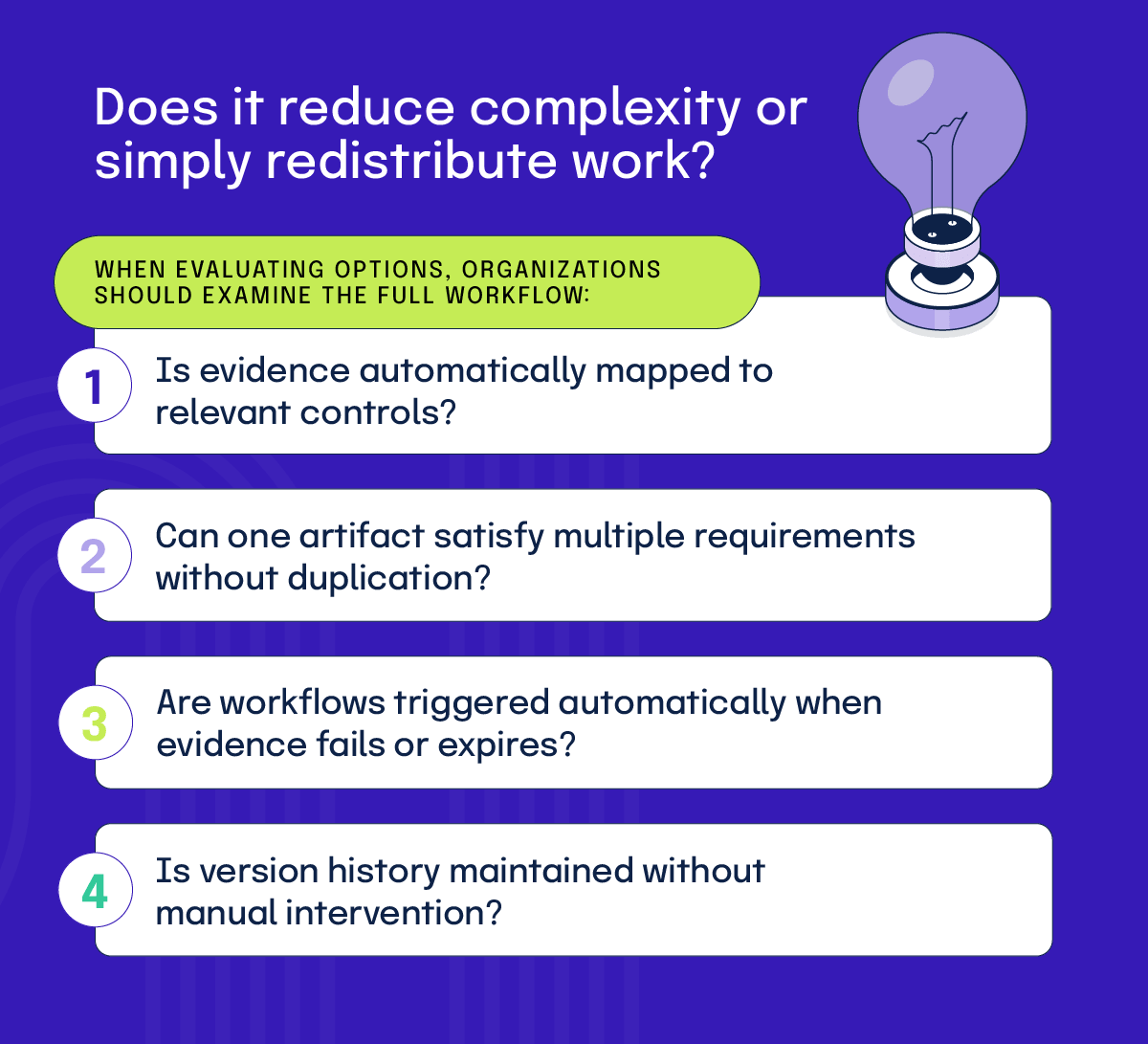
When evaluating options, organizations should examine the full workflow:
- Is evidence automatically mapped to relevant controls?
- Can one artifact satisfy multiple requirements without duplication?
- Are workflows triggered automatically when evidence fails or expires?
- Is version history maintained without manual intervention?
True automation reduces friction across the lifecycle of evidence management. It does not require constant oversight to function effectively. If compliance professionals spend more time managing the automation than benefiting from it, the promised efficiency gains may never materialize.
Can evidence be reused across frameworks and business units?
As organizations mature, their compliance obligations multiply. A company that begins with SOC 2Ⓡ may end up adding ISO 27001, PCI DSS, HIPAA, or regional privacy regulations.
If each framework requires separate evidence collection, complexity grows exponentially. Teams duplicate effort, inconsistencies arise, and audit fatigue increases.
A scalable solution should support a unified control approach, where evidence collected once can satisfy multiple frameworks. This requires thoughtful control mapping and flexible data structures.
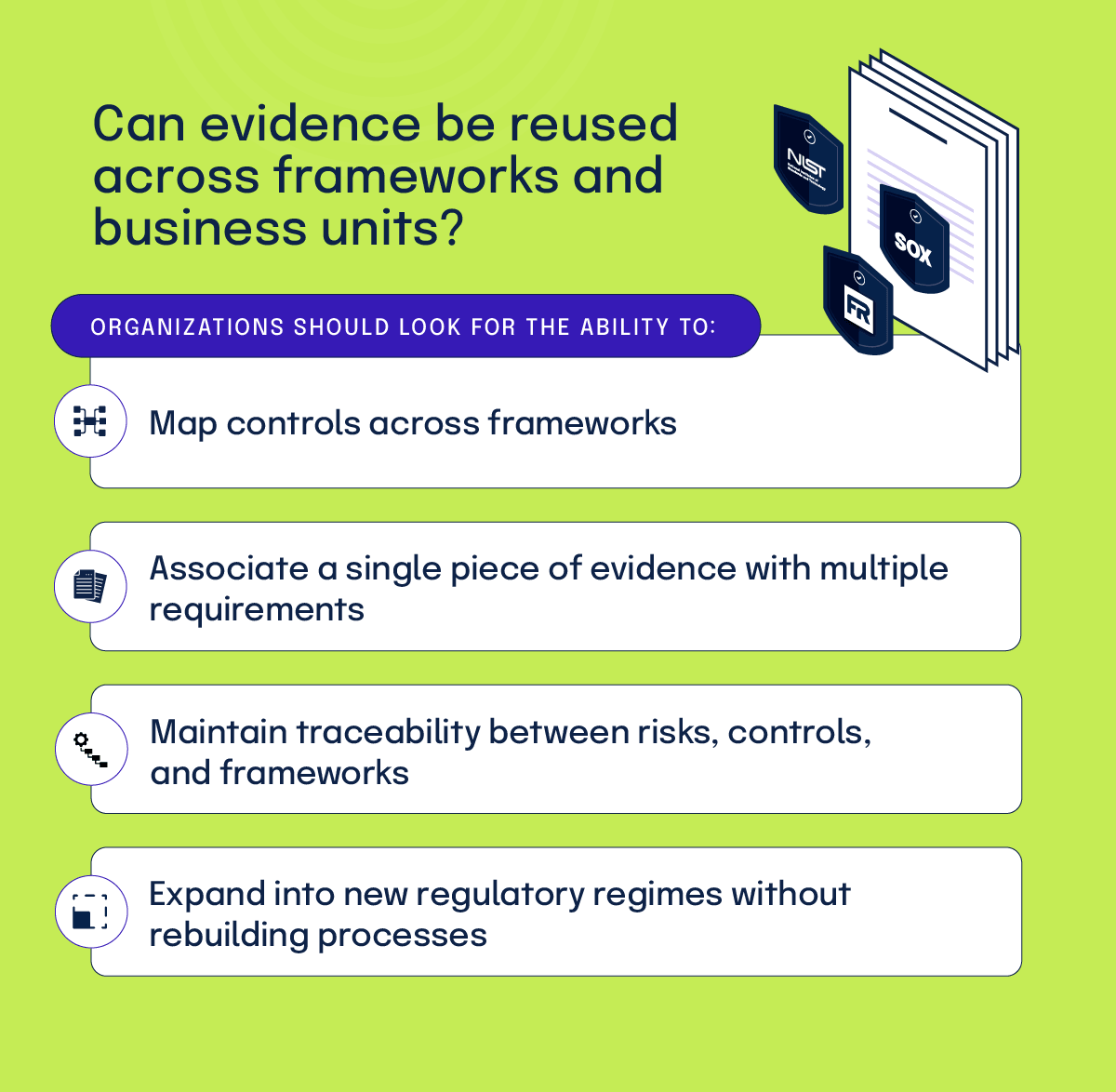
Organizations should look for the ability to:
Automated evidence collection should simplify expansion, not compound administrative burden.
Does it support collaboration across the organization?
Compliance does not belong to one department. IT, engineering, security, finance, human resources, and operations all contribute to control execution.
If evidence collection lives in a siloed tool accessible only to a small group, communication gaps may widen. Teams may revert to email and shared drives,causing accountability to become unclear. Modern GRC programs require transparency and collaboration.
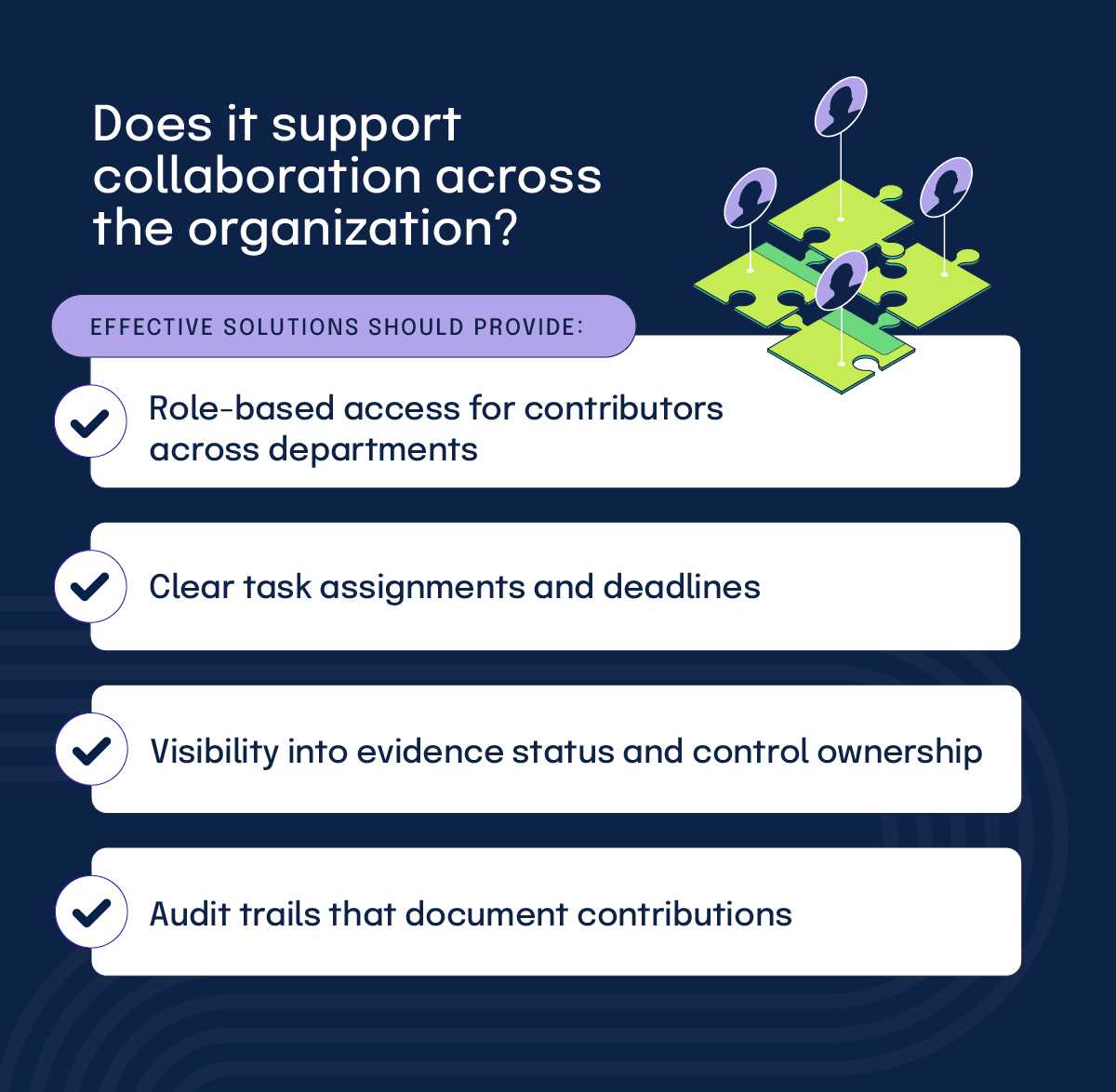
Effective solutions should provide:
When stakeholders understand how their actions support broader GRC goals, participation improves.
Is the platform adaptable to real-world environments?
No two organizations operate identically. Control structures vary, approval workflows differ, and business units may require unique reporting views.
Rigid automation solutions can force teams to adapt their processes to the tool rather than the other way around. This may create shadow systems, workarounds, or resistance to adoption.
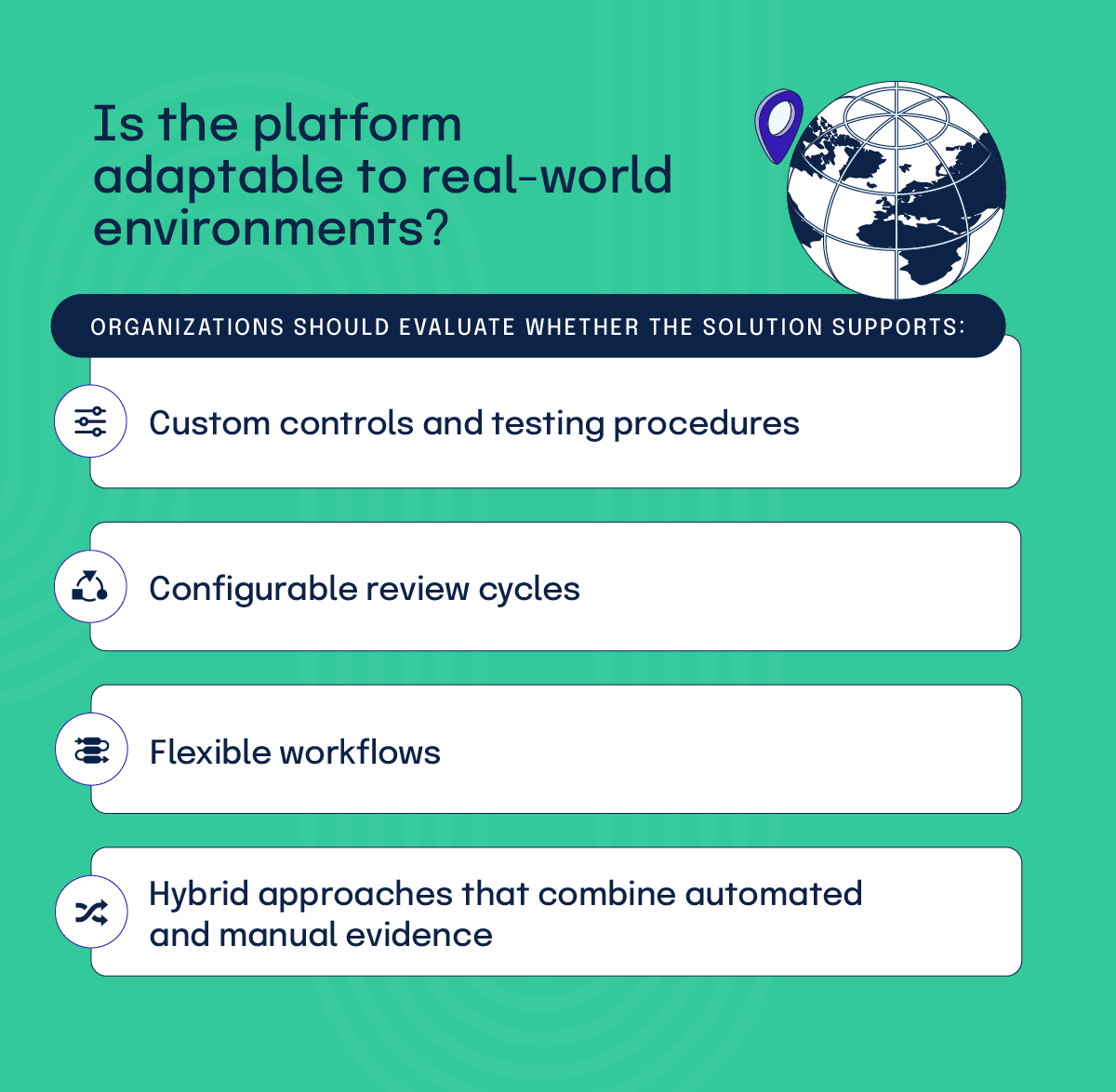
Organizations should evaluate whether the solution supports:
Adaptability ensures longevity. As regulations evolve and business models change, the GRC system should evolve alongside them.
Hyperproof’s Hierarchical Scopes capability was designed specifically to address this complexity. Hierarchical Scopes allow organizations to structure their GRC program in a way that mirrors how the business actually operates.
With Hierarchical Scopes, teams can:
This balance between centralization and flexibility is critical as organizations scale. Rather than duplicating programs for each entity or forcing a one-size-fits-all model, Hyperproof enables structured variation within a governed framework.
Does it provide meaningful insight or just data aggregation?
Collecting evidence is only the first step. The ultimate goal is assurance and confidence that controls are functioning and risks are managed.
Some tools focus heavily on data ingestion but offer limited analytical capability. They store artifacts but provide little context about performance trends, recurring issues or emerging risks.
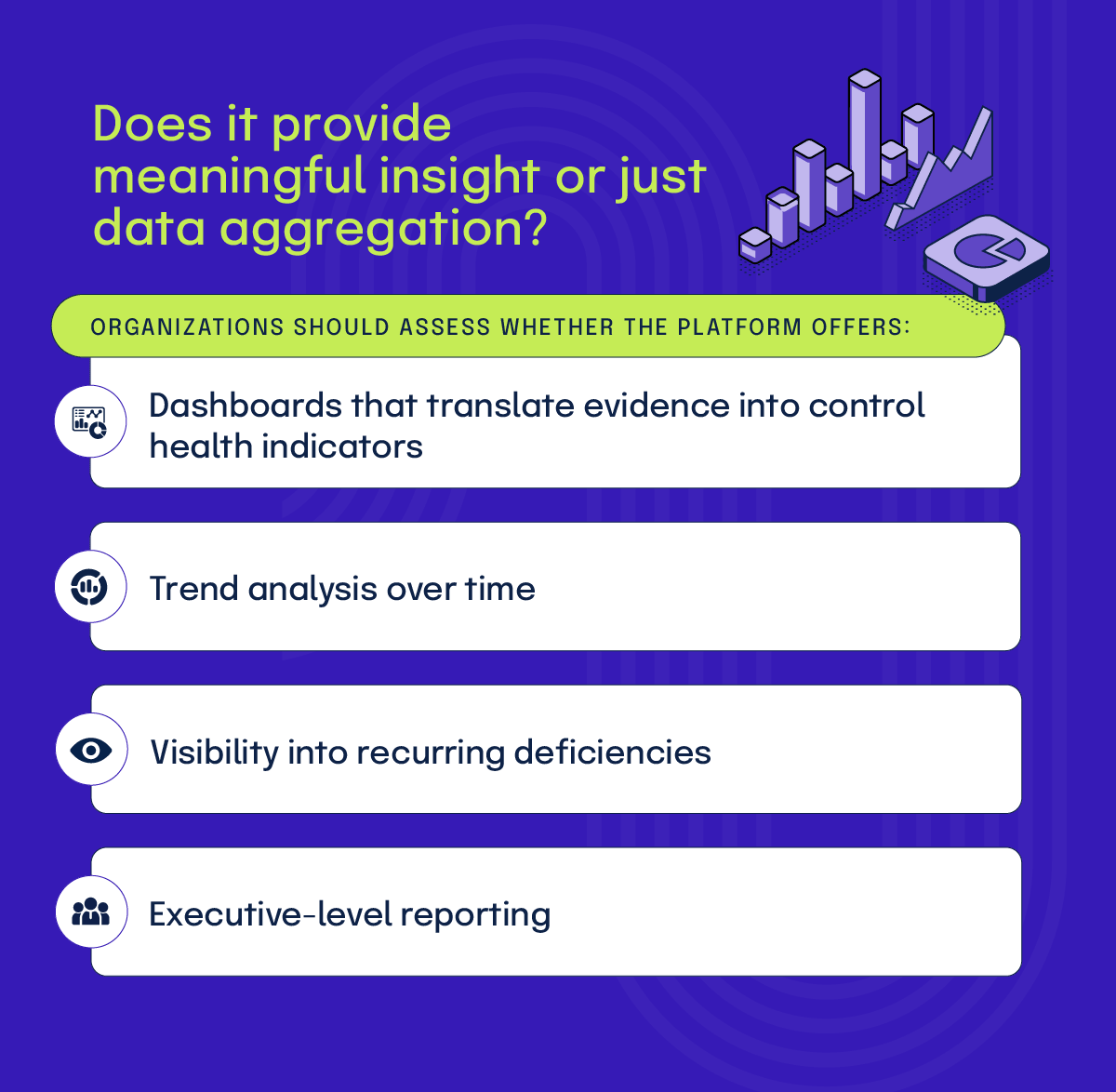
Organizations should assess whether the platform offers:
Automation should empower leaders with insight, not overwhelm them with raw data.
Hyperproof’s reporting capabilities are designed to turn compliance data into actionable insight. Because risks, controls, policies, evidence, tasks, and frameworks are connected within a unified platform, reporting is not limited to static artifact lists. Leaders can view control performance dashboards, track remediation progress, monitor framework readiness, and generate audit-ready reports without manually stitching together data from multiple systems.
This allows compliance and security teams to move beyond reactive reporting. Instead of preparing last-minute audit summaries, they can provide continuous, real-time visibility into the organization’s risk posture.
How transparent is the vendor about implementation and support?
The success of automated evidence collection depends not only on the technology itself, but also on implementation. Integrations must be configured properly, control mappings must align with internal frameworks, and users must understand workflows.
Vendors should be transparent about:
Overpromising speed and simplicity can create disappointment later. Organizations benefit from partners who acknowledge complexity and provide structured guidance.
A solution that appears simple in a demonstration may require significant internal effort if not supported effectively.
Hyperproof’s implementation and Customer Success approach is a meaningful differentiator in this area. Rather than offering a “set it and forget it” deployment, Hyperproof provides structured onboarding led by experienced GRC practitioners who understand compliance frameworks, control mapping, and real-world operational constraints.
Customers receive:
This hands-on model helps organizations avoid common pitfalls, accelerate time to value, and build a scalable foundation for long-term GRC maturity.
When evaluating automated evidence collection solutions, leaders should look beyond product functionality and ask: Who will help us implement this successfully? Transparency about implementation effort — paired with structured, expert guidance — is often what separates a successful GRC transformation from a stalled deployment.
Hyperproof was recently recognized by Software Advice for Best Customer Support in Risk Management

Will it strengthen trust internally and externally?
Ultimately, automated evidence collection exists to build trust.
Internally, executives want confidence that compliance programs are functioning effectively. Security leaders want assurance that controls operate as intended. Board members expect visibility into risk posture.
Externally, customers and regulators expect transparency and accountability.
The right solution should strengthen that trust by delivering reliable, accessible, and defensible evidence.
It should help organizations move from reactive explanations to proactive demonstrations of control effectiveness.
When evaluating vendors, leaders should consider not only operational efficiency but also credibility. Does the solution produce outputs that auditors respect? Does it support defensible documentation and clear audit trails?
Automation should enhance the integrity of the compliance program, not merely accelerate it.
Can it support your company’s evolution in your GRC maturity?
GRC is not static. What begins as a tactical effort to pass a single audit often evolves into a strategic, organization-wide discipline that informs executive decision-making, risk prioritization, and long-term resilience.
In early stages, teams may focus on documenting controls, collecting evidence manually, and preparing for one framework such as SOC 2Ⓡ. But as the business grows, expectations expand. New regulations emerge. Customers demand stronger assurances. Boards expect visibility into enterprise risk. Compliance shifts from reactive validation to continuous oversight.
A solution that works at an early stage may not support this evolution.
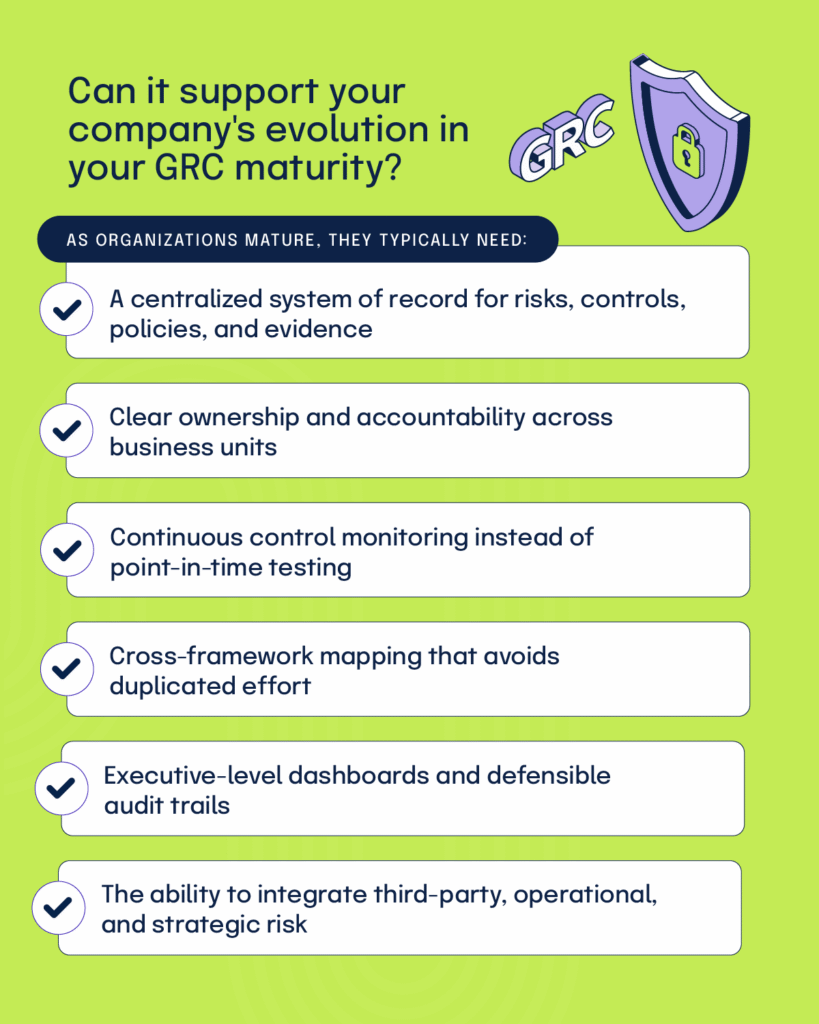
As organizations mature, they typically need:
Automation should not just make audits easier. It should help formalize and elevate your entire GRC program.
Platforms like Hyperproof are built to grow alongside organizations. Teams can begin by automating evidence collection for a single framework and progressively expand into unified control management, policy governance, third-party risk management, and enterprise-wide reporting — all within the same connected system.
When evaluating solutions, leaders should ask a critical question: Will this tool support where our GRC program is going, or only where it is today?
True value comes from choosing a platform that enables maturity — not one that must be replaced once maturity is achieved.
Want to evaluate your GRC maturity?

Can it help manage policies and governance?
Evidence collection is only one piece of effective governance. Controls are derived from policies, and evidence demonstrates that those policies are operating as intended. If policy management lives in a separate system — or worse, in shared drives and email threads — governance becomes fragmented and difficult to defend.
As GRC programs mature, policy management must become structured, traceable, and integrated into day-to-day operations.
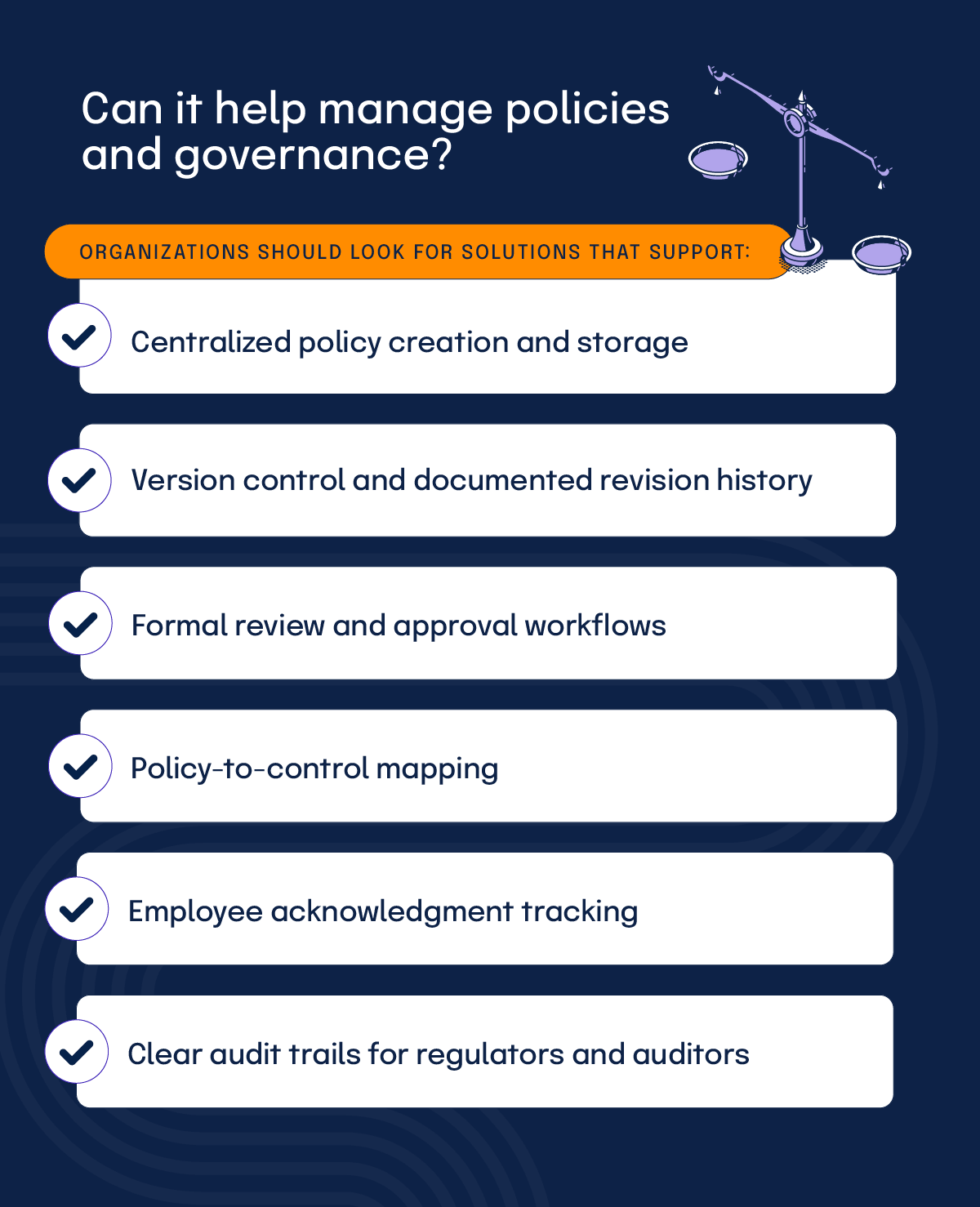
Organizations should look for solutions that support:
Without this foundation, there is often a disconnect between what the organization says it does (policy) and what it can prove (evidence).
With Hyperproof’s policy management capabilities — including enhancements introduced in its recent policy management release — organizations can manage the full policy lifecycle within the same platform used for controls and automated evidence collection. Policies can be mapped directly to controls and frameworks, approvals can be tracked through configurable workflows, and acknowledgment records are maintained in a defensible, audit-ready format.
This creates end-to-end traceability: from policy to control to evidence to reporting.
When evaluating automated evidence collection solutions, leaders should ask whether the platform strengthens governance holistically — or whether it leaves policy management disconnected from the rest of the GRC ecosystem. True maturity requires alignment between documented intent and operational proof.
Can it help streamline my third-party risk management processes?
Third-party risk management (TPRM) has become one of the most resource-intensive areas of modern GRC programs. Vendors, service providers, and strategic partners can introduce security, operational, privacy, and regulatory risk — yet oversight of those risks is often fragmented.
Many organizations still manage vendor assessments in spreadsheets, store documentation in shared drives, and track remediation through email threads. Meanwhile, internal evidence collection lives in a separate system. The result is duplication, limited visibility, and inconsistent follow-through.
When evaluating automated evidence collection solutions, leaders should consider whether the platform also supports third-party risk workflows in a connected way.
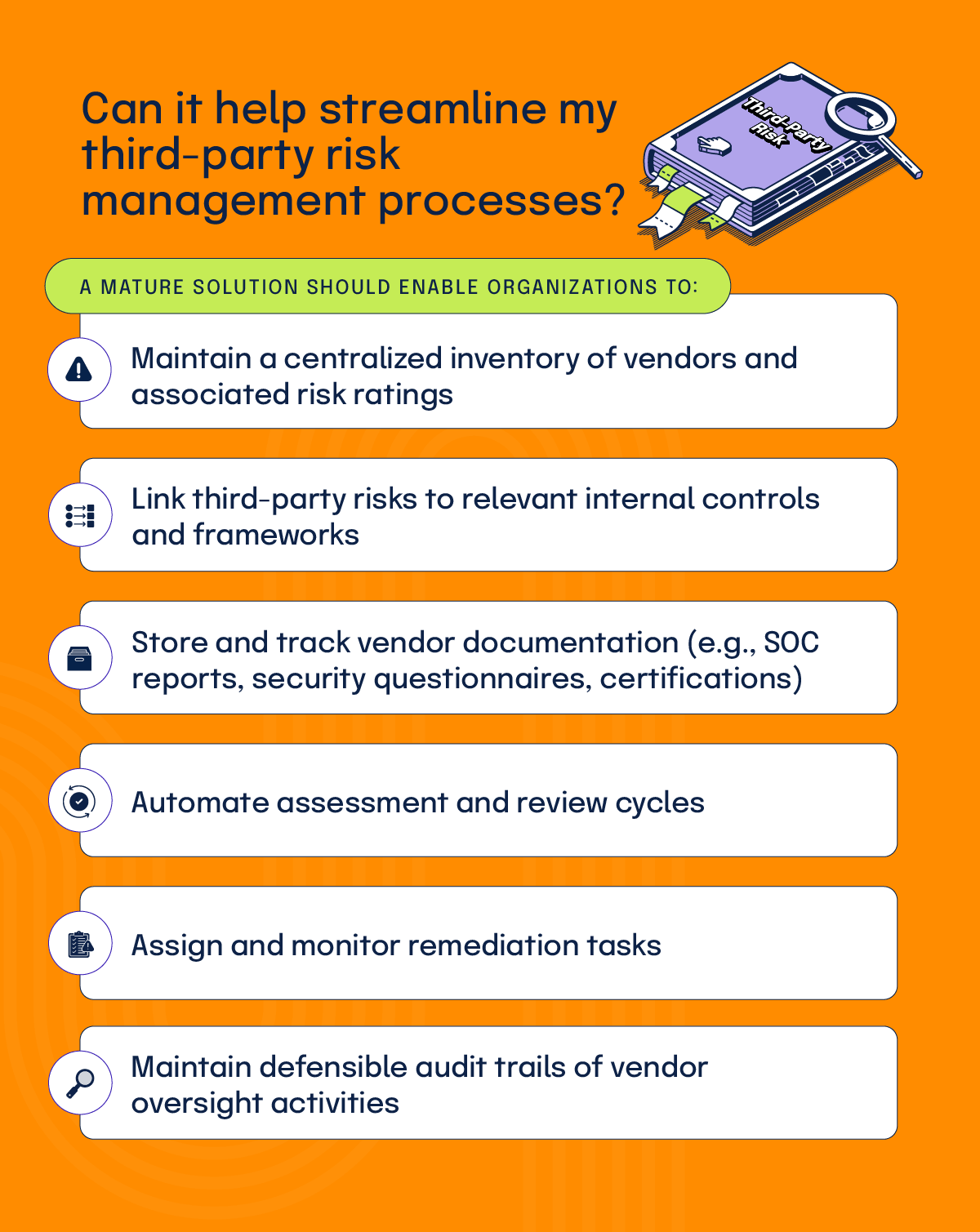
A mature solution should enable organizations to:
Third-party risk does not exist independently from internal controls. Vendor failures can directly impact compliance posture, operational resilience, and customer trust. A disconnected approach creates blind spots.
Hyperproof streamlines third-party risk management by bringing vendor oversight into the same platform used for risk registers, controls, policies, and evidence collection. This unified model allows organizations to see how third-party risks intersect with regulatory obligations and internal control performance — reducing silos and strengthening oversight.
When considering automation tools, the key question is not simply whether they can store vendor documentation. It’s whether they help you operationalize third-party risk management as part of a cohesive, risk-driven GRC strategy.
Looking beyond the feature checklist
In a crowded market, it is tempting to compare vendors based on the number of integrations they advertise or the speed of their connectors.
These metrics matter, but they do not tell the full story.
The deeper questions involve architecture, security, scalability, and strategic alignment.
Organizations should ask whether the solution:
In a crowded market, the right choice is not the loudest or the fastest. It is the one that strengthens the entire compliance ecosystem.
When automation aligns with strategy, security, and scalability, it becomes more than a time saver. It becomes a catalyst for program maturity.
And in today’s regulatory environment, maturity is the real differentiator.
See Hyperproof in Action
Related Resources


Ready to see Hyperproof in action?