Top 5 Takeaways from the 2026 IT Risk and Compliance Benchmark Report

Updated on: Feb 26, 2026 9 Minute Read
Every year, Hyperproof conducts an in-depth survey of GRC and cybersecurity professionals to capture how risk and compliance programs are actually operating across industries. The 2026 IT Risk and Compliance Benchmark Report is based on 1,002 responses collected in November and December of 2025, with respondents spanning technology, manufacturing, healthcare, financial services, and other industries. The technology industry represented the largest share of respondents at close to 50%.
The findings this year show that organizations are investing seriously in maturing GRC programs while still working through the operational realities of scaling them. Budgets are growing, AI adoption has reached near-universal levels, and centralized GRC is becoming the norm.
At the same time, the data shows that structure and investment alone do not determine outcomes. How programs are built and operated matters just as much.
Here are the five findings that stood out most from this year’s data.
1. 97% of GRC teams are using AI in their day-to-day workflows
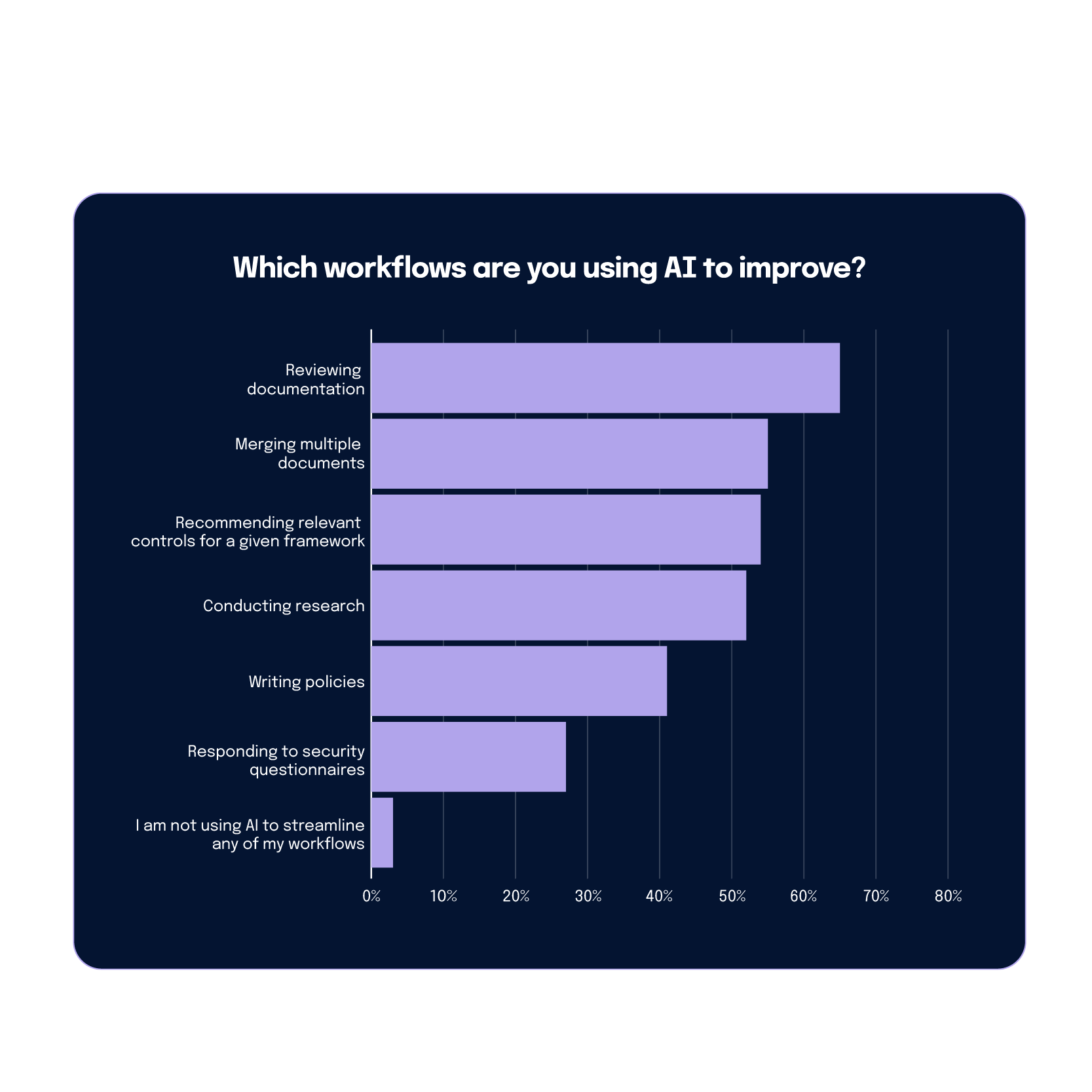
GRC teams have embraced AI at scale, with 97% reporting active use across their workflows. The adoption is highest in the areas that have always carried the most manual weight, such as reviewing documentation, merging content across sources, researching requirements, and normalizing inputs across frameworks. These are the tasks that eat hours without moving the program forward, and AI is giving teams meaningful time back on all of them.
Where the data gets more interesting is at the platform level. When AI is embedded directly into a GRC platform rather than used as a standalone tool, it works across controls, evidence, and assessments as a connected system. The whole program becomes more consistent and traceable, not just the individual tasks that happen to touch AI. That distinction matters because most teams are still at the standalone stage, which means most are leaving the bigger gains on the table.
The clearest example of that gap is the security questionnaire response. Only 27% of respondents are using AI there, even though questionnaire workload consistently ranks among the most cited pain points in GRC work. The potential is real, and the tools exist. Most organizations have not made that connection yet.
2. 50% of respondents who manage risk ad hoc experienced a breach in 2025
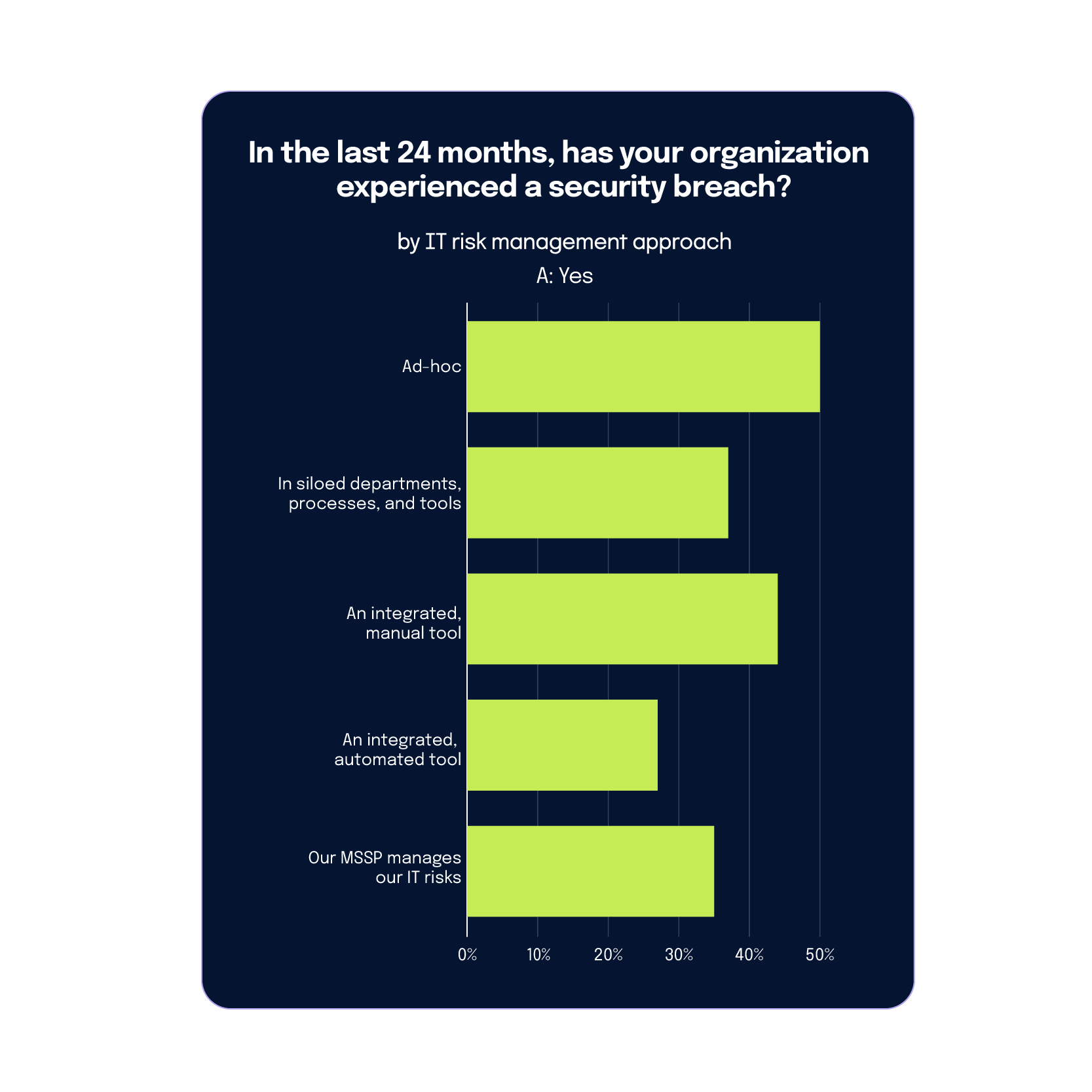
This year’s benchmark makes the stakes of how organizations choose to run their GRC programs concrete. 50% of respondents managing risk ad hoc experienced a breach in 2025, compared to 27% among those with an integrated, automated approach. This gap has appeared consistently across the last three years of Hyperproof’s benchmark research, which makes it one of the more durable findings in the dataset.
The difference comes down to what each approach enables in practice. Ad-hoc risk management tends to activate after something has already gone wrong, and a few things break down as a result:
An integrated, automated approach changes that dynamic. When risk management is connected to compliance operations, controls, and evidence in a single system, teams have a clearer picture of where gaps exist before they become problems. The result is a program that is harder to catch off guard. For context on what a breach actually costs, one in four respondents reported costs of $5M or more.
For organizations still managing risk reactively or across disconnected tools and spreadsheets, this finding is a practical argument for re-evaluating that operating model. The breach rate difference is significant enough that it moves the conversation from a best practice discussion to a risk outcome discussion.
3. 58% of organizations that experienced a breach anticipate spending more time on IT risk management in 2026
A breach does not end when the incident is contained. Among organizations that experienced a security breach, 58% anticipate spending more time on IT risk management and compliance in 2026, compared to only 37% of those who did not experience a breach. The workload expands well beyond immediate response.
The compounding effect is what makes this finding particularly relevant for teams already operating under capacity pressure. The report shows that 76% of respondents spend 30% or more of their time on repetitive administrative tasks.
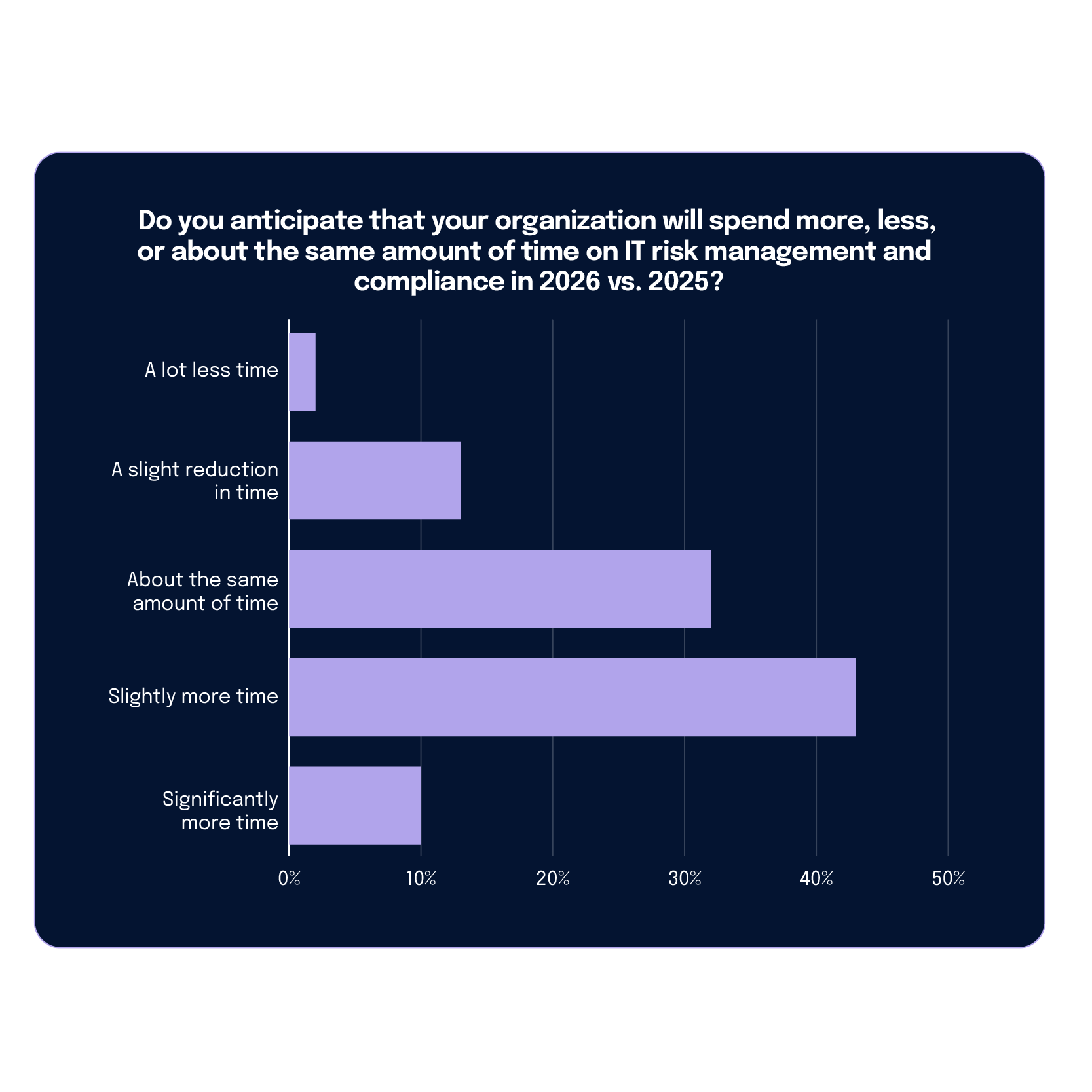
For teams already stretched thin, absorbing a meaningful post-breach workload increase puts pressure on everything else the program is trying to deliver.
4. 56% of respondents use a common controls framework to streamline GRC processes
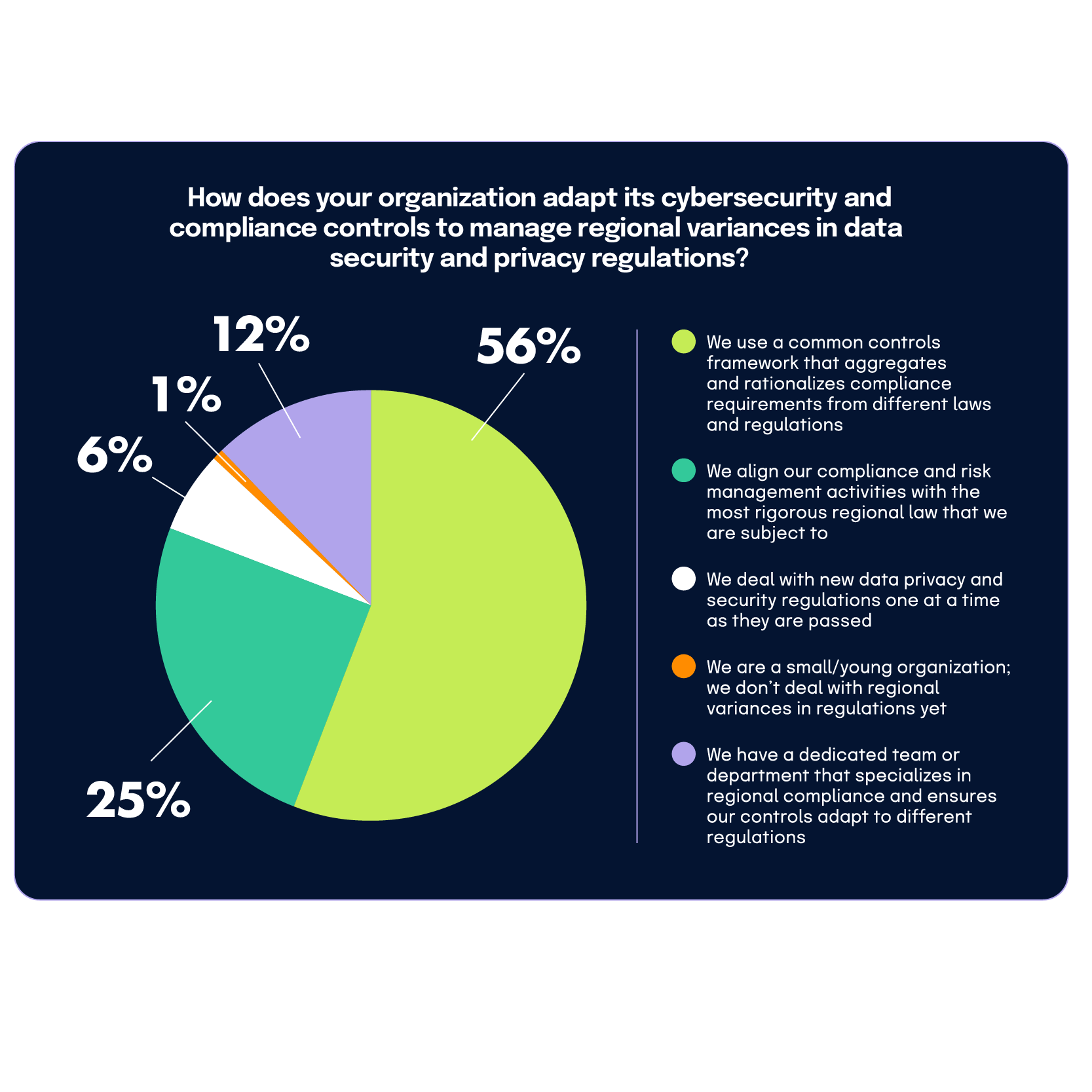
More than half of respondents now use a common controls framework to manage regional and regulatory variation, making it the most widely adopted strategy for handling compliance complexity at scale. Only 25% of organizations default to aligning with the most rigorous applicable law and applying it uniformly, while the rest handle requirements on a case-by-case basis.
The shift toward common controls frameworks reflects a practical reality that many GRC teams have learned the hard way. As organizations operate across more jurisdictions, add more frameworks, and face more frequent regulatory changes, managing each requirement independently becomes unsustainable.
A common controls framework turns that complexity into a single internal standard that teams can implement, monitor, and evidence consistently regardless of geography or framework.
The report also shows that centralized programs are substantially more likely to adopt this approach. For organizations still handling regulatory variation through one-off interpretations or by defaulting to the strictest applicable standard across the board, the data suggests there is a more scalable path. The majority of peers have already found it.
5. 86% of respondents have a centralized team to manage GRC
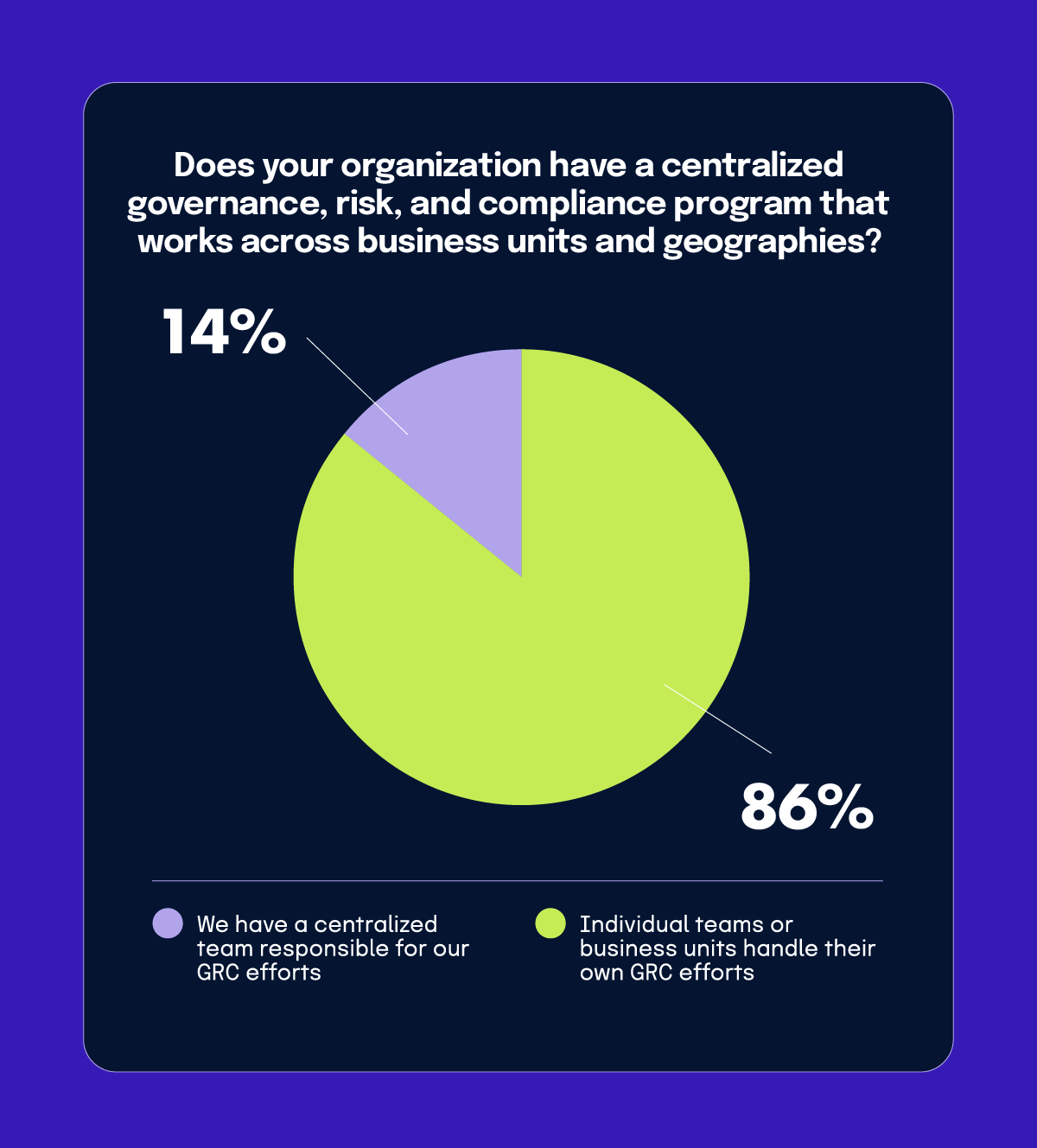
Centralizing GRC activities has become the dominant operating model, with 86% of organizations now reporting a dedicated centralized team responsible for governance, risk, and compliance. Only 14% still manage GRC through individual teams or business units, making distributed ownership the exception.
The report is clear that centralization alone does not guarantee better outcomes. What it does is create the conditions for consistency: shared standards for controls, evidence, and reporting that are harder to establish when accountability is fragmented across the organization.
Programs that pair centralization with integrated tooling and standardized workflows are the ones best positioned to scale readiness without scaling administrative overhead alongside it.
Next steps for GRC and cybersecurity professionals
The 2026 benchmark data points to a clear direction for teams looking to strengthen their programs this year. The organizations performing best are not necessarily the largest or the best funded. They are the ones that have made deliberate choices about how they structure, operate, and tool their GRC programs. Here is where to focus.
Treat AI adoption as a platform decision
With 97% of teams now using AI in some form, the competitive question has shifted. The organizations getting the most out of AI are the ones that have it embedded in their GRC workflows, working across controls, evidence, and assessments as a connected system.
If your current AI usage is limited to standalone tools or individual productivity, it is worth asking what it would take to bring that intelligence closer to where the actual compliance work happens. A centralized GRC platform is what makes that possible, because it gives AI a unified data layer to work from.
Evaluate your risk management operating model honestly
The breach rate gap between ad-hoc and integrated approaches is too significant to ignore. If your team is still managing risk reactively, or across disconnected spreadsheets and point tools, that is the highest-leverage place to start.
Map out how risk identification, assessment, remediation tracking, and control monitoring actually flow today, and identify where the handoffs break down. The goal is not a perfect system overnight but a clear-eyed view of where fragmentation is creating exposure.
Build pre-breach readiness into your operating model
The post-breach workload data is a useful forcing function. Ask whether your program could absorb a significant demand increase without breaking. Building that kind of readiness usually comes down to a few operational shifts.
Standardize how your program handles regulatory complexity
If your team is still managing regional and framework variation through one-off interpretations, a common controls framework is worth serious consideration. The majority of peers have already made that shift, and the operational benefits compound over time.
The programs that execute this well consistently point to one enabling condition, which is a platform that supports control mapping, evidence reuse, and change management across frameworks in one place.
Strengthen the connection between centralization and execution
Having a centralized GRC team has quickly become the norm, but centralization alone does not guarantee consistent outcomes. The differentiator is whether centralized ownership translates into standardized workflows across the business.
If your centralized team is still spending significant time chasing evidence from distributed stakeholders, that is a process and tooling problem worth addressing directly.
A few operational changes tend to move the needle most.
Align third-party risk management with how your vendor ecosystem actually operates
Third-party risk is no longer a periodic checkpoint. As vendor ecosystems grow and AI-enabled suppliers become more common, programs that rely on annual questionnaires and document-based assessments are falling behind the pace of change. The shift toward continuous monitoring and structured reassessment cadence is already underway among more mature programs.
Building the workflows and tooling to support that shift now puts your program ahead of where regulatory and customer expectations are heading.
The 2026 benchmark covers a lot more ground than these five findings. There is a detailed analysis on third-party risk management, framework adoption, budget and resourcing trends, and how operating model choices play out differently across industries and company sizes. The data is broken down in ways that make it easier to find what is relevant to your specific program, whether that is your industry, your team size, or how you currently manage risk.
If you are trying to understand where your program stands relative to peers, make the case internally for where to invest next, or simply get a clearer picture of where the market is heading, the full report is worth spending time with. It is available now at no cost.
Related Resources
Ready to see Hyperproof in action?