Why Control Health is the Backbone of Continuous Compliance

Updated on: Jan 15, 2026 6 Minute Read
If you’re running a compliance program, you already know controls are the unsung heroes. They quietly keep everything in check, linking to requirements, managing risk, capturing proof, and making sure you’re not scrambling right before an audit. The reality is, a control is only as effective as its overall health.
In Hyperproof, “control health” isn’t just a buzzword. It’s a central metric that tells you whether or not your compliance program is thriving. If you get it right, you move closer to what we call continuous compliance, where staying compliant becomes a steady rhythm instead of a mad dash.
What makes a control healthy?
When program health is turned on in Hyperproof, each control’s status is automatically calculated against five criteria:
- Testing
- Implementation
- Freshness
- Proof
- Past due issues
We’ll discuss what these five criteria mean in-depth later. A healthy control ticks all of those boxes. If even one criterion isn’t met, a control’s health status will drop to At Risk or Critical.
Control health statuses
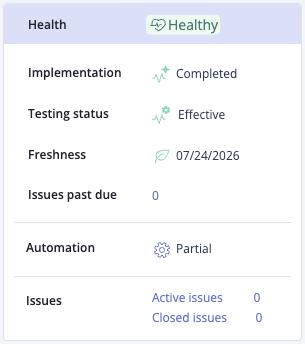
Hyperproof has three control health statuses:
Critical
Testing proved ineffective and the implementation status is set to either Unknown, Not Started, or In Progress
At risk
Testing proved ineffective and the implementation status is set to either Unknown, Not Started, or In Progress
Healthy
Testing proved ineffective and the implementation status is set to either Unknown, Not Started, or In Progress
Testing: Is the control effective?
Testing isn’t just a checkbox — it’s how you find weaknesses before they cause harm. In Hyperproof, you can test controls manually or automate the process with Hypersyncs. Automation means the system can pull in fresh data, run it through logical tests (think VLOOKUPs, IF statements, etc.), and alert you when something is off.
When you standardize your approach to continuous compliance testing, you turn these individual control checks into a repeatable system that keeps audit readiness and risk visibility high year-round.
Example: If you have a password policy requiring 10+ characters, an automated test with a linked Hypersync can automatically check proof to confirm it. Failures trigger alerts via email, Slack, or Teams, so you can fix the issue before it escalates.
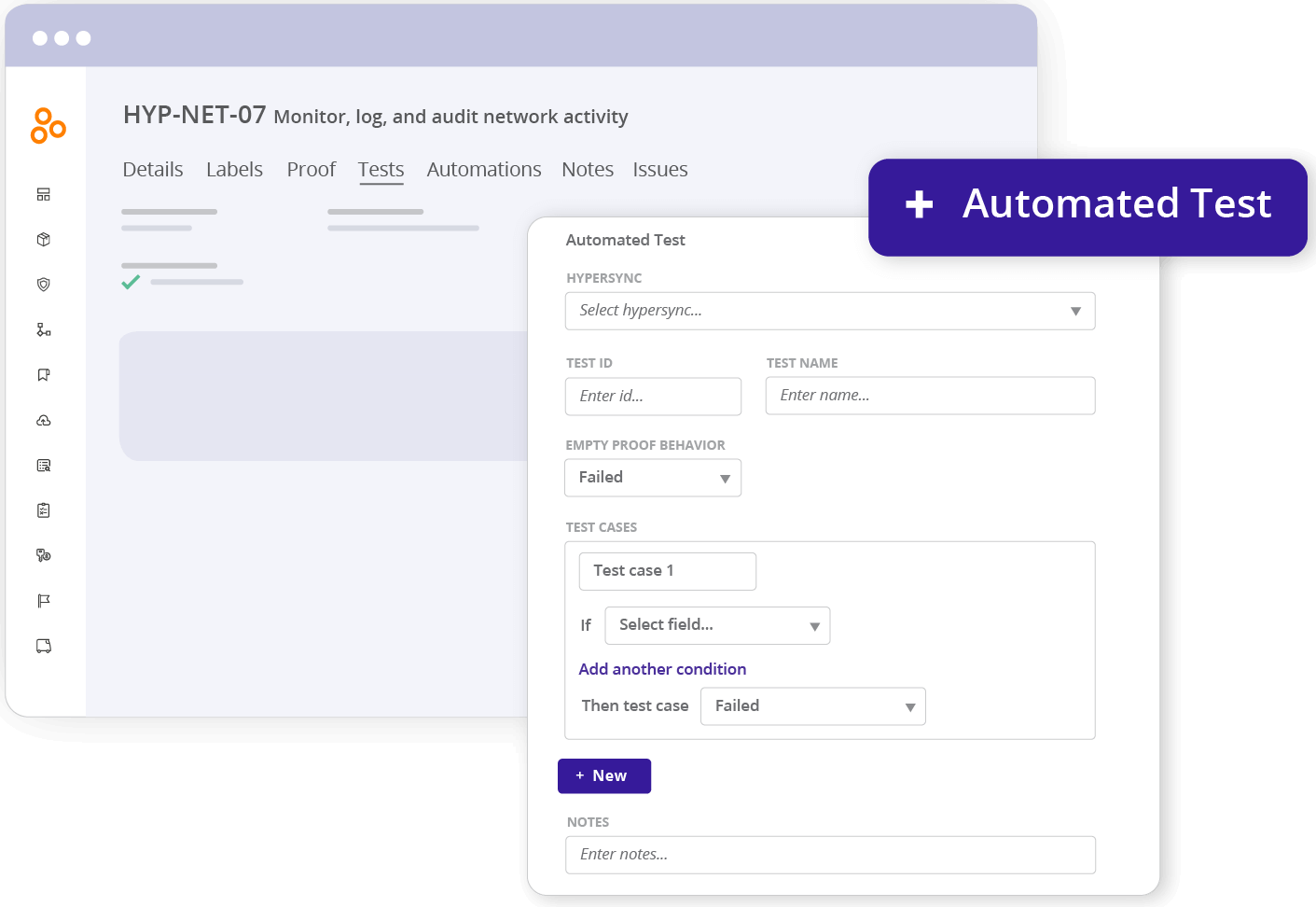
To use automated control testing:
- Select the control you want to test.
- Configure a Hypersync for the control to collect proof.
- Review the proof to determine what needs to be tested.
- Configure a test to verify that the proof collected meets the criteria for the control.
Implementation: Is your control actually in place?
A control that’s Not Started or In Progress remains in the planning or development phase and is not yet providing effective protection. Implementation status matters because a half-built control won’t protect your organization from a breach. Hyperproof makes it obvious where you stand.
Tip: Treat preventative, technical, operational, and detective controls differently. Each has its role—whether it’s stopping bad actors, detecting errors, or enforcing day-to-day safeguards.
Freshness: Have you recently reviewed control freshness?
Think of freshness like a use-by date for your controls. When it expires, you review and decide if updates are needed. This could be as simple as confirming proof is still valid or as deep as rewriting control language. Either way, it keeps your compliance program from quietly drifting out of date.
To use freshness:
- Enable freshness for one or more controls.
- Review the proof linked to the controls. If the proof is up-to-date, mark the controls as Fresh and set an expiration date.
- Use the Needs Attention panel on the program dashboard to watch for controls that are expired or close to expiring.
Proof: Do you have evidence to validate that your control is operating as intended?
You can say you’re compliant all day, but without proof, you’re just hoping your auditor takes your word for it. Hyperproof streamlines collecting and reusing proof, whether that’s logs, screenshots, or third-party reports. If you’re working across multiple frameworks, you can link the same proof to different controls so you’re not doubling your workload.
Hyperproof offers several methods for ensuring that your proof is up-to-date:
Past due issues: Are there any open and overdue issues?
One overdue issue can sink a control’s health rating. That’s why Hyperproof recommends linking tasks to every issue so remediation work gets assigned, tracked, and closed on time.
Basic control management
Beyond keeping your controls healthy, it’s a good idea to also:
Additional steps to take
Keeping controls healthy is the main goal, but taking a few extra steps can make your entire program stronger.
Reuse controls across multiple frameworks
If you manage multiple compliance frameworks, odds are you’ve got overlapping controls. Hyperproof lets you manage controls in one program and reuse them in another. That means updates, proof, and testing flow through everywhere they’re linked without duplicate effort.
Link controls to requirements
Controls are what make sure your compliance requirements are met. With Hyperproof’s illustrative controls, many are pre-linked, but you can add or remove links anytime. You can also customize controls to document exactly how you meet each requirement.
Add the right people
Every control needs an owner, but you can bring in more team members to share the work. Assign tasks, track progress, and set permission levels so only the right people can make edits.
From reactive to continuous compliance
Control health isn’t a “once-a-year” effort. It’s the heartbeat of continuous compliance. When controls are maintained, linked to requirements, and reviewed on a schedule, you avoid last-minute chaos and reduce the amount of time spent on audit prep. More importantly, you reduce the risk of security and compliance lapses because you’re fixing issues in real time, not after the fact.
The takeaway? Healthy controls equal a healthy program. And a healthy program means you can stop firefighting and start operating with confidence.
Related Resources
Ready to see Hyperproof in action?