Why You Need a GRC Platform

Updated on: Dec 4, 2025 9 Minute Read
Let’s be honest, governance, risk, and compliance (GRC) isn’t getting easier. It’s becoming increasingly complex and challenging to manage. The volume of regulations, the complexity of digital systems, and the speed at which AI is changing how we work all make yesterday’s spreadsheets and manual tracking processes feel useless.
If you’re leading risk, security, or compliance efforts at your organization, you already know this. You’ve felt the pain of reconciling evidence across systems, managing an endless number of vendors, and getting a dozen stakeholders to sign off on one policy.
This is exactly why a GRC platform is not just another line item. It’s how modern organizations are adapting and able to scale trust, compliance, and risk management.
The problem no one wants to talk about
Most organizations already have some sort of GRC process. It’s just not unified, automated, or all that efficient. It might live across Excel sheets, shared drives, Jira tickets, and one (stressed-out) compliance manager’s head.
Which works until it doesn’t.
As businesses mature and risks diversify, suddenly you’re dealing with more vendors, more data, more audits, and more scrutiny. Manual processes can’t keep up with digital ecosystems that change daily.
A GRC platform provides the infrastructure to scale compliance and risk management efficiently by automating evidence collection, mapping controls across frameworks, and maintaining continuous audit readiness instead of a seasonal approach.
Here’s what a GRC platform does differently:
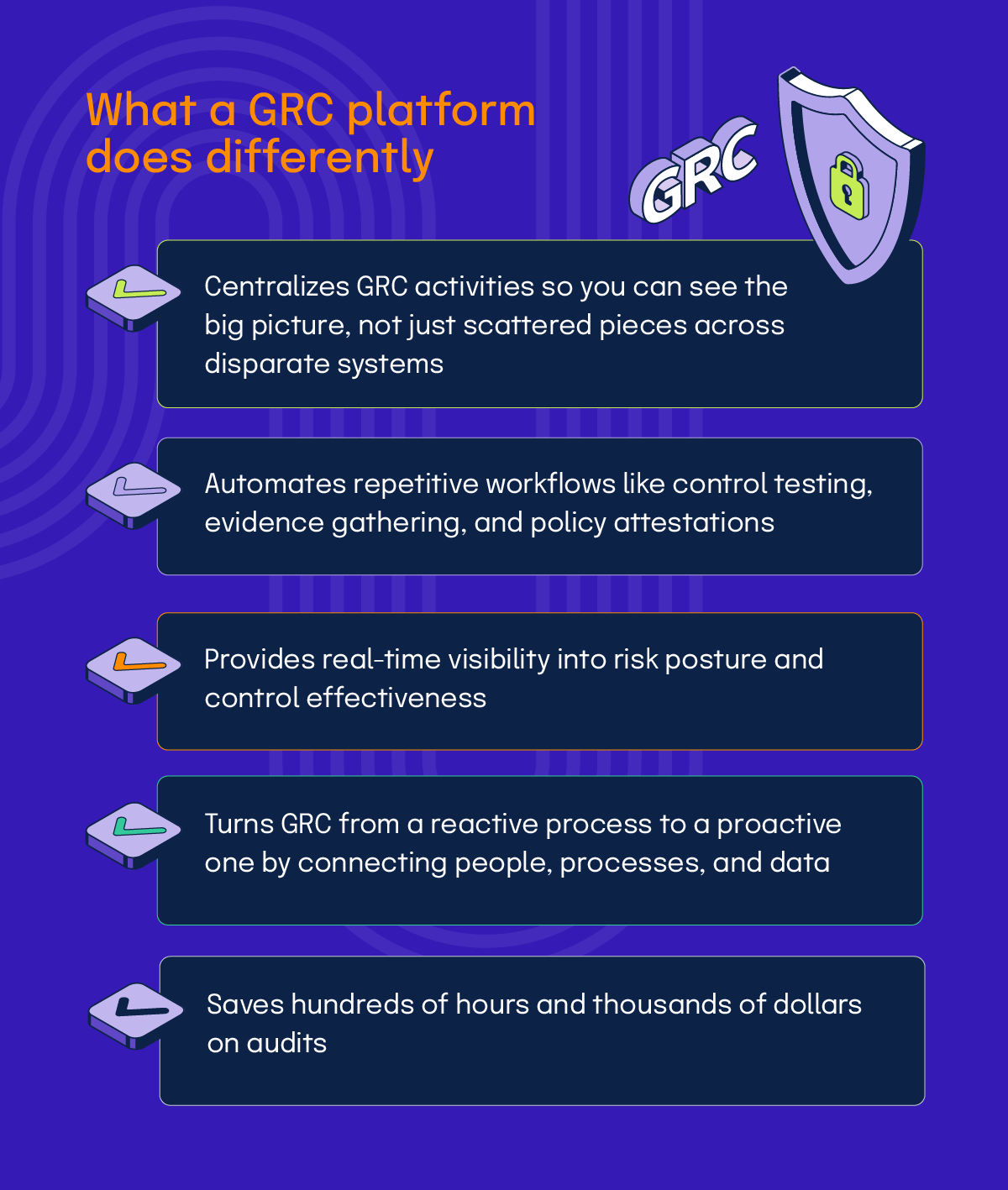
The difference between GRC being a cost center and GRC being a growth engine comes down to the platform.
Why GRC platforms are essential
Several factors have led to a massive shift in the GRC industry over a short period. Here’s what’s shifted and why it matters:
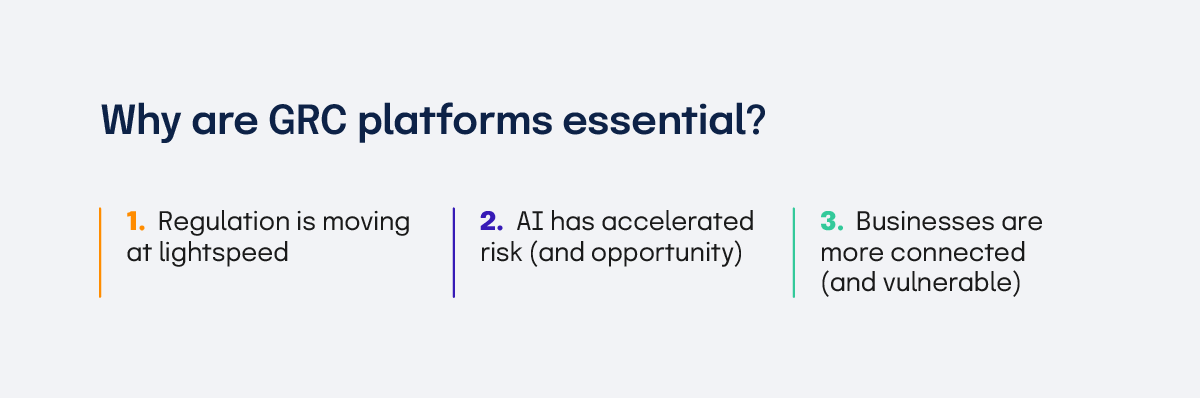
1. Regulation is moving at lightspeed
New cybersecurity, privacy, and AI regulations are emerging faster than most teams can track. The SEC’s cyber disclosure rules, the EU AI Act, and global data protection frameworks like GDPR have raised the bar for compliance accountability.
It’s no longer enough to “be compliant once.” You must demonstrate continuous compliance through evidence, documentation, and demonstrable control operations. A GRC platform lets you automate that proof, eliminating manual work for the team.
2. AI has accelerated risk (and opportunity)
AI is the new frontier for both innovation and exposure. From data governance to model bias, AI introduces new risks that require ongoing monitoring and structured governance. This led to the rise of AI risk-management frameworks, which have created additional work for GRC leaders who must both adopt new AI tools and demonstrate they are managing AI responsibly.
Modern GRC software will track those AI risks and help you comply with AI risk management frameworks. On the other hand, it should also come equipped with AI to enhance your own efficiency by spotting control gaps, automating documentation, and surfacing trends before they become issues.
3. Businesses are more connected (and vulnerable)
Third-party ecosystems are now extensions of your risk surface. Vendor risk, data flow, and operational interdependence mean a single supplier’s security lapse can impact your entire compliance posture. GRC platforms integrate vendor management, linking risk scoring, due diligence, and continuous monitoring in a single platform.
The budget question: Is the spend justified?
Let’s talk about budgets.
A GRC platform might not be in your current budget (yet). But the ROI is undeniable once you look beyond the estimate and focus on what it replaces:
But how can you tie GRC to revenue?
Strong GRC is a revenue-enabler, not a cost center, but how can you prove it to leadership?
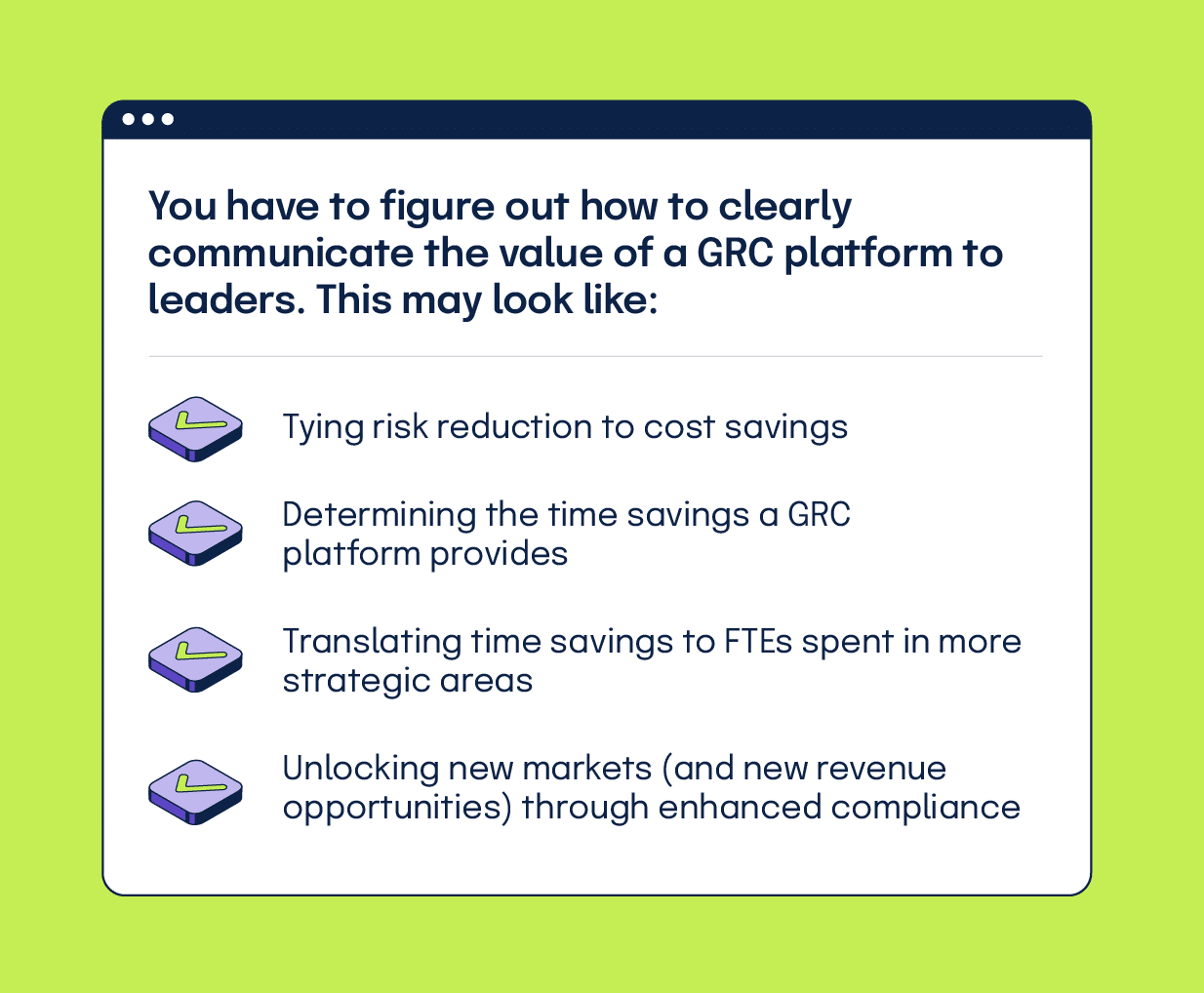
In short, you have to figure out how to clearly communicate the value of a GRC platform to leaders. This may look like:
For more detailed insights, read our guide on how to tie GRC efforts to revenue.
How a GRC platform supports company objectives
Your company is likely looking to:
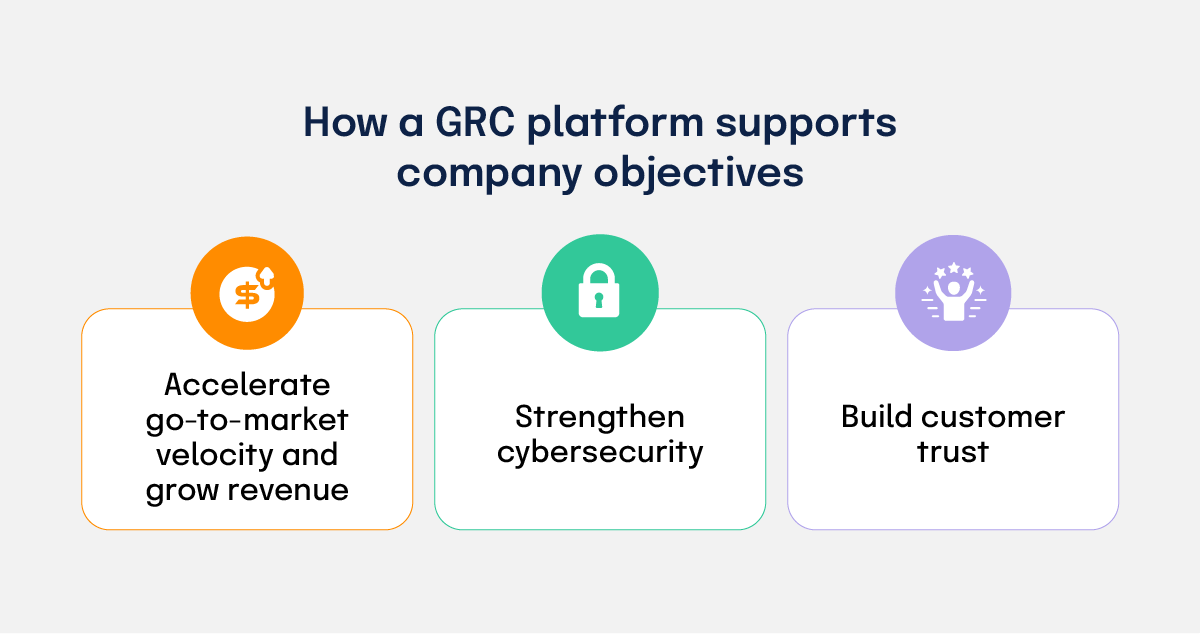
A GRC platform contributes to each of those. Here’s how:
Accelerate go-to-market velocity and grow revenue
As your organization expands into new markets or product lines, the complexity of compliance grows. You can’t ship products faster if compliance holds up release cycles. A GRC platform lets you replicate success by scaling frameworks, automating new audits, and integrating additional teams without reinventing the wheel.
Wondering just how much a GRC platform can save you? Calculate your ROI >
Strengthen cybersecurity
GRC software unites risk, controls, and compliance data. That means security and compliance teams work from a shared source of truth and can map technical controls to frameworks like ISO 27001 or SOC 2Ⓡ to close the loop on findings faster.
Build customer trust
Customers, partners, and investors increasingly demand proof of security and compliance. A GRC platform makes that transparency easy with evidence collection and documentation.
How urgently do you need a GRC platform?
The short answer: probably yesterday.
The longer answer depends on your organization’s current risk exposure. If you’re preparing for your first SOC 2Ⓡ, ISO 27001, or GDPR audit, expanding your vendor ecosystem, or managing compliance for AI-related regulations, then urgency is a strategic consideration.
The earlier you implement a GRC platform, the faster you can mature your risk posture and operationalize compliance across departments. Waiting until “the next audit” is like installing a sprinkler system after the fire.
The role of AI in making a GRC platform decision
AI is reshaping business models and redefining industries. Modern GRC platforms use AI to make compliance smarter, faster, and more predictive. Some of the most valuable capabilities emerging now include:
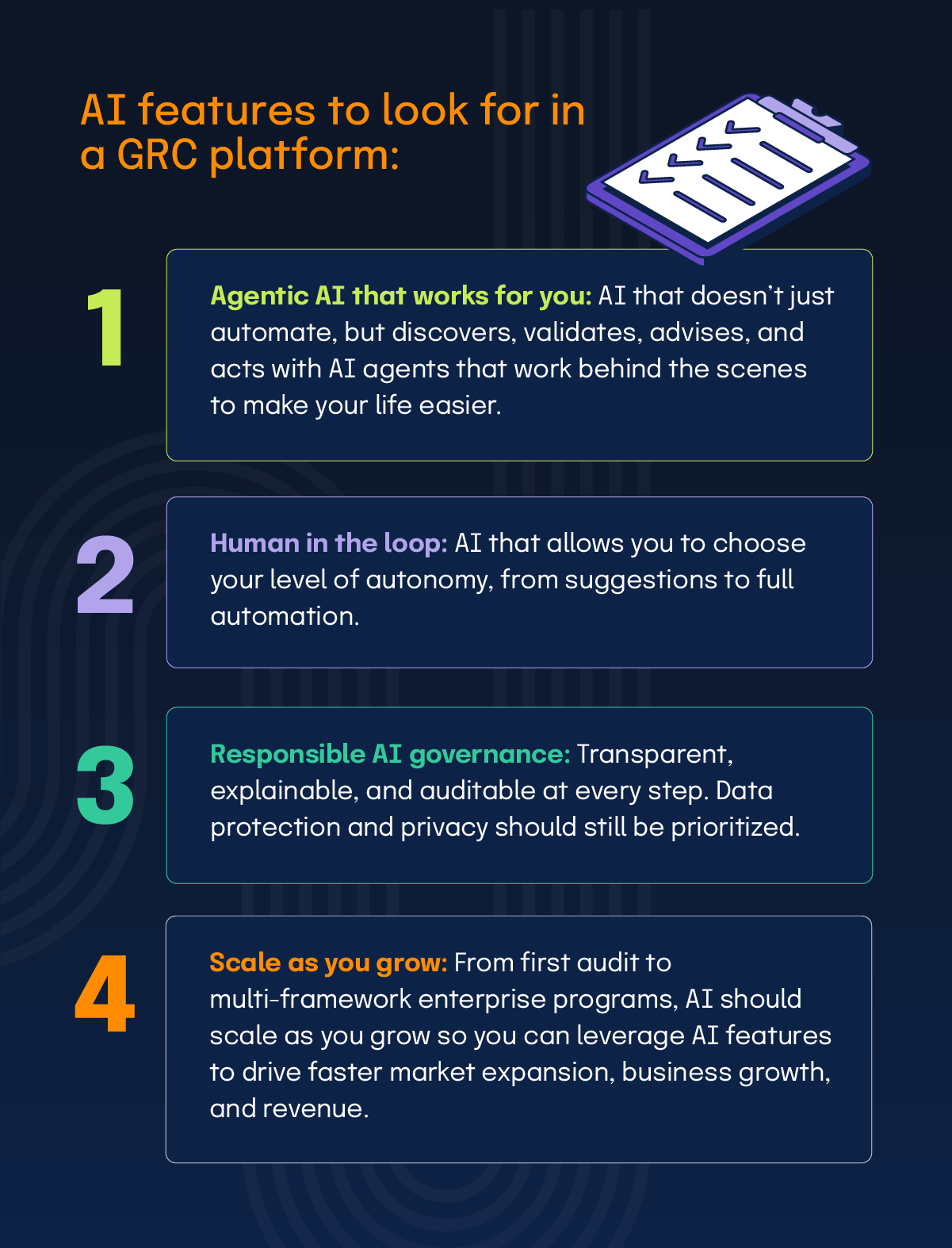
Of course, AI also amplifies why you need structured governance. Managing AI responsibly (ensuring ethical use, transparency, and compliance with emerging regulations) requires its own controls, testing, and documentation.
In other words, AI both requires and enables a GRC platform.
Build vs. buy: The decision has changed
Once upon a time, companies tried to build their own GRC tools. It sounded logical and perhaps even easy: “We’ll customize it to our needs.” But those internal builds quickly became outdated, under-supported, and impossible to scale.
The GRC software market has evolved. Platforms like Hyperproof are built to integrate with your existing tech stack (Jira, Slack, Azure, AWS, and more) while automatically adapting to new regulatory frameworks.
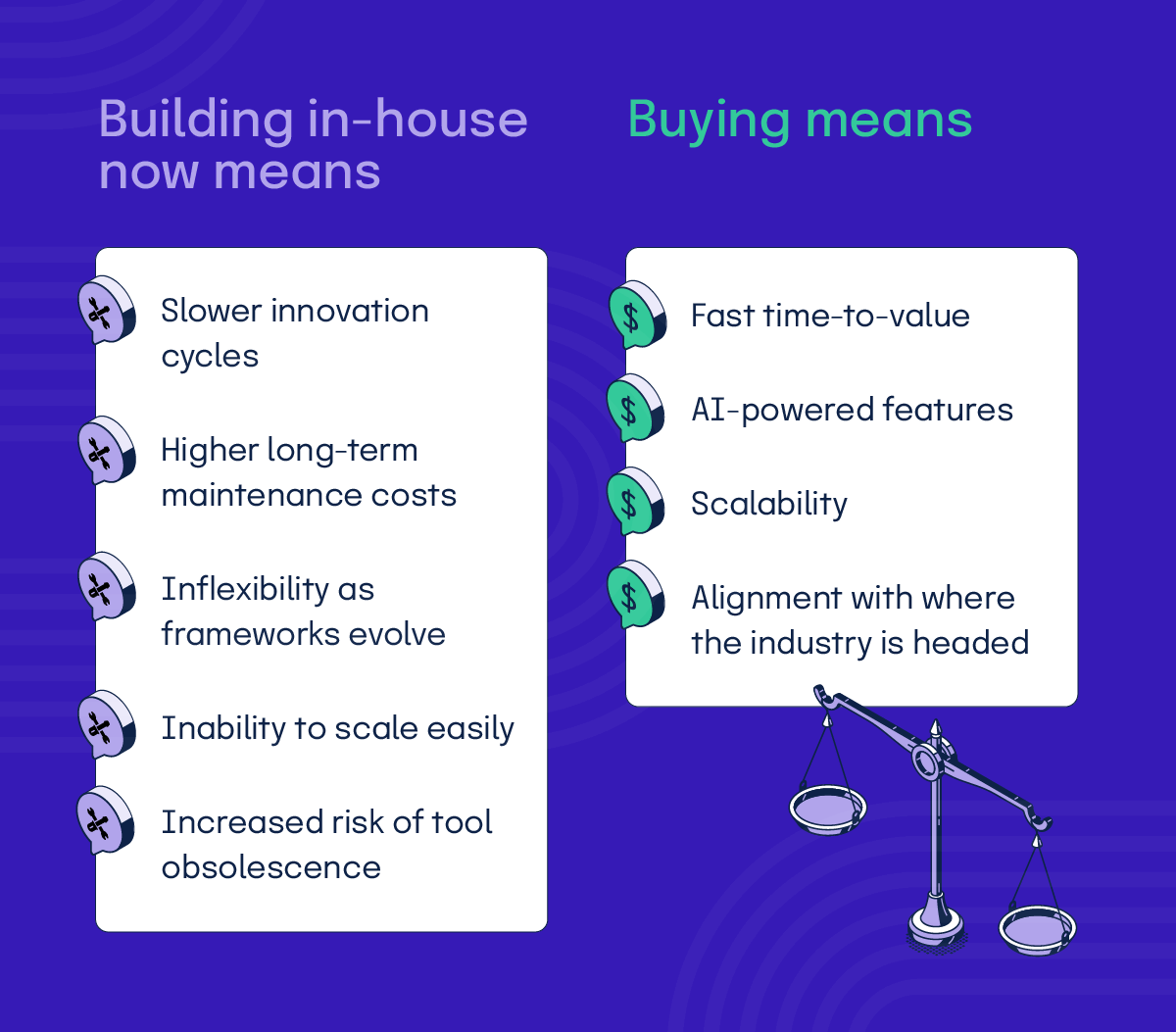
Building in-house now means:
Buying a modern GRC platform means fast time-to-value, AI-powered features, scalability, and alignment with where the industry is headed, not where it’s been.
Need more guidance on how to choose a GRC platform? Here are 8 features to look for >
Will a GRC platform add more or less value over time?
This is one of the most underrated questions, and the answer is clear: more.
A well-implemented GRC platform compounds in value year over year. Why? The more controls you manage, risks you mitigate, and reports you leverage, the more intelligent your GRC insights become. The more frameworks you add, the easier cross-mapping controls and reusing evidence for your next audit become. The more your organization matures, the more the platform becomes your single source of truth for compliance, security, and risk.
As AI capabilities grow, these platforms will transition from reactive dashboards to proactive intelligence engines, surfacing where you’re exposed, predicting what’s next, and guiding where to focus.
Over time, your GRC platform stops being a cost center and starts being a strategic asset. One that informs decision-making across the entire business.
Trust as a competitive advantage
At the end of the day, governance, risk, and compliance aren’t about checkboxes. They’re about trust.
When every business is digital, trust becomes the competitive edge. Customers won’t sign with vendors that can’t prove security. Regulators won’t accept vague assurances. Boards won’t tolerate surprise risks.
A GRC platform is how you turn compliance from a reactive function into a competitive differentiator and prove that your organization doesn’t just meet standards but leads with integrity, resilience, and transparency.
The future belongs to the proactive
The risks facing modern enterprises aren’t slowing down. But neither is technology helping us manage them.
A modern GRC platform bridges that gap. Automating what should be automated, surfacing what matters most, and empowering your teams to focus on strategy instead of spreadsheets.
If you’re leading risk or compliance today, a GRC platform is not another software purchase. It’s how you future-proof your function and your reputation. Because in an era defined by velocity and volatility, the organizations that manage risk best will win trust fastest.
See Hyperproof in Action
Related Resources

Ready to see
Hyperproof in action?