Guide
The GRC Maturity Model: How Mature is Your GRC Program?
Introduction
Maturity models are relatively commonplace in cybersecurity and provide a vendor-agnostic roadmap for how companies can improve key business operations. They set community knowledge to paper so that organizations aren’t entirely dependent on hiring specific experts to elevate their security posture. Maturity models differ from frameworks in that they do not define hard requirements and remain open to interpretation. Though an auditor might view maturity models through a rigid lens, a well-designed maturity model should always serve as a strategic roadmap, not a strict recipe.
The historical absence of a widely adopted maturity model for Governance, Risk, and Compliance (GRC) has created an uneven playing field across industries. Organizations with mature GRC programs hold a distinct competitive advantage, yet that edge often stems from hiring the right individual at the right time rather than a deliberate, repeatable organizational strategy. This dynamic creates a GRC poverty line, where organizations with leaner resources struggle against an expanding landscape of regulatory and legal obligations. This document provides an accessible roadmap for organizations of all sizes while establishing standard GRC functions across companies.
This model is designed by Hyperproof to address specific operational GRC workflows rather than high-level organizational capability frameworks as described in the OCEG Red Book. While broad frameworks offer value at the organizational level, this document provides granular, process-level characteristics aimed at addressing the operational challenges behind GRC processes.
Documenting common processes requires balancing granular detail with actionable scope. If processes are described too narrowly, they become unique to a single organization; if written too broadly, they fail to provide measurable characteristics for improvement. Deliberately separating key functions — such as evaluating risk assessment separately from risk mitigation planning — allows organizations to closely examine the operational behaviors that separate mature programs from those struggling to get started.
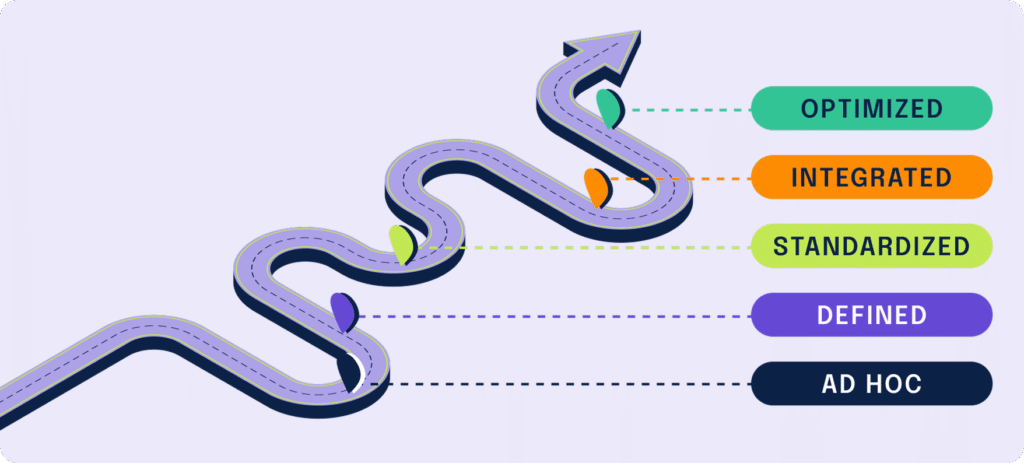
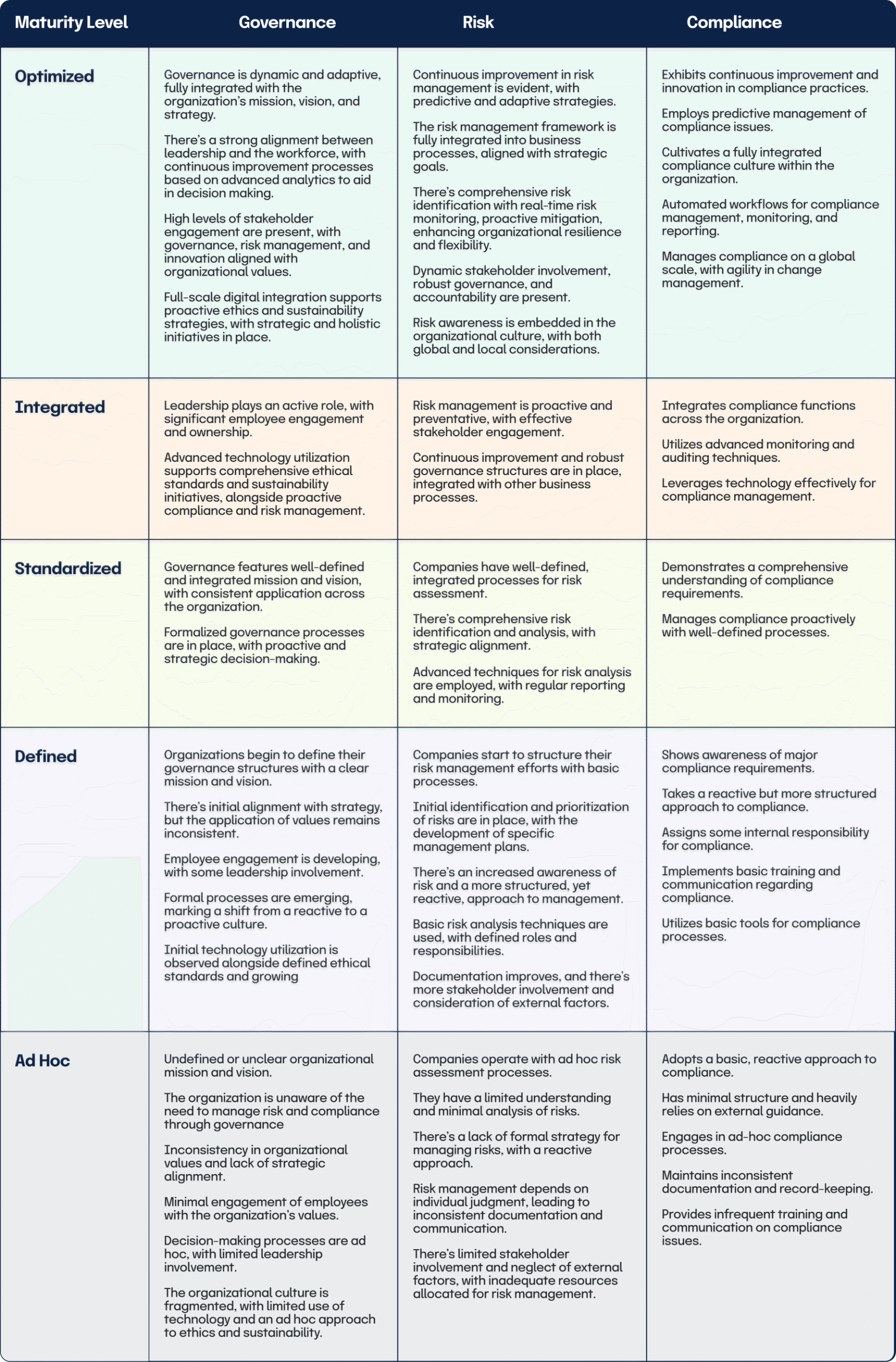
Five maturity levels are defined in this model: ad hoc, defined, standardized, integrated, and optimized. Each stage represents an intentional effort to improve, establishing operational habits that become significantly easier to sustain once implemented.
When evaluating GRC maturity, organizations should focus first on processes that exhibit the lowest maturity combined with the highest business impact. Incremental gains in an area that already functions well yield far lower returns than fixing a critical operational gap. For example, an organization struggling with contractual compliance will realize far greater value by modernizing contract workflows than by refining its mission statement.
This model is designed as a living document that will continue to evolve alongside cybersecurity and regulatory standards. Practitioner feedback and ongoing industry insights remain critical to refining these processes. This work would not be possible without the collaboration of experts at Hyperproof and the valuable contributions of the CISOs, security leaders, and GRC subject matter experts who reviewed this document.
Overview of Governance, Risk, and Compliance
Governance, Risk, and Compliance (GRC) aligns an enterprise’s overarching strategy with external regulations and risk management. By integrating these three pillars, organizations ensure legal and operational adherence while maintaining risks within acceptable tolerances.
Core Benefits of GRC
Advancing GRC maturity requires dedicated organizational change management to successfully adapt processes, technology, and culture for long-term sustainability. Ultimately, a unified GRC strategy transforms compliance into a driver of efficiency, credibility, and growth.
Maturity Levels Summary Chart
GRC
|
Maturity Level |
Governance |
Risk |
Compliance |
|---|---|---|---|
|
Optimized |
|||
|
Integrated |
|||
|
Standardized |
|||
|
Defined |
|||
|
Ad Hoc |
What’s in each section
Each of the following sections follows the same basic flow:
Governance: Overview of Activities and Desired Outcomes
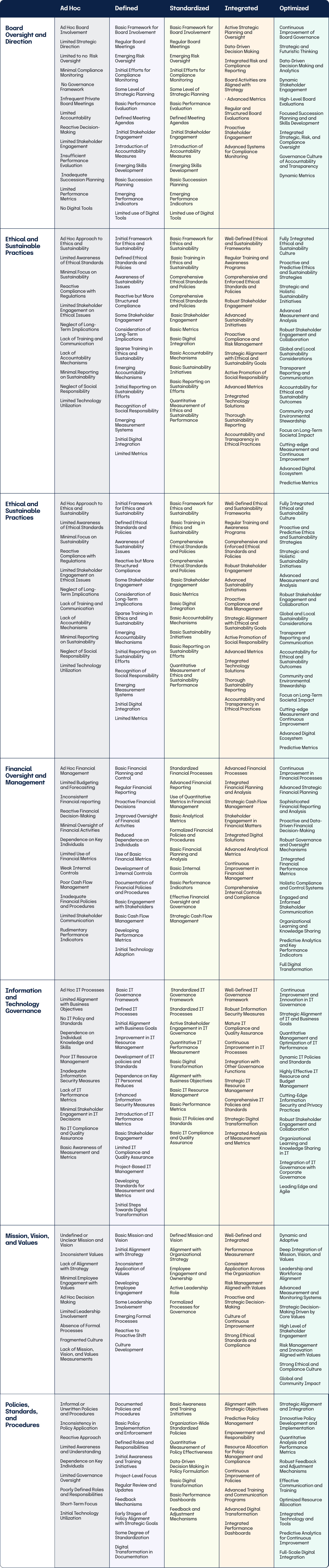
Board Oversight and Direction
Providing high-level oversight, and ensuring that management actions align with the set objectives. Effective board oversight and direction leads to enhanced organizational resilience, better alignment of corporate strategies with risk management, improved regulatory compliance, and increased stakeholder confidence. This results in a more robust governance framework capable of navigating complex business environments.
Ethical and Sustainable Practices
Promoting ethical behavior and sustainability within the organization, and aligning business practices with societal expectations and environmental responsibilities. The outcomes of ethical and sustainable practices in corporate governance include enhanced corporate reputation, increased customer loyalty, and improved risk management. These practices can lead to better financial performance in the long term, foster a positive work environment, and contribute to the overall well-being of society and the environment.
Financial Oversight and Management
Managing the organization’s finances, including budgeting, financial planning, and ensuring truthful financial reporting. The Chief Financial Officer (CFO) plays a crucial role in this aspect. The primary outcome is the establishment of financial stability and transparency within the organization. It leads to improved decision-making based on accurate financial data, enhanced investor confidence, and compliance with legal and regulatory requirements.
Information and Technology Governance
Managing IT resources effectively, ensuring that information technology aligns with the organization’s goals and complies with regulations. The outcomes include enhanced strategic decision-making, improved management of IT-related risks, increased efficiency in IT operations, and stronger compliance with legal and regulatory standards.
Mission, Vision, and Values
Establishing the organization’s core principles and objectives. This involves defining the ethical guidelines, risk appetite, and overall strategic direction of the company. This provides a clear direction for the organization, aiding in strategic planning and decision-making. Employees and management alike gain a better understanding of the organization’s purpose and objectives, enhancing employee engagement and commitment as they are able to see how their work contributes to the broader goals. Externally, well-defined Mission, Vision, and Values can strengthen the organization’s reputation and brand, making it more attractive to clients, investors, and potential employees. In terms of compliance, these statements ensure that ethical considerations are at the forefront, reducing the risk of legal or regulatory violations.
Policies, Standards, and Procedures
Creating guidelines for operations and decision-making across the organization. These policies ensure compliance with laws and regulations and guide the organization’s internal conduct. Expected outcomes include improved regulatory compliance, enhanced risk management, and more efficient governance processes. Policies and procedures also contribute to creating a culture of accountability and transparency within the organization, leading to better decision-making, reduced legal risks, and potentially improved operational efficiency.
Governance: Maturity Chart
|
Ad Hoc |
Defined |
Standardized |
Integrated |
Optimized |
|
|
Board Oversight and Direction |
• Ad Hoc Board Involvement• Limited Strategic Direction• Limited to no Risk Oversight• Minimal Compliance Monitoring• No Governance Framework• Infrequent Private Board Meetings• Limited Accountability• Reactive Decision-Making• Limited Stakeholder Engagement• Insufficient Performance Evaluation• Inadequate Succession Planning• Limited Performance Metrics• No Digital Tools |
• Basic Framework for Board Involvement• Regular Board Meetings• Emerging Risk Oversight• Initial Efforts for Compliance Monitoring• Some Level of Strategic Planning• Basic Performance Evaluation• Defined Meeting Agendas• Initial Stakeholder Engagement• Introduction of Accountability Measures• Emerging Skills Development• Basic Succession Planning• Emerging Performance Indicators• Limited use of Digital Tools |
• Well-Defined Board Governance Structures |
• Active Strategic Planning and Oversight• Data-Driven Decision Making• Integrated Risk and Compliance Reporting• Board Activities are Aligned with Strategy• Advanced Metrics• Regular and Structured Board Evaluations• Proactive Stakeholder Engagement•Advanced Systems for Compliance Monitoring |
• Continuous Improvement of Board Governance• Strategic and Futuristic Thinking• Data-Driven Decision Making and Analytics• Dynamic Stakeholder Engagement• High-Level Board Evaluations• Focused Succession Planning and and Skills Development• Integrated Strategic, Risk, and Compliance Oversight• Governance Culture of Accountability and Transparency• Dynamic Metrics |
|
Ethical and Sustainable Practices |
• Ad Hoc Approach to Ethics and Sustainability• Limited Awareness of Ethical Standards• Minimal Focus on Sustainability• Reactive Compliance with Regulations• Limited Stakeholder Engagement on Ethical Issues• Neglect of Long-Term Implications• Lack of Training and Communication• Lack of Accountability Mechanisms• Minimal Reporting on Sustainability• Neglect of Social Responsibility• Limited Technology Utilization |
• Initial Framework for Ethics and Sustainability• Defined Ethical Standards and Policies• Awareness of Sustainability Issues• Reactive but More Structured Compliance• Some Stakeholder Engagement• Consideration of Long-Term Implications• Sparse Training in Ethics and Sustainability• Emerging Accountability Mechanisms• Initial Reporting on Sustainability Efforts• Recognition of Social Responsibility• Emerging Measurement Systems• Initial Digital Integration• Limited Metrics |
• Basic Framework for Ethics and Sustainability• Basic Training in Ethics and Sustainability• Comprehensive Ethical Standards and Policies• Basic Stakeholder Engagement• Basic Metrics• Basic Digital Integration• Basic Accountability Mechanisms• Basic Sustainability Initiatives• Basic Reporting on Sustainability Efforts• Quantitative Measurement of Ethics and Sustainability Performance |
• Well-Defined Ethical and Sustainability Frameworks• Regular Training and Awareness Programs• Comprehensive and Enforced Ethical Standards and Policies• Robust Stakeholder Engagement• Advanced Sustainability Initiatives• Proactive Compliance and Risk Management• Strategic Alignment with Ethical and Sustainability Goals• Active Promotion of Social Responsibility• Advanced Metrics• Integrated Technology Solutions• Thorough Sustainability Reporting• Accountability and Transparency in Ethical Practices |
• Fully Integrated Ethical and Sustainability Culture• Proactive and Predictive Ethics and Sustainability Strategies• Strategic and Holistic Sustainability Initiatives• Advanced Measurement and Analysis• Robust Stakeholder Engagement and Collaboration• Global and Local Sustainability Considerations• Transparent Reporting and Communication• Accountability for Ethical and Sustainability Outcomes• Community and Environmental Stewardship• Focus on Long-Term Societal Impact• Cutting-edge Measurement and Continuous Improvement• Advanced Digital Ecosystem• Predictive Metrics |
|
Financial Oversight and Management |
• Ad Hoc Financial Management• Limited Budgeting and Forecasting• Inconsistent Financial Reporting• Reactive Financial Decision-Making• Minimal Oversight of Financial Activities• Dependence on Key Individuals• Limited Use of Financial Metrics• Weak Internal Controls• Poor Cash Flow Management• Inadequate Financial Policies and Procedures• Limited Stakeholder Communication• Rudimentary Performance Indicators |
• Basic Financial Planning and Control• Regular Financial Reporting• Proactive Financial Decisions• Improved Oversight of Financial Activities• Reduced Dependence on Individuals• Use of Basic Financial Metrics• Development of Internal Controls• Documentation of Financial Policies and Procedures• Basic Engagement with Stakeholders• Basic Cash Flow Management• Developing Performance Metrics• Initial Technology Adoption |
• Standardized Financial Processes• Advanced Financial Reporting• Use of Quantitative Metrics in Financial Management• Basic Analytical Metrics• Formalized Financial Policies and Procedures• Basic Financial Planning and Analysis• Basic Internal Controls• Basic Performance Indicators |
• Advanced Financial Processes• Integrated Financial Planning and Analysis |
• Continuous Improvement in Financial Processes• Advanced Strategic Financial Planning• Sophisticated Financial Reporting and Analysis• Proactive and Data-Driven Financial Decision-Making• Robust Governance and Oversight Mechanisms• Integrated Financial Performance Metrics• Holistic Compliance and Control Systems• Engaged and Informed Stakeholder Communication• Organizational Learning and Knowledge Sharing• Predictive Analytics and Key Performance Indicators• Full Digital Transformation |
|
Information and Technology Governance |
• Ad Hoc IT Processes• Limited Alignment with Business Objectives• No IT Policy and Standards• Dependence on Individual Knowledge and Skills• Poor IT Resource Management• Inadequate Information Security Measures• Lack of IT Performance Metrics• Minimal Stakeholder Engagement in IT Decisions• No IT Compliance and Quality Assurance• Basic Awareness of Measurement and Metrics |
• Basic IT Governance Framework• Defined IT Processes• Initial Alignment with Business Goals• Improvement in IT Resource Management• Development of IT Policies and Standards• Dependence on Key IT Personnel Reduces• Enhanced Information Security Measures• Introduction of IT Performance Metrics• Basic Stakeholder Engagement• Limited IT Compliance and Quality Assurance• Project-Based IT Management• Developing Standards for Measurement and Metrics• Initial Steps Towards Digital Transformation |
• Standardized IT Governance Framework• Standardized IT Processes• Active Stakeholder Engagement in IT Governance• Quantitative IT Performance Measurement |
• Well-Defined IT Governance Framework• Robust Information Security Measures• Mature IT Compliance and Quality Assurance• Continuous Improvement in IT Processes• Integration with Other Governance Functions• Strategic IT Resource Management• Comprehensive IT Policies and Standards• Strategic Digital Transformation• Integrated Analysis of Measurement and Metrics |
• Continuous Improvement and Innovation in IT Governance• Strategic Alignment of IT and Business Goals• Quantitative Management and Optimization of IT Performance• Dynamic IT Policies and Standards• Highly Effective IT Resource and Budget Management• Cutting-Edge Information Security and Privacy Practices• Robust Stakeholder Engagement and Collaboration• Organizational Learning and Knowledge Sharing in IT• Integration of IT Governance with Corporate Governance• Leading Edge and Agile Technology and Digital Transformation |
|
Mission, Vision, and Values |
• Undefined or Unclear Mission and Vision• Inconsistent Values• Lack of Alignment with Strategy• Minimal Employee Engagement with Values• Ad Hoc Decision Making• Limited Leadership Involvement• Absence of Formal Processes• Fragmented Culture• Lack of Mission, Vision, and Values Measurements |
• Basic Mission and Vision• Initial Alignment with Strategy• Inconsistent Application of Values• Developing Employee Engagement• Some Leadership Involvement• Emerging Formal Processes• Reactive to Proactive Shift• Culture Development |
Defined Mission and Vision• Alignment with Organizational Strategy• Employee Engagement and Ownership• Active Leadership Role• Formalized Processes for Governance |
• Well-Defined and Integrated• Performance Measurement• Consistent Application Across the Organization• Risk Management Aligned with Values• Proactive and Strategic Decision-Making• Culture of Continuous Improvement• Strong Ethical Standards and Compliance |
• Dynamic and Adaptive• Deep Integration of Mission, Vision, and Values• Leadership and Workforce Alignment• Advanced Measurement and Monitoring Systems• Strategic Decision-Making Driven by Core Values• High Level of Stakeholder Engagement• Risk Management and Innovation Aligned with Values• Strong Ethical and Compliance Culture• Global and Community Impact |
|
Policies, Standards, and Procedures |
• Informal or Unwritten Policies and Procedures• Inconsistency in Policy Application• Reactive Approach• Limited Awareness and Understanding• Dependence on Key Individuals• Limited Governance Oversight• Poorly Defined Roles and Responsibilities• Short-Term Focus• Initial Technology Utilization |
• Documented Policies and Procedures• Basic Policy Implementation and Enforcement• Defined Roles and Responsibilities• Initial Awareness and Training Initiatives• Project-Level Focus• Regular Review and Updates• Feedback Mechanisms• Early Stages of Policy Alignment with Strategic Goals• Some Degree of Standardization• Digital Transformation in Documentation |
• Basic Awareness and Training Initiatives• Organization-Wide Standardized Policies |
• Alignment with Strategic Objectives• Predictive Policy Management• Empowerment and Responsibility• Resource Allocation for Policy Management and Compliance• Continuous Improvement of Policies• Advanced Training and Communication Programs• Advanced Digital Transformation• Integrated Performance Dashboards |
• Strategic Alignment and Integration• Innovative Policy Development and Implementation• Quantitative Analysis and Performance Metrics• Robust Feedback and Adjustment Mechanisms• Effective Communication and Training• Optimized Resource Allocation• Integrated Technology and Tools• Predictive Analytics for Continuous Improvement• Full-Scale Digital Integration |

Access the PDF version of this guide
Governance: Moving to the Next Maturity Level
1 Moving from Ad Hoc to Defined Maturity
Focus: Establishing baseline structures, formal documentation, and basic operational awareness.
2 Moving from Defined to Standardized Maturity
Focus: Ensuring enterprise-wide consistency, proactive enforcement, and system-driven alignment.
3 Moving from Standardized to Integrated Maturity
Focus: Breaking down functional silos to embed cross-departmental governance, risk, and values directly into daily operations.
4 Moving from Integrated to Optimized Maturity
Focus: Continuous improvement, dynamic innovation, predictive insights, and an embedded culture of stewardship.
Risk: Overview of Activities and Desired Outcomes
Crisis Management and Response Planning
Preparing for and responding to crises, and ensuring that the organization can effectively handle unexpected events and minimize their impact. Effective crisis management and response planning result in minimized impact of crises on the organization’s operations, reputation, and financial stability. It ensures a swift, organized response to emergencies, aiding in the quick resumption of normal operations. Additionally, it builds confidence among employees, stakeholders, and the public in the organization’s ability to handle crises.
Integrating Risk with Strategy and Decision Making
Aligning risk management at the operational and executive levels with the organization’s strategy and decision-making processes. This ensures that risk posture along with the mechanisms for risk oversight and decision making are an integral part of planning and operational decisions. The primary outcome is enhanced decision-making, where risks are understood and managed in the context of achieving strategic objectives. This integration leads to more resilient and adaptable organizations that are better prepared to handle uncertainties and opportunities. Improved alignment between risk management and business strategy also results in more efficient use of resources and a stronger risk-aware culture throughout the organization.
Risk Assessment and Analysis
Identifying and evaluating the identified risks in terms of their likelihood and potential impact. This often involves qualitative and quantitative analysis techniques to understand the severity and probability of each risk, including legal penalties, financial losses, and reputational damage. The outcomes of a successful risk assessment include a comprehensive understanding of the company’s risk profile, a prioritized list of risks based on their potential impact, and strategies for risk mitigation. This process leads to informed decision-making and the development of effective risk management plans to protect the company’s assets and ensure business continuity.
Risk Mitigation Planning
Developing strategies and a risk tolerance to reduce or eliminate the impact of risks. This includes selecting appropriate risk response strategies such as avoiding, transferring, mitigating, or accepting the risk. The primary outcome of effective risk mitigation planning is the reduced likelihood and impact of risks on the organization. This leads to enhanced business resilience, better compliance with regulatory requirements, and improved stakeholder confidence. Additionally, it fosters a proactive culture of risk awareness and management within the organization.
Risk Monitoring and Reporting
Continuously monitoring the risk environment and the effectiveness of risk response measures. This includes keeping track of new and emerging risks and reporting the risk status to relevant stakeholders. Outcomes include enhanced understanding of the current risk landscape, improved decision-making based on up-to-date risk information, and effective communication of risk status to stakeholders. This leads to a proactive approach in managing potential threats and opportunities.
Risk Prioritization
Ranking risks in order of importance or potential impact to effectively focus resources and attention. This helps in determining which risks need immediate attention and which can be monitored over time. The main outcome of risk prioritization is a clear understanding of which risks need immediate attention and resources. It leads to more informed decision-making, better allocation of resources, and enhanced ability to mitigate or manage critical risks effectively.
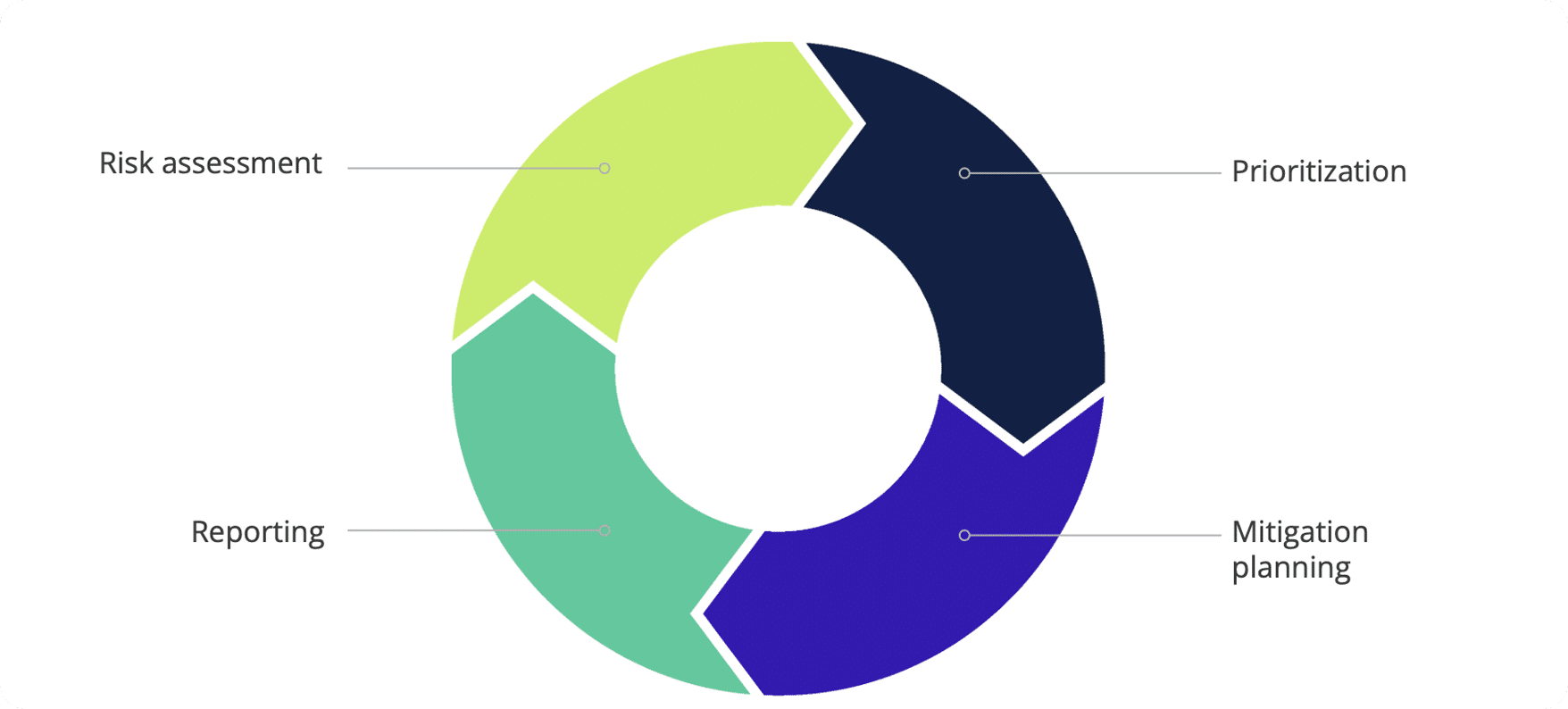
Risk: Maturity Chart
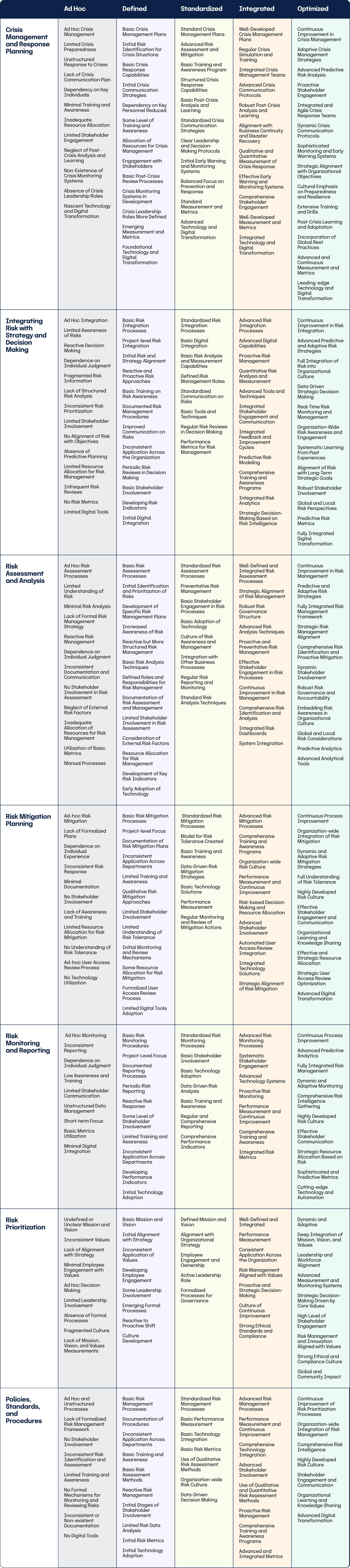
|
Ad Hoc |
Defined |
Standardized |
Integrated |
Optimized |
|
|
Crisis Management and Response Planning |
• Ad Hoc Crisis Management• Limited Crisis Preparedness• Unstructured Response to Crises• Lack of Crisis Communication Plan• Dependency on Key Individuals• Minimal Training and Awareness• Inadequate Resource Allocation• Limited Stakeholder Engagement• Neglect of Post-Crisis Analysis and Learning• Non-Existence of Crisis Monitoring Systems• Absence of Crisis Leadership Roles• Nascent Technology and Digital Transformation |
• Basic Crisis Management Plans• Initial Risk Identification for Crisis Situations• Basic Crisis Response Capabilities• Initial Crisis Communication Strategies• Dependency on Key Personnel Reduced• Some Level of Training and Awareness• Allocation of Resources for Crisis Management• Engagement with Stakeholders• Basic Post-Crisis Review Processes• Crisis Monitoring Systems in Development• Crisis Leadership Roles More Defined• Emerging Measurement and Metrics• Foundational Technology and Digital Transformation |
• Standard Crisis Management Plans• Advanced Risk Assessment and Mitigation |
• Well-Developed Crisis Management Plans• Regular Crisis Simulation and Training• Integrated Crisis Management Teams• Advanced Crisis Communication Protocols |
• Continuous Improvement in Crisis Management• Adaptive Crisis Management Strategies• Advanced Predictive Risk Analysis• Proactive Stakeholder Engagement• Integrated and Agile Crisis Response Teams• Dynamic Crisis Communication Protocols• Sophisticated Monitoring and Early Warning Systems• Strategic Alignment with Organizational Objectives• Cultural Emphasis on Preparedness and Resilience• Extensive Training and Drills• Post-Crisis Learning and Adaptation• Incorporation of Global Best Practices• Advanced and Continuous Measurement and Metrics• Leading-edge Technology and Digital Transformation |
|
Integrating Risk with Strategy and Decision Making |
• Ad Hoc Integration• Limited Awareness of Risks• Reactive Decision Making• Dependence on Individual Judgment• Fragmented Risk Information• Lack of Structured Risk Analysis• Inconsistent Risk Prioritization• Limited Stakeholder Involvement• No Alignment of Risk with Objectives• Absence of Predictive Planning• Limited Resource Allocation for Risk Management• Infrequent Risk Reviews• No Risk Metrics• Limited Digital Tools |
• Basic Risk Integration Processes• Project-level Risk Integration• Initial Risk and Strategy Alignment• Reactive and Proactive Risk Approaches• Basic Training on Risk Awareness• Documented Risk Management Procedures• Improved Communication on Risks• Inconsistent Application Across the Organization• Periodic Risk Reviews in Decision Making• Basic Stakeholder Involvement• Developing Risk Indicators• Initial Digital Integration |
• Standardized Risk Integration Processes• Basic Digital Integration• Basic Risk Analysis and Measurement Capabilities• Defined Risk Management Roles• Standardized Communication on Risks• Basic Tools and Techniques• Regular Risk Reviews in Decision Making |
• Advanced Risk Integration Processes• Advanced Digital Capabilities• Proactive Risk Management• Quantitative Risk Analysis and Measurement• Advanced Tools and Techniques• Integrated Stakeholder Engagement and Communication• Integrated Feedback and Improvement Cycles• Predictive Risk Modeling• Comprehensive Training and Awareness Programs• Integrated Risk Analytics• Strategic Decision-Making Based on Risk Intelligence |
• Continuous Improvement in Risk Integration• Advanced Predictive and Adaptive Risk Strategies• Full Integration of Risk into Organizational Culture• Data-Driven Strategic Decision Making• Real-Time Risk Monitoring and Management• Organization-Wide Risk Awareness and Engagement• Systematic Learning from Past Experiences• Alignment of Risk with Long-Term Strategic Goals• Robust Stakeholder Involvement• Global and Local Risk Perspectives• Predictive Risk Metrics• Fully Integrated Digital Transformation |
|
Risk Assessment and Analysis |
• Ad Hoc Risk Assessment Processes• Limited Understanding of Risk• Minimal Risk Analysis• Lack of Formal Risk Management Strategy• Reactive Risk Management• Dependence on Individual Judgment• Inconsistent Documentation and Communication• No Stakeholder Involvement in Risk Assessment• Neglect of External Risk Factors• Inadequate Allocation of Resources for Risk Management• Utilization of Basic Metrics• Manual Processes |
• Basic Risk Assessment Processes• Initial Identification and Prioritization of Risks• Development of Specific Risk Management Plans• Increased Awareness of Risk• Reactive but More Structured Risk Management• Basic Risk Analysis Techniques• Defined Roles and Responsibilities for Risk Management• Documentation of Risk Assessment and Management• Limited Stakeholder Involvement in Risk Assessment• Consideration of External Risk Factors• Resource Allocation for Risk Management• Development of Key Risk Indicators• Early Adoption of Technology |
• Standardized Risk Assessment Processes• Preventative Risk Management• Basic Stakeholder Engagement in Risk Processes• Basic Adoption of Technology• Culture of Risk Awareness and Management• Integration with Other Business Processes• Regular Risk Reporting and Monitoring• Standard Risk Analysis Techniques |
• Well-Defined and Integrated Risk Assessment Processes• Strategic Alignment of Risk Management• Robust Risk Governance Structure• Advanced Risk Analysis Techniques |
• Continuous Improvement in Risk Management• Predictive and Adaptive Risk Strategies• Fully Integrated Risk Management Framework• Strategic Risk Management Alignment• Comprehensive Risk Identification and Proactive Mitigation• Dynamic Stakeholder Involvement• Robust Risk Governance and Accountability• Embedding Risk Awareness in Organizational Culture• Global and Local Risk Considerations• Predictive Analytics• Advanced Analytical Tools |
|
Risk Mitigation Planning |
• Ad-hoc Risk Mitigation• Lack of Formalized Plans• Dependence on Individual Experience• Inconsistent Risk Response• Minimal Documentation• No Stakeholder Involvement• Lack of Awareness and Training• Limited Resource Allocation for Risk Mitigation• No Understanding of Risk Tolerance• Ad-hoc User Access Review Process• No Technology Utilization |
• Basic Risk Mitigation Processes• Project-level Focus• Documentation of Risk Mitigation Plans• Inconsistent Application Across Departments• Limited Training and Awareness• Qualitative Risk Mitigation Approaches• Limited Stakeholder Involvement• Limited Understanding of Risk Tolerance• Initial Monitoring and Review Mechanisms• Some Resource Allocation for Risk Mitigation• Formalized User Access Review Process• Limited Digital Tools Adoption |
• Standardized Risk Mitigation Processes• Model for Risk Tolerance Created |
• Advanced Risk Mitigation Processes• Comprehensive Training and Awareness Programs• Organization-wide Risk Culture• Performance Measurement and Continuous Improvement• Risk-based Decision Making and Resource Allocation• Advanced Stakeholder Involvement• Automated User Access Review Integration• Integrated Technology Solutions• Strategic Alignment of Risk Mitigation |
• Continuous Process Improvement• Organization-wide Integration of Risk Mitigation• Dynamic and Adaptive Risk Mitigation Strategies• Full Understanding of Risk Tolerance• Highly Developed Risk Culture• Effective Stakeholder Engagement and Communication• Organizational Learning and Knowledge Sharing• Effective and Strategic Resource Allocation• Strategic User Access Review Optimization• Advanced Digital Transformation |
|
Risk Monitoring and Reporting |
• Ad Hoc Monitoring• Inconsistent Reporting• Dependence on Individual Judgment• Low Awareness and Training• Limited Stakeholder Communication• Unstructured Data Management• Short-term Focus• Basic Metrics Utilization• Minimal Digital Integration |
• Basic Risk Monitoring Procedures• Project-Level Focus• Documented Reporting Processes• Periodic Risk Reporting• Reactive Risk Response• Some Level of Stakeholder Involvement• Limited Training and Awareness• Inconsistent Application Across Departments• Developing Performance Indicators• Initial Technology Adoption |
• Standardized Risk Monitoring Processes•Basic Stakeholder Involvement• Basic Technology Adoption• Data-Driven Risk Analysis• Basic Training and Awareness• Regular and Comprehensive Reporting• Comprehensive Performance Indicators |
• Advanced Risk Monitoring Processes• Systematic Stakeholder Engagement• Advanced Technology Systems• Proactive Risk Monitoring• Performance Measurement and Continuous Improvement |
• Continuous Process Improvement• Advanced Predictive Analytics• Fully Integrated Risk Management• Dynamic and Adaptive Monitoring• Comprehensive Risk Intelligence Gathering• Highly Developed Risk Culture• Effective Stakeholder Communication• Strategic Resource Allocation Based on Risk• Sophisticated and Predictive Metrics• Cutting-edge Technology and Automation |
|
Risk Prioritization |
• Ad Hoc and Unstructured Processes• Lack of Formalized Risk Management Framework• No Stakeholder Involvement• Inconsistent Risk Identification and Assessment• Limited Training and Awareness• No Formal Mechanisms for Monitoring and Reviewing Risks• Inconsistent or Non-existent Documentation• No Digital Tools |
• Basic Risk Management Processes• Documentation of Procedures• Inconsistent Application Across Departments• Basic Training and Awareness• Basic Risk Assessment Methods• Reactive Risk Management• Initial Stages of Stakeholder Involvement• Limited Risk Data Analysis• Initial Risk Metrics• Initial Technology Adoption |
• Standardized Risk Management Processes• Basic Performance Measurement • Basic Technology Integration• Basic Risk Metrics• Use of Qualitative Risk Assessment Methods• Organization-wide Risk Culture• Data-Driven Decision Making |
• Advanced Risk Management Processes• Performance Measurement and Continuous Improvement• Comprehensive Technology Integration• Advanced Stakeholder Involvement• Use of Qualitative and Quantitative Risk Assessment Methods• Proactive Risk Management• Comprehensive Training and Awareness Programs• Advanced and Integrated Metrics |
• Continuous Improvement of Risk Prioritization Processes• Organization-wide Integration of Risk Management• Comprehensive Risk Intelligence• Highly Developed Risk Culture• Stakeholder Engagement and Communication• Organizational Learning and Knowledge Sharing• Advanced Digital Transformation |
Risk: Moving to the Next Maturity Level
1 Moving from Ad Hoc to Defined Maturity
Focus: Establishing baseline risk processes, initial documentation, structured crisis responses, and elementary risk awareness.
2 Moving from Defined to Standardized Maturity
Focus: Driving organization-wide standardization, proactive risk mitigation, data-driven analysis, and advanced technology adoption.
3 Moving from Standardized to Integrated Maturity
Focus: Embedding risk intelligence directly into operational workflows, breaking down functional silos, and creating cross-departmental risk synergies.
4 Moving from Integrated to Optimized Maturity
Focus: Fostering continuous innovation, predictive risk intelligence, dynamic adaptability, and a deeply ingrained risk-aware culture.
Compliance: Overview of Activities and Desired Outcomes
Attaining and Maintaining External Attestations and Certifications
Keeping current all external compliance attestations and certifications that apply to the organization. The primary outcome is the achievement of certifications, such as ISO or SOC 2®, which serve as evidence of the organization’s compliance with industry standards. This leads to improved stakeholder confidence, potentially opening up new business opportunities. Additionally, it helps in identifying and mitigating risks, ensuring operational efficiency, and maintaining a competitive edge in the market.
Compliance with Contractual Requirements
Keeping up-to-date with all supply chain contractual requirements that apply to the organization. Successful compliance leads to strengthened business relationships, reduced legal risks, and enhanced reputation. It also ensures operational consistency and can lead to improvements in efficiency and effectiveness, as processes are aligned with agreed-upon standards and expectations.
Compliance with Legal Requirements
Keeping up-to-date with all relevant laws, regulations, and standards that apply to the organization, including both domestic and international compliance requirements if the organization operates globally. Successful compliance with legal requirements minimizes the risk of legal sanctions, fines, or lawsuits. It enhances the company’s reputation and credibility among clients, partners, and the public. Compliance also creates a more structured and transparent business environment, which can improve operational efficiency and foster a culture of accountability and ethical conduct within the organization.
Managing Relationships with Regulatory Bodies
Maintaining open and cooperative relationships with regulatory authorities and other governing bodies. Effective management of these relationships results in compliance with legal requirements, reduced risk of penalties or legal issues, and a positive reputation with regulators and the public. It also leads to an informed understanding of regulatory expectations, aiding in proactive compliance planning and strategy development.
Monitoring and Auditing
Regularly reviewing and auditing internal processes to ensure they comply with set standards and regulations. This involves internal audits, assessments, and sometimes external audits. The primary outcome of effective compliance monitoring and auditing is the reduction in risk of legal penalties and reputation damage. It also leads to improved operational efficiency and a stronger culture of compliance within the organization.
Remediation of Compliance Issues
Addressing and resolving any compliance issues that arise, including making necessary changes to policies and procedures. Successful remediation leads to improved compliance with laws and regulations, reduced risk of legal penalties and reputational damage, enhanced operational efficiency, and a strengthened culture of compliance within the organization.
Compliance: Maturity Chart

|
Ad Hoc |
Defined |
Standardized |
Integrated |
Optimized |
|
|
Attaining and Maintaining External Attestations and Certifications |
• Ad Hoc Processes• Reactive Approach• Limited Awareness• Dependence on Individual Knowledge• Inconsistent Documentation and Record Keeping• Limited Verification and Validation Efforts• No Formal Review or Improvement Processes• Absence of Strategic Alignment• Basic Tracking• Manual Processes |
• Basic Processes• Consistency in Implementation• Basic Monitoring and Control• Awareness and Training Activities• Assigned Responsibility and Accountability• Basic Documentation and Record Keeping• Basic Performance Measurement• Initial Strategic Alignment• Feedback and Improvement• Structured Measurement• Basic Digital Tools |
• Standardized Processes• Training and Awareness Program• Knowledge Management• Initial Stakeholder Engagement • Advanced Performance Measurement• Issue Identification and Resolution |
• Well-Defined, Tailored Processes• Advanced Monitoring and Control Mechanisms• Strategic Alignment with Business Goals• Proactive Issue Management• Stakeholder Engagement and Communication• Qualitative and Quantitative Performance Measurement• Comprehensive Training and Awareness• Robust Knowledge Management• Advanced Analytics• Integrated Systems |
• Continuous Process Improvement• Strategic Alignment and Business Impact• Full Employee Engagement• Knowledge Sharing and Organizational Learning• Effective Change Management• Stakeholder Collaboration and Feedback• Predictive Metrics and Continuous Monitoring• Advanced Digital Transformation |
|
Compliance with Contractual Requirements |
• Ad Hoc Processes• Lack of Standardization• Reactive Approach• Limited Awareness• Dependence on Individuals• Inconsistent Documentation• Lack of Monitoring and Reporting• No Formal Training• Absence of Audits and Reviews• Basic Data Recording• Manual Processes |
• Basic Processes• Consistency in Implementation• Basic Monitoring and Control• Basic Awareness and Training• Responsibility and Accountability• Issue Identification and Resolution• Basic Documentation• Feedback and Improvement• Initial Performance Indicators• Introduction of Basic Digital Tools |
• Standardized Processes• Standardized Metrics and KPIs• Detailed Roles and Responsibilities• Basic Analytics and Risk Management• Standard Performance Measurement• Regular Audits and Reviews• Consistent Contractual Requirements Across the Supply Chain |
• Well-Defined and Tailored Processes• Organization-Wide Standardization• Advanced Monitoring and Control• Predictive Analytics and Risk Management• Proactive Issue Management• Qualitative and Quantitative Performance Measurement• Comprehensive Training and Awareness• Robust Knowledge Management |
• Continuous Process Improvement• Organization-Wide Integration• Strategic Alignment and Business Impact Focus• Full Employee Engagement• Robust Risk Management• Knowledge Sharing and Organizational Learning• Change Management Capability• Predictive and Proactive Compliance Management• Predictive Analytics• Innovative Digital Transformation |
|
Compliance with Legal Requirements |
• Reactive• Limited Awareness of Requirements• Ad Hoc Processes for Compliance• Dependence on External Guidance• Inconsistent Documentation and Record Keeping• Lack of Training and Communication• Limited Use of Technology• Isolated Incidents of Compliance Efforts |
• Initial Compliance Processes• Awareness of Major Requirements• Reactive but More Structured Approach• Some Internal Responsibility for Compliance• Basic Training and Communication• Use of Basic Tools• Some Level of Compliance Monitoring• Initial Efforts in Compliance Reporting |
• Basic Compliance Processes |
• Well-Defined Compliance Processes• Comprehensive Understanding of Requirements |
• Continuous Improvement and Innovation• Predictive Management• Fully Integrated Compliance Culture• Advanced Technology Utilization• Strategic Alignment of Compliance• Global Compliance Management• Agility in Change Management• Comprehensive Compliance Audits and Reporting• Empowerment and Responsibility at All Levels |
|
Managing Relationships with Regulatory Bodies |
• Ad Hoc Interactions• Limited Understanding of Regulatory Requirements• Inconsistent Communication• Reactive Compliance Management• Dependence on Individual Expertise• Minimal Documentation and Record-Keeping• Limited Strategic Focus• Infrequent Engagement• Limited Technology Use |
• Basic Processes and Procedures• Designated Responsibility• Regular Communication• Awareness of Regulatory Requirements• Proactive Elements in Compliance Management• Record-Keeping of Interactions• Basic Training and Awareness • Reactive but Organized Response to Regulatory Changes• Initial Stakeholder Engagement• Initial Metrics Implementation• Foundational Technology Adoption |
• Standardized Processes and Procedures• Comprehensive Understanding of Regulatory Landscape• Proactive Response to Regulatory Changes• Regular Stakeholder Engagement• Data-Driven Compliance Management |
• Advanced and Tailored Processes• Proactive Regulatory Engagement• Advanced Documentation and Record-Keeping• Regular Training and Awareness Programs• Strategic Alignment and Stakeholder Engagement• Sharing of Compliance Best Practices with Industry Forums and Peers• Integrated Metrics System• Advanced Technology Integration |
• Continuous Process Improvement• Proactive and Predictive Regulatory Management• Deep Integration with Business Strategy• Organization-Wide Cultural Emphasis• Robust Feedback and Learning Mechanisms• Strategic and Collaborative Relationships• Global and Local Regulatory Expertise• Stakeholder Engagement and Transparency• Predictive and Strategic Metrics• Full Digital Transformation |
|
Monitoring and Auditing |
• Ad Hoc Monitoring and Auditing• Inconsistent Implementation• Reactive Approach• Limited Scope and Depth• Dependence on Individual Knowledge and Effort• Lack of Formal Training• Limited Documentation• Infrequent and Irregular Audits• Lack of Follow-Up and Corrective Actions• Limited Digital Tools |
• Basic Monitoring and Auditing Processes• Consistent Implementation• Regular Scheduling• Assigned Responsibility and Accountability• Training for Relevant Staff• Documentation of Processes and Findings• Regular Audits • Feedback and Improvement• Integration with Compliance Goals• Developing Metrics System• Initial Digital Integration |
• Defined Monitoring and Auditing Processes• Organization-Wide Standardization |
• Well-Defined, Tailored Processes |
• Continuous Process Improvement• Organization-Wide Integration• Strategic Alignment and Business Impact• Full Employee Engagement and Participation• Knowledge Sharing and Organizational Learning• Effective Change Management• Stakeholder Collaboration and Feedback• Predictive and Proactive Compliance Management• Predictive Analytics and Comprehensive Metrics• Cutting-Edge Digital Transformation |
|
Remediation of Compliance Issues |
• Ad Hoc Remediation Efforts• Dependence on Individual Effort• Lack of Systematic Identification of Deficiencies• Limited Resources Allocation• Inconsistent Follow-Up and Verification• Low Awareness and Training• Limited Technology Use |
• Basic Remediation Processes Defined• Assigned Responsibilities• Consistent Application Within Projects• Resource Allocation for Remediation• Reactive but Structured Approach• Limited Stakeholder Engagement• Initial Data Collection and Analysis• Follow-Up and Effectiveness Assessment• Departmental Technology Solutions |
• Standardized Remediation Processes• Basic Training and Awareness• Defined Compliance Metrics• Stakeholder Engagement• Proactive, structured Approach• Advanced Data Management and Analysis |
• Advanced and Tailored Remediation Processes• Organization-Wide Consistency• Proactive Self-Identification of Compliance Deficiencies• Proactive Remediation Strategies• Comprehensive Training and Awareness Programs• Integrated Technology Platforms• Advanced Metrics and KPIs |
• Continuous Process Improvement• Innovative Remediation Strategies• Proactive and Predictive Compliance Management• Organization-Wide Integration• Knowledge Sharing and Best Practices• Robust Culture of Compliance• Stakeholder Engagement and Feedback Mechanisms• Strategic Alignment with Business Goals• Predictive Analytics and Continuous Improvement• Advanced Digital Ecosystem |
Compliance: Moving to the Next Maturity Level
1 Moving from Ad Hoc to Defined Maturity
Focus: Establishing baseline procedures, assigning clear roles, standardizing documentation, and building foundational awareness.
2 Moving from Defined to Standardized Maturity
Focus: Enterprise-wide standardization, proactive compliance management, tailored processes, and integrated technology platforms.
3 Moving from Standardized to Integrated Maturity
Focus: Embedding compliance into operational workflows, breaking down functional silos, and establishing cross-departmental governance synergies.
4 Moving from Integrated to Optimized Maturity
Focus: Fostering continuous innovation, predictive compliance analytics, dynamic adaptability, and an ingrained compliance-first culture.