What Are the Key Differences Between NIS1 and NIS2?

Updated on: Jul 17, 2026 4 Minute Read
The Network and Information Security Directive 2 (NIS2) is the EU’s latest cybersecurity legislation aimed at improving the resilience of critical infrastructure and essential services across member states.
NIS2 represents a significant evolution from the original NIS Directive (NIS1), addressing its shortcomings and adapting to today’s more complex threat landscape. While NIS1 and the EU Cyber Resilience Act (CRA) laid the foundation for EU-wide cybersecurity regulation, NIS2 broadens the scope, deepens enforcement mechanisms, and harmonizes implementation across member states.
Sector and scope coverage differences
NIS2 dramatically expands who is covered and removes ambiguity by standardizing thresholds and sector definitions. While NIS1 focused primarily on essential services such as energy, transport, and healthcare, NIS2 includes additional sectors such as public administration, space, and digital infrastructure, and introduces a two-tier classification:
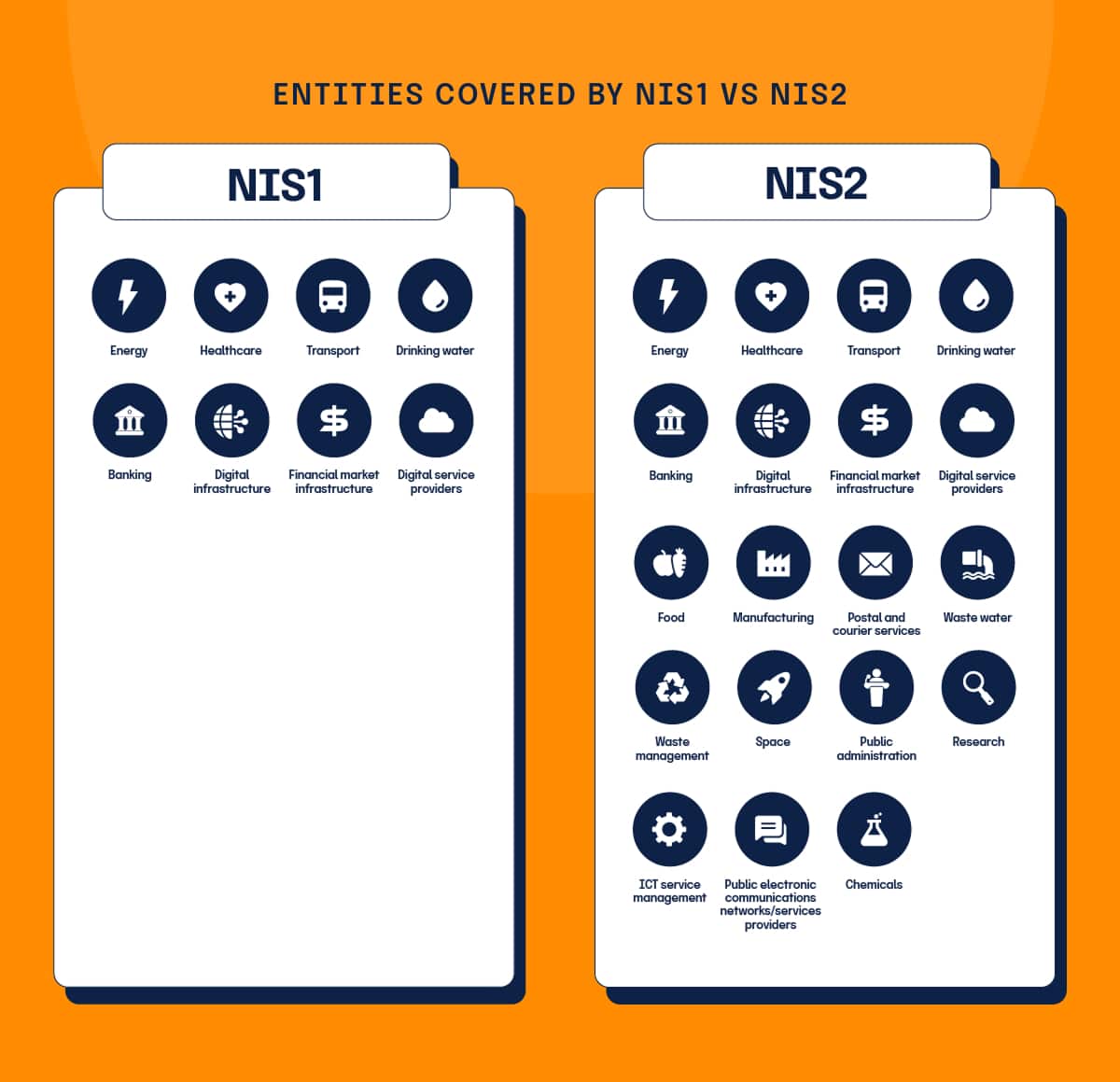
NIS2 also uses size-cap rules (250+ employees or €50M+ revenue for essential entities, with medium and large-sized companies in selected sectors included in scope) to determine applicability, improving consistency across the EU. The framework includes public administration bodies, space infrastructure, and wider digital services that were not covered under NIS1.
Get started on the path to NIS2 compliance with our Practical Guide to the NIS2 Directive.
Core area differences
Security risk management requirements
NIS1 introduced detailed cybersecurity risk management obligations that required entities to take “appropriate and proportionate” technical and organizational measures. However, it did not define these measures with specificity, leaving wide discretion to national authorities and organizations.
NIS2 provides concrete expectations for cyber hygiene, making compliance more measurable and enforceable:
Incident reporting obligations
NIS1 required incident notifications “without undue delay,” guidelines which are often interpreted inconsistently. NIS1 provided no specific reporting timelines or clear escalation procedures.
NIS2 standardizes incident reporting and introduces real-time operational accountability in strict reporting timelines:
NIS 2 also expands what qualifies as a “significant incident,” including incidents that cause severe operational disruption or financial loss to the entity, or that affect other parties by causing considerable material or non-material damage.
Governance and accountability
NIS1 had vague requirements for management involvement in cybersecurity, and there was no mention of personal liability or executive-level oversight.
With NIS2, cybersecurity is no longer just IT’s responsibility, and executives are now personally accountable:
NIS2 encourages integration of cybersecurity into corporate governance practices.
Enforcement penalties
NIS1 lacked strong, harmonized enforcement mechanisms. Member states had significant discretion in applying sanctions, leading to weak or inconsistent penalties.
NIS2 introduces mandatory and harmonized enforcement across the EU. Failure to comply now carries significant business and legal consequences. National authorities are empowered to:
Fines for noncompliance:
Cross-border coordination and harmonization
NIS1 implementation varied significantly across member states, leading to fragmented practices, and there was no centralized vulnerability database or EU-wide crisis management system.
NIS2 aims to unify cybersecurity posture across all EU member states, enabling faster and more coherent responses to threats via:
Supply chain and third-party risk
NIS1 did not explicitly require organizations to address third-party or supply chain cybersecurity.
NIS2 treats third-party risk as a core cybersecurity issue, not an optional add-on. NIS2 requires entities to assess and manage cybersecurity risks in their entire supply chain, including:
NIS2 also calls for contractual obligations, monitoring procedures, and vendor accountability mechanisms.
How Hyperproof helps with NIS2 compliance
With real-time risk monitoring, incident response tracking, and automated workflows, Hyperproof simplifies meeting NIS2 obligations, reducing the compliance burden and enhancing overall cybersecurity resilience.
Interested in jumpstarting your NIS2 compliance journey with a pre-built framework template? Get a Hyperproof demo.
Related Resources



Ready to see Hyperproof in action?