Guide
The Ultimate Guide to GLI-33: A Practical Guide for Sports Wagering Systems
Introduction
GLI-33 is a widely used standard for sports wagering systems, and it tends to show up at the exact moment teams can’t afford ambiguity: certification, expansion into a new jurisdiction, or a post-incident “prove it” request.
For compliance managers of Sports Wagering systems, the hard part usually isn’t agreeing with the intent of the requirements. It’s making GLI-33 operable: translating requirements into controls engineering and operations can execute, collecting evidence in a lab-friendly way, and keeping everything current as builds, environments, venues, and vendors change.
This guide focuses on what makes GLI-33 compliance painful in practice — and how teams reduce that pain with repeatable patterns.
Why GLI-33 can feel harder than other security frameworks
GLI-33 requirements often cut across domains that are managed separately in many organizations:
1 System boundary and scope:
What counts as the “Event Wagering System” (and what doesn’t) is rarely obvious without diagrams, inventories, and data-flow clarity.
2 Operational requirements (not just technical):
Venue procedures, staff workflows, maintenance, and surveillance often matter as much as secure code.
3 Audit realism:
Labs and regulators tend to ask for specific, time-stamped, reproducible evidence — especially for integrity, logging, and transaction traceability.
4 Change velocity:
Even if a control is implemented correctly today, GLI-33 work fails when evidence or control narratives drift behind the current release.
A useful mental model is: GLI-33 is less like a one-time checklist and more like an operating cadence. If you can make requirements traceable and evidence repeatable, the program becomes much easier to run.
The most common pain points (and what actually fixes them)
1 Interpretation drift
Different stakeholders read the same clause differently, and you end up with “compliance says…” vs “engineering says…” conversations.
What helps:
Example: instead of a generic “we track versions,” a GLI-33-aligned control statement should spell out where version/build identifiers appear and how they support traceability. A control like “Software Version Identification” (often mapped to GLI33-3.2.2) makes that concrete: user-visible version, machine-readable metadata, and (where practical) inclusion in audit exports or logs.
2 The engineering-to-audit translation gap
Teams often do the work (secure comms, integrity checks, logging), but can’t show it in an auditor-friendly way.

Separate evidence into three buckets so you can answer most lab questions quickly:
Example: GLI-33 secure communications requirements are usually easier to defend when you can show (1) an allow-listing approach for endpoints/components, (2) TLS/mTLS configuration choices, and (3) blocked-connection logging. A well-written control for “Authorized Component Communications” (commonly mapped to GLI33-3.2.7) naturally points to evidence artifacts, such as endpoint allow lists, certificate settings, and connection/audit logs.
3 Evidence goes stale
GLI-33 programs get stressed during certification, not because controls don’t exist, but because evidence can’t be trusted to reflect the current build and environment.
What helps:
Example: Integrity verification requirements are a classic “stale evidence” trap. For controls like “Critical Component Integrity Verification” (often mapped to a set of GLI 2.3.2 requirements), what matters is not just that you can verify integrity, but that you do it on the expected schedule, retain results for the expected period, and can retrieve them on demand.
4 Cross-domain ownership is unclear
GLI-33 blends application, infrastructure, network, venue, and vendor responsibilities. When ownership isn’t explicit, gaps hide in handoffs.
What helps:
Example: a system-boundary control (e.g., “System Boundary Definition”) is often owned by compliance or security architecture, but the evidence depends on engineering and operations (diagrams, inventories, data flows, vendor dependencies). If ownership isn’t defined, your scope story gets shaky fast.
Turning GLI-33 requirements into controls teams can run
A practical approach is to treat each GLI requirement as answering four questions:
1 What behavior is required? (the control statement)
2 Where is it implemented? (systems/components in scope)
3 How do you know it’s operating? (evidence and validation)
4 How do changes stay controlled? (release/change linkage)
If you do this consistently, you reduce interpretation drift and speed up lab Q&A.
A quick example of what “decoded” controls look like:
Some teams maintain their own internal control library to standardize this translation; others start from a purpose-built GLI-33 control set and tailor it to their architecture.
Evidence that labs and regulators actually find useful
When labs ask follow-ups, they’re often trying to answer one of these:
1 Can you trace the deployed system to what was approved? (version/build and configuration traceability)
2 Can you prove controls operate on schedule? (integrity checks, logging, monitoring, access reviews)
3 Can you reconstruct a specific event/wager outcome? (timestamps, IDs, records, audit trails)
4 Can you explain the scope and responsibility boundaries? (diagrams, inventories, vendor/venue roles)
A simple way to make evidence “audit-ready” is to standardize the metadata you capture:
This turns a pile of artifacts into a defensible evidence story.
Keeping GLI-33 current across releases
GLI-33 work breaks down when it’s treated as a one-time certification sprint. Teams that stay ahead of GLI-33 usually run a cycle like:
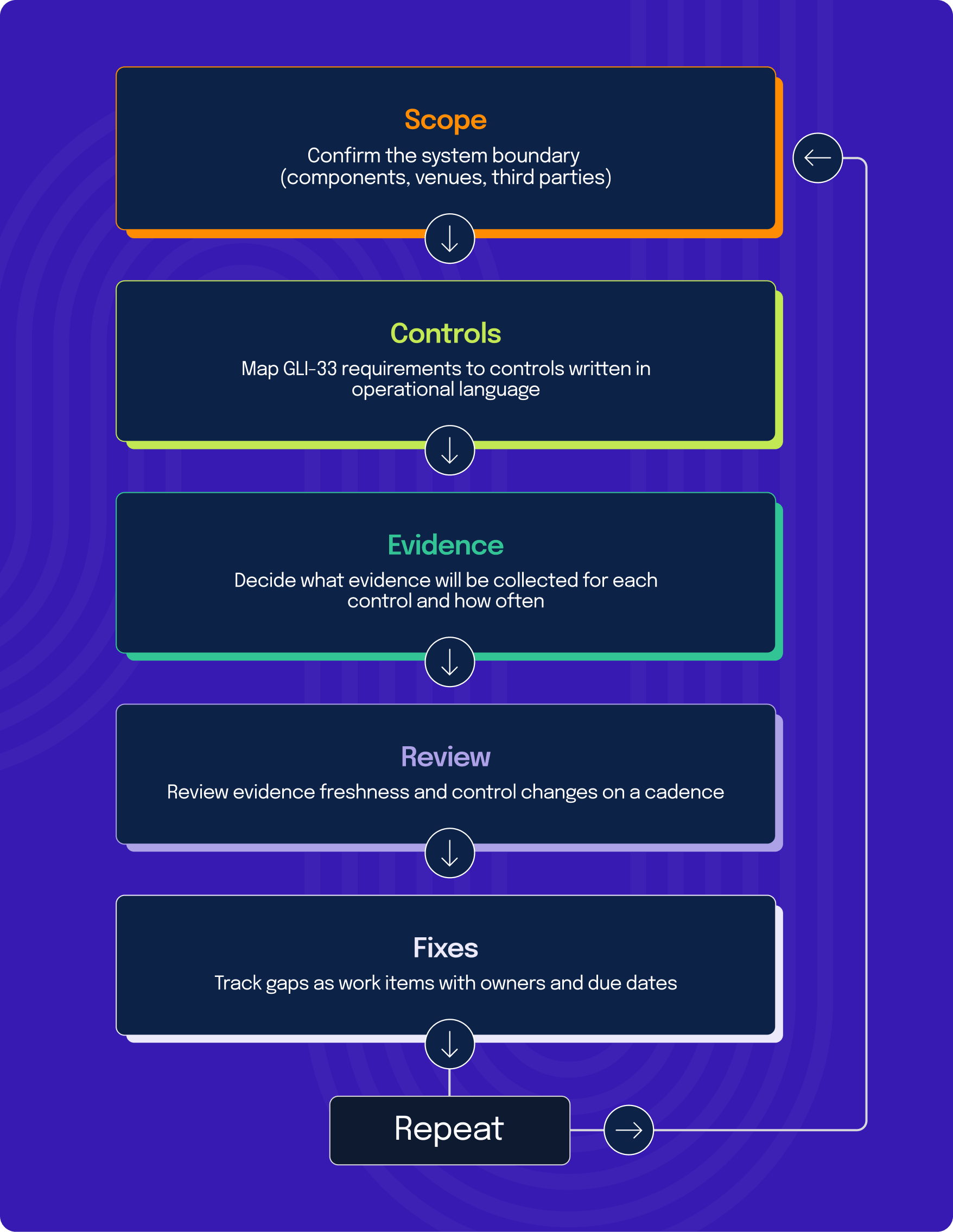
What that looks like in practice:
1 Confirm the system boundary (components, venues, third parties)
2 Map GLI-33 requirements to controls written in operational language
3 Decide what evidence will be collected for each control and how often
4 Review evidence freshness and control changes on a cadence
5 Track gaps as work items with owners and due dates
If you can connect evidence to releases (and avoid rewriting narratives every time), certification and expansion work becomes much less chaotic.
Where tooling helps (without replacing the work)
A lot of GLI-33 pain is coordination: ownership, consistency, and evidence tracking. A GRC platform can help by:
1 Centralizing the control register and mappings
2 Managing ownership and review schedules
3 Collecting and organizing evidence with audit trails
4 Supporting exports/views that make the requirement-to-evidence traceability easy
Hyperproof’s GLI-33 program is one way teams do this. In addition to common GRC workflows (ownership, evidenc
e collection, reviews, audit trails), it includes a custom GLI-33 control set that translates GLI-33 requirements into implementation-ready controls with clear mappings.
Used well, a mapped control set isn’t the “solution” by itself — it’s a way to reduce interpretation drift and standardize what evidence should look like. For example, controls such as Software Version Identification, Authorized Component Communications, and Periodic Location Recheck can serve as starting points for consistent control language and repeatable evidence expectations, while still being tailored to your architecture.
Where to start
If you’re early in GLI-33 work:
If you’re in the middle of certification:
If you’re expanding into new jurisdictions or venues:
Build a sustainable GLI-33 compliance engine with Hyperproof
GLI-33 compliance gets easier when you treat it less like a document you “map to” and more like an operating cadence you run: define the system boundary, translate requirements into testable controls, standardize evidence that proves the controls operate (not just that they exist), and keep that proof current as releases and venues change. The teams that succeed are the ones who remove interpretation drift early, make cross-team ownership explicit, and build repeatable evidence packages that hold up under lab scrutiny and “prove it” requests.
By using a platform like Hyperproof, you can keep control ownership, review cycles, and evidence trails organized in one place. Plus, a custom GLI-33 control set can speed up the “decode and map” step, but the real win is a compliance process that stays defensible even when your system keeps moving.