How Evidence Reuse Unlocks New Audit Capacity Without Hiring

Updated on: Aug 27, 2026 5 Minute Read
Audit firms, CPA organizations, and assurance service providers face growing pressure to modernize audit delivery. Traditional methods — manual document pulls, disconnected systems, and repetitive client requests — create inefficiency, erode margins, and limit firm growth. These outdated approaches make it harder to compete for larger enterprise clients, differentiate beyond price, and retain loyal relationships.
Audit fatigue and scope confusion lead clients to view compliance as a bureaucratic hurdle and audit firms as interchangeable vendors rather than strategic advisors. To compete, progressive firms need a scalable way to deliver more engagements with existing resources while enhancing client collaboration and transparency.
Reusing audit evidence, often termed “collect once, test many,” is one of the most effective strategies for assurance teams to expand audit capacity without increasing headcount. Instead of treating each framework or engagement as an isolated island, modern firms leverage evidence reuse to eliminate redundant testing, shorten audit cycles, and unlock capacity for high-margin advisory services.
Here are three ways evidence automation and reuse can increase a firm’s capacity without increasing staffing levels.
Automated evidence gathering unlocks audit capacity
Manual evidence gathering is the primary bottleneck in audit execution. Evidence collection frequently stalls, stretching engagement timelines, inflating administrative overhead, and limiting senior auditor bandwidth.
When evidence requests are scattered across emails, portals, and spreadsheets, both the client and the audit firm suffer:
- Operational disruption: Client teams prioritize daily operations over audit requests, resulting in delayed responses and audit fatigue.
- Administrative purgatory: Audit staff waste hours chasing down missing files, sending manual follow-ups, and resolving conflicting documentation.
- Eroded margins: Unplanned back-and-forth stretches fixed-fee engagement timelines, directly eating into firm profitability.
Modern assurance firms help clients break this bottleneck by shifting from manual document pulls to automated data harvesting. By connecting directly to cloud environments, task management platforms, and security tools, clients can collect evidence continuously on a defined schedule.
Shifting to continuous evidence ingestion provides four key operational capabilities:
- Scheduled evidence harvesting: Automated pulls run on defined cadences without requiring client intervention.
- Early drift detection: Real-time visibility flags control failures or missing configurations before formal testing begins.
- Centralized health dashboards: Single-pane views reflect current control health across all active client environments.
- Continuous assurance oversight: Reporting goes from a point-in-time fire drill to ongoing operational visibility.
Multi-framework mapping eliminates duplicate client requests
Most enterprise organizations manage multiple compliance frameworks simultaneously, and they expect their assurance partners to deliver multi-framework coverage cost-effectively. Manually requesting, verifying, and testing evidence for SOC 2®, ISO 27001, and NIST CSF independently creates friction and unnecessary duplication.
Standardizing control operations across frameworks minimizes control redundancy and eliminates duplicate requests. By establishing a Common Controls Framework (CCF), firms and their clients map a single core control — such as identity management — to requirements across multiple regulatory regimes at once.
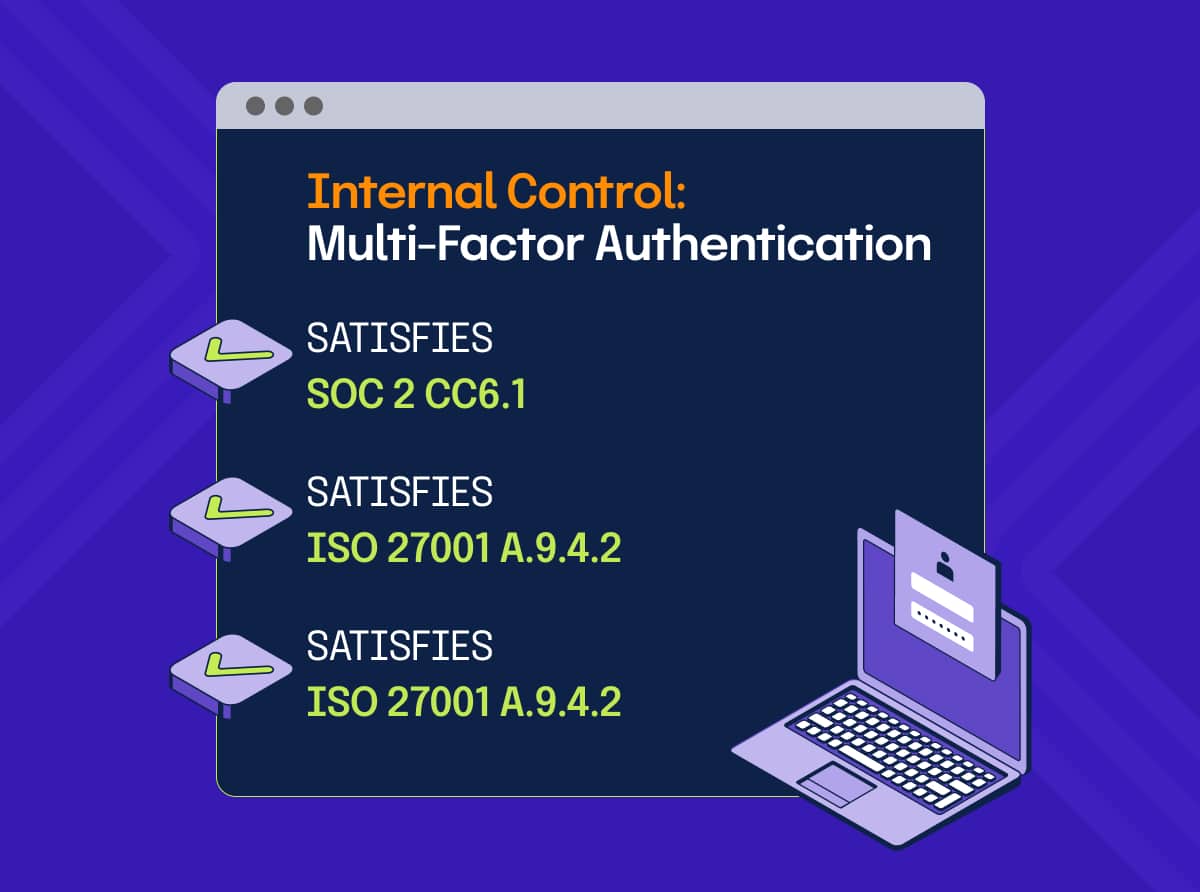
Streamlining evidence workflows across mapped controls provides three major operational benefits:
- Single-upload documentation: Clients upload proof once to satisfy multiple audit requests concurrently.
- Reduced control redundancy: Cross-framework control mapping reduces duplicative controls by up to 66%, drastically cutting client preparation time.
- Continuous evidence freshness: Ingested documentation automatically links across all related framework requirements, ensuring that compliance status is updated across multiple dashboards.
Automated control mapping expands margins and unlocks capacity
Automated control mapping operationalizes “collect once, test many” by recognizing that standards like SOC 2, ISO 27001, SOX, and HIPAA test the same underlying controls. For example, showing that employee offboarding triggers immediate access revocation satisfies user access controls across almost all regulatory frameworks simultaneously.
To scale this strategy, firms execute a three-step master control process:
- Identify overlapping objectives: Pinpoint common controls across various standards (e.g., access control, encryption, change management, and incident response).
- Build a Master Control Framework (MCF): Consolidate distinct audit requirements into a unified control library.
- Execute unified control testing: Test evidence against the MCF once, applying results across all relevant engagements.
The business impact of automated evidence reuse
Transitioning from manual point-in-time sampling to automated evidence reuse fundamentally alters firm economics:
| Engagement Metric | Traditional Audit Model | Evidence Reuse Model | Business Impact |
| Audit Preparation Time | Weeks spent chasing screenshots and files. | Immediate access to pre-collected, mapped evidence. | Up to 75% reduction in audit prep time |
| Client & Stakeholder Friction | High “audit fatigue” due to repetitive, overlapping requests. | One evidence request covers multiple framework audits. | Drastically reduced operational disruption. |
| Audit Coverage Quality | Limited sample sizes due to manual constraints. | Broad population testing via automated data connectors. | Higher assurance quality and lower risk exposure. |
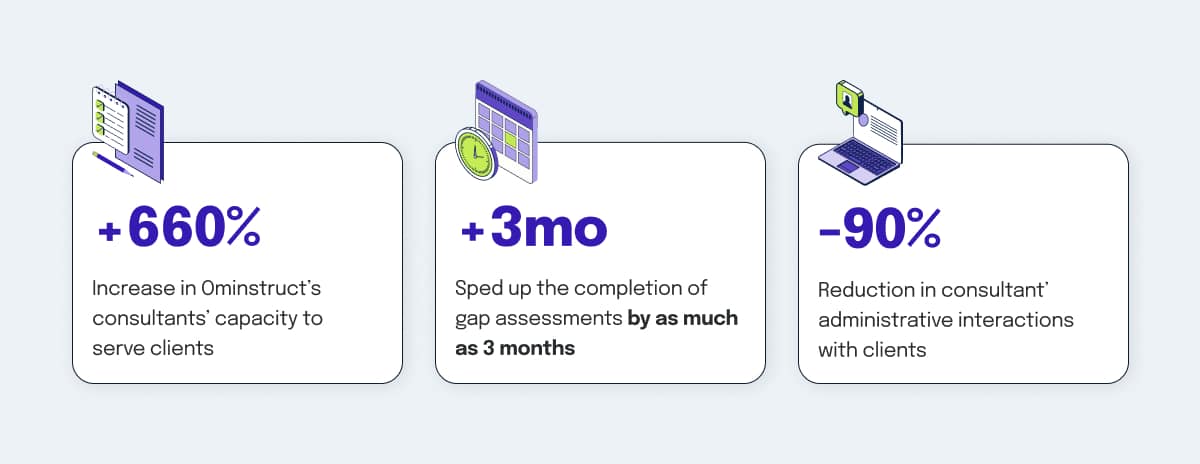
| Firm Delivery Capacity | Fixed capacity bound to manual testing hours. | Scalable capacity expansion via automated mapping. | 660% increase in capacity to serve clients |
How Hyperproof helps audit firms scale
Modernizing audit delivery is not just about completing engagements faster — it’s about connecting workflows, strengthening client trust, and building a scalable, high-margin practice.
Hyperproof transforms audit delivery into a modern, collaborative, and efficient experience. By consolidating multiple frameworks into one streamlined view, Hyperproof enables audit partners and service providers to eliminate duplicated work, reduce client friction, and expand capacity without adding headcount.
With Hyperproof, partner firms can:
- Enhance the client experience: Deliver transparent, real-time collaboration that eliminates audit fatigue and boosts client retention.
- Grow revenue and retention: Win enterprise accounts, expand into multi-framework engagements, and convert one-time audits into ongoing managed compliance services.
- Drive operational efficiency and scale: Reduce audit preparation time by up to 75%, reuse controls and evidence seamlessly, and execute more audits with your existing team.
Ready to expand your audit capacity and modernize your client experience? Contact us to become a Hyperproof partner today.
Related Resources

Ready to see Hyperproof in action?