GRC Teams Scale AI Governance: Insights from the 2026 IT Risk and Compliance Benchmark

Updated on: Aug 31, 2026 4 Minute Read
Hyperproof’s 2026 IT Risk and Compliance Benchmark Report reveals that while 97% of GRC teams leverage AI for internal productivity, only 27% have operationalized AI for external assurance. To bridge this gap, modern compliance leaders are anchoring programs in frameworks like ISO 42001 and mapping AI risks directly into existing GRC infrastructure.
Here are three findings from this year’s report, along with actionable steps to mature your AI governance program.
AI adoption is widespread, but assurance lags behind
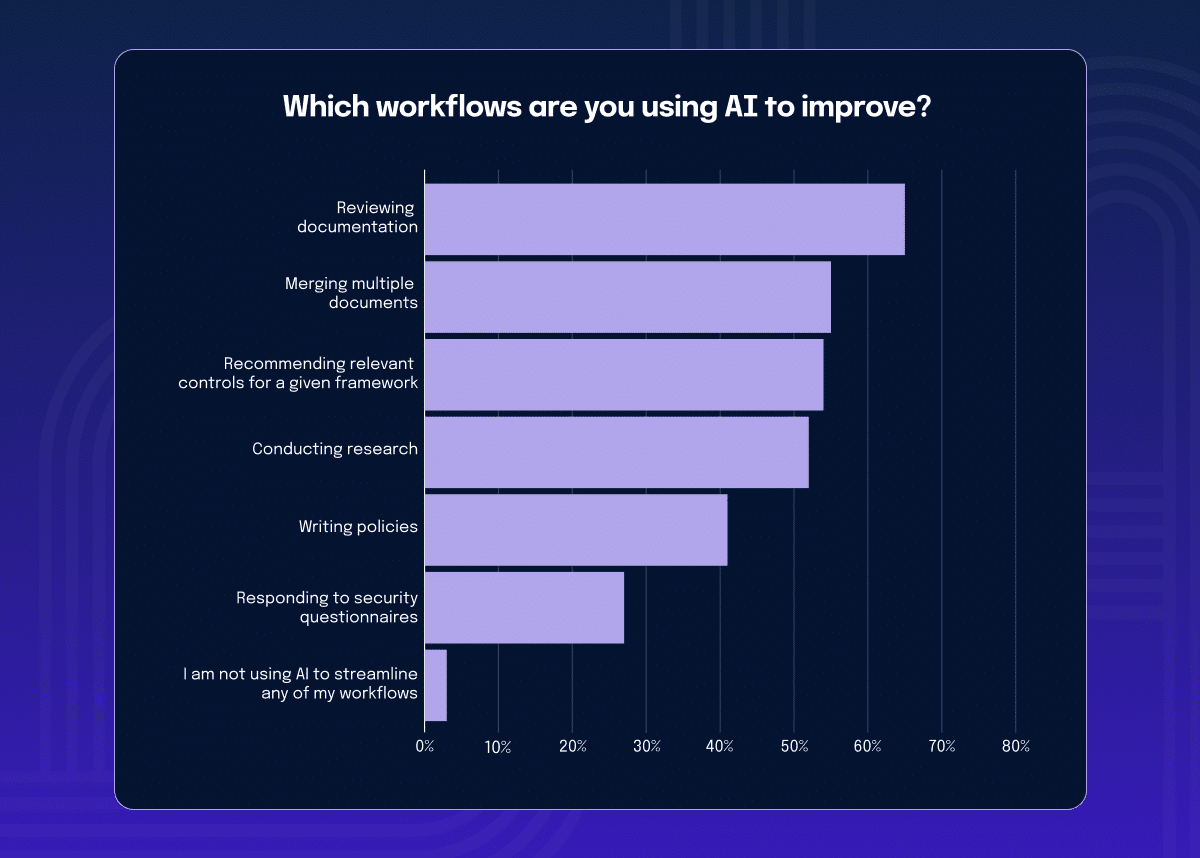
Only 3% of respondents say they are not using AI to streamline any workflows, demonstrating how quickly AI is becoming a baseline productivity layer for many teams rather than a niche capability used by early adopters. However, adoption is unevenly distributed across the compliance lifecycle.
Internal efficiency vs external trust
- Documentation heavy-lifting: Teams primarily rely on AI for time-consuming tasks like parsing documentation, normalizing inputs, and drafting policies (41%).
- Context & decision support: More than half (52%) use AI for research, indicating that teams are increasingly relying on AI to gather context, summarize requirements, and support decision-making quickly.
- The external assurance gap: Only 27% use AI for vendor security questionnaires.
This gap highlights a critical market reality: while teams see value in using AI for core internal workflows, few have fully operationalized AI for external-facing assurance where accuracy, defensibility, and proven evidence are mandatory. Bridging this gap requires moving beyond generic AI assistants toward grounded, agentic AI engines connected directly to systems of record.
AI governance enters mainstream planning
The most notable signal this year is the significant shift in AI governance from early adoption to mainstream planning. ISO 42001 and the NIST AI Risk Management Framework appear at levels that suggest many organizations are actively operationalizing AI risk, not merely discussing it.
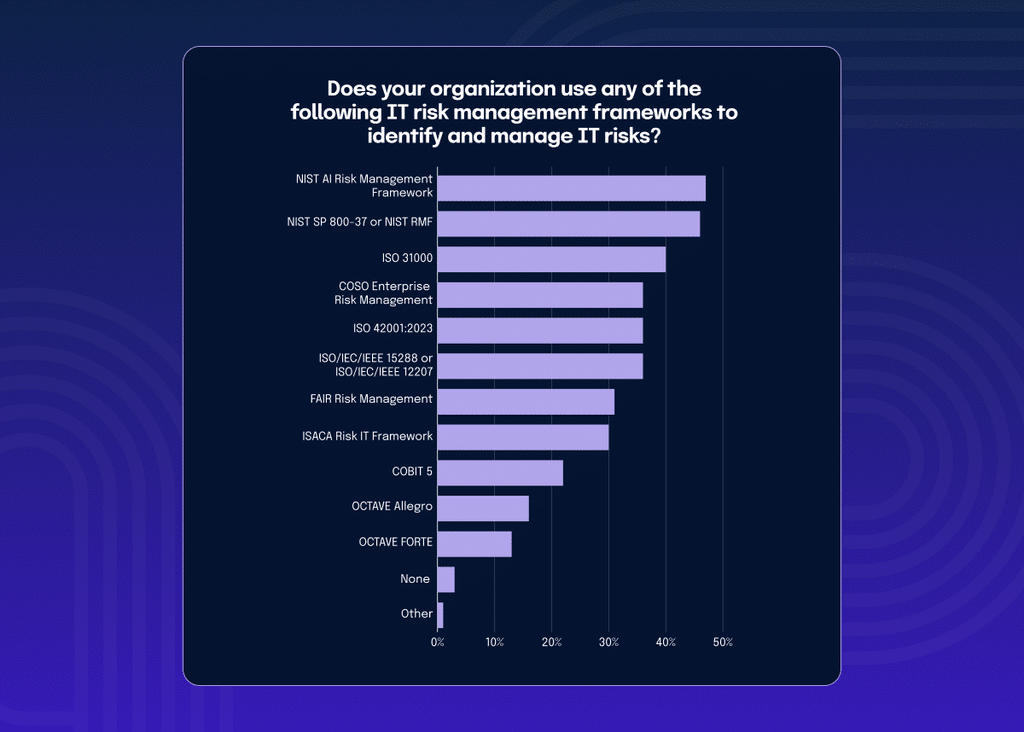
The framework ecosystem is becoming more complex, not less. As AI governance becomes a core component, organizations will benefit from systems that can map requirements, reuse evidence, and keep controls current without multiplying effort.
Enterprise scale and geography drive alignment
Larger organizations tend to exhibit higher adoption of AI governance standards, which is consistent with their increased AI exposure, larger vendor ecosystems, and more complex internal deployment environments.
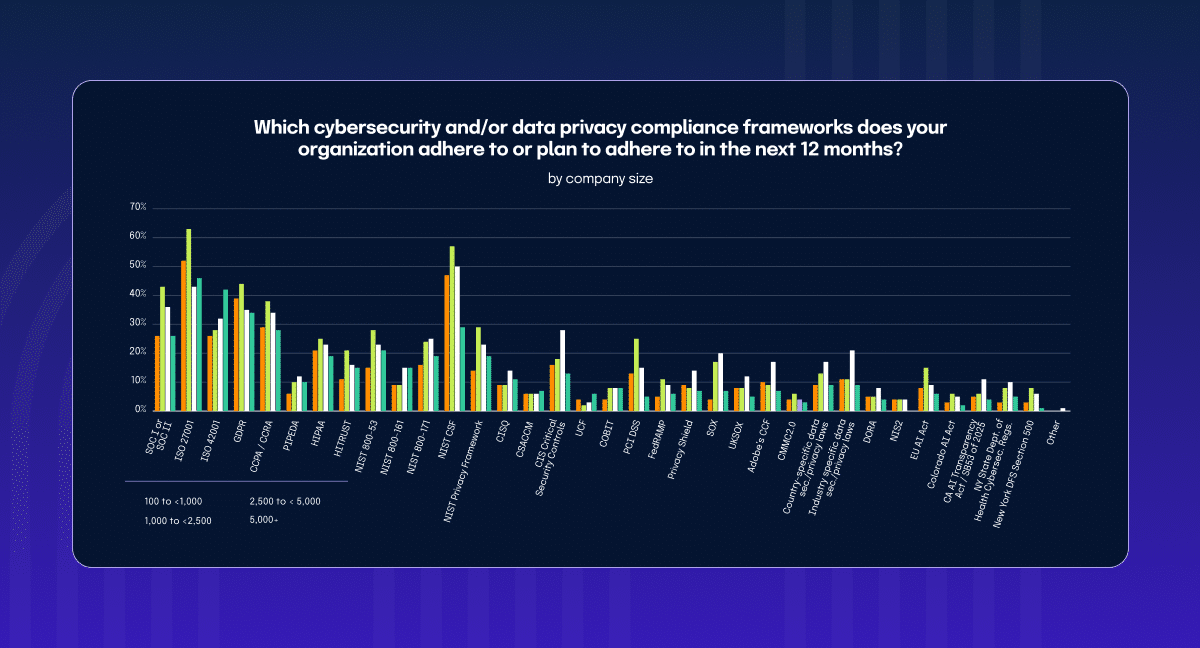
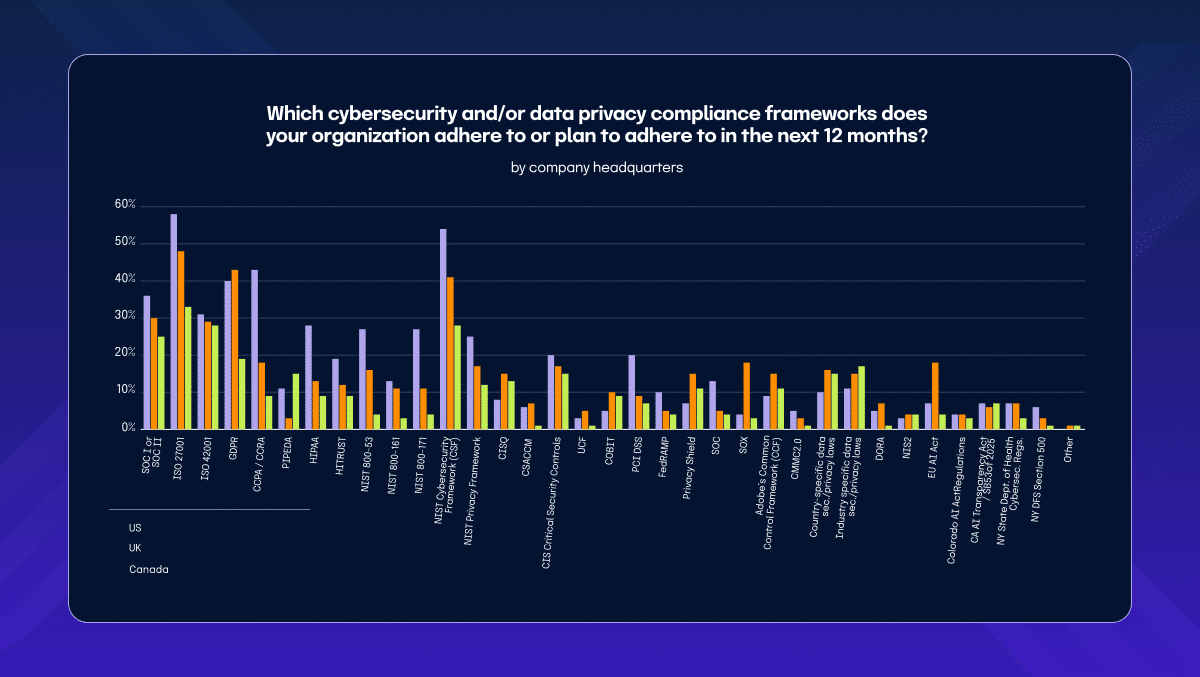
Privacy framework alignment reflects where regulatory pressure is strongest, while AI governance standards are rising across all geographies.
How to operationalize AI governance in your GRC program
Based on our report findings, many GRC teams are leaving tangible value on the table. Here are three low-risk, high-impact strategies to scale your program.
Strategy 1: Target low-risk, narrowly scoped administrative bottlenecks
Sophisticated risk teams operate best when machine learning handles administrative bottlenecks, freeing team members to focus on strategic risk engineering.
- Evidence orchestration and alerts: Use automation to ping system owners, manage continuous control health, and trigger real-time compliance task alerts.
- Questionnaire ingestion: Leverage processing models to ingest and generate initial draft answers for lengthy third-party vendor security questionnaires.
- Initial report grading: Deploy automated parsing engines to run preliminary evaluations on incoming SOC 2® reports and highlight coverage gaps for third-party vendors.
Watch our webinar to learn how to build a program where AI tackles the repetitive heavy lifting.
Strategy 2: Anchor your program in established frameworks
With over 1,080 AI-related bills introduced across the U.S. between 2024 and 2025, the regulatory landscape is moving too fast to build a compliance program from scratch. Align with established standards instead:
| Framework | Best Used For |
| NIST AI RMF | Voluntary risk management, mapping, and impact assessments. |
| ISO 42001 | Certifiable AI Management System (AIMS) across operations. |
| EU AI Act | Mandatory compliance for high-risk AI deployments in European markets. |
Strategy 3: Map AI risks into existing GRC infrastructure
Skip the separate, parallel program. Start with a deliberate audit of your current GRC environment.
The mapping between what you already have and what AI governance requires is closer than you realize. For example:
- Your risk register is the infrastructure for an AI system inventory. Add AI as a new asset class, classify systems by risk tier, and assign owners.
- Your audit trails and approval workflows already produce evidence of human review. Applying them explicitly to AI decision points is an extension, not a new build.
For a structured view of this mapping process in action, Hyperproof’s guide to getting started with AI compliance provides a six-step operationalization approach and 90-day roadmap that you can adapt to your existing programs.
As AI adoption accelerates across your business, managing emerging risks requires more than disconnected point tools or static spreadsheets. With Hyperproof AI, you get an end-to-end assurance engine that embeds intelligence across every workflow to continuously discover gaps, validate evidence, and automate control health checks with full human-in-the-loop control. Hyperproof helps you eliminate administrative bottlenecks, scale your framework mapping, and turn GRC into a strategic growth advantage.
Take the learnings from the 2026 IT Risk and Compliance Benchmark Report into planning sessions for 2H 2026
Related Resources

Ready to see Hyperproof in action?